Forex Trading Sessions: Hours and Best Times

Beginner3 min read
View of London skyline by night
Image by vwalakte on Magnific

Why Forex Runs 24 Hours

The forex market has no single exchange. Instead it operates as a global network of banks that opens as one financial centre wakes and closes as the next winds down. That relay begins in Sydney, moves to Tokyo, then to London, and finally to New York before the cycle repeats. From Monday morning in Asia to Friday evening in New York, trading never stops.

For traders in Southeast Asia this is a real advantage: the most active hours fall conveniently in your afternoon and evening rather than the middle of the night.

The Four Trading Sessions (UTC)

Session times shift slightly with daylight saving in Europe and North America, but as a working reference in UTC:

  • Sydney: 21:00 – 06:00 UTC
  • Tokyo: 00:00 – 09:00 UTC
  • London: 07:00 – 16:00 UTC
  • New York: 12:00 – 21:00 UTC

To convert to your local clock, add your offset from UTC. In Indonesia (WIB, UTC+7) the London session runs roughly 14:00 – 23:00, while in Singapore, Malaysia and the Philippines (UTC+8) it runs about 15:00 – 00:00. Checking the current UTC time before you trade saves a lot of confusion.

Session Personalities

Each session has its own character. The Sydney and Tokyo (Asian) sessions are generally quieter, with tighter ranges, and tend to favour JPY and AUD pairs. Price often consolidates here, which can suit range strategies.
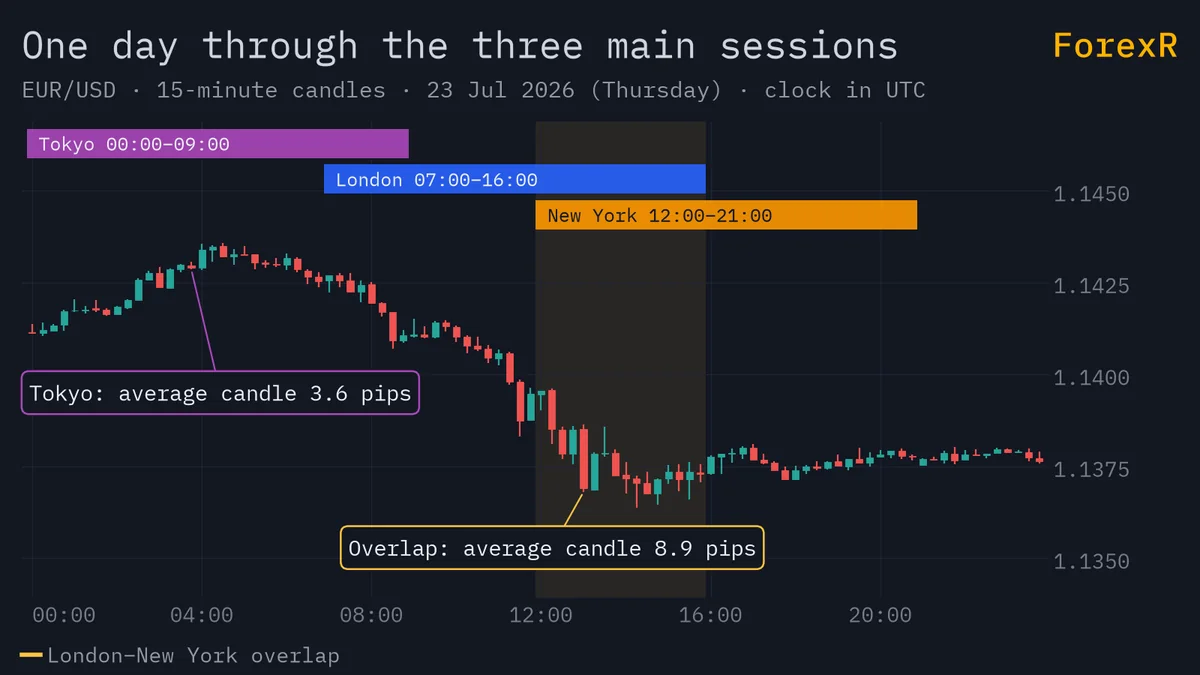
EUR/USD 15-minute candlestick chart of one day in UTC, with bars marking the Tokyo, London and New York sessions and small candles in Tokyo growing larger through the London–New York overlap
A real EUR/USD day on 15-minute candles, with New York timestamps converted to UTC. Candles stay small in Tokyo, grow after London opens at 07:00 and are largest in the 12:00–16:00 overlap with New York.

The London session is the heavyweight: it accounts for the largest share of daily volume, brings sharp moves, and sets the tone for the European majors. The New York session overlaps with London in its early hours and reacts strongly to US economic data.

The Overlaps That Matter

Volatility peaks when two sessions are open at once, because more participants are active. The most important is the London–New York overlap (roughly 12:00 – 16:00 UTC), which typically produces the day's largest ranges and tightest spreads on major pairs. The smaller Sydney–Tokyo overlap keeps the Asian session ticking over.

If you have limited screen time, the London open and the London–New York overlap usually offer the best combination of liquidity and movement. Watching how price behaves around these times, together with pivot points, helps you anticipate breakouts. On TradingView, the browser-based charting platform, free session indicators in our Pine Script Library can mark these hours on the chart, so you can see them at a glance.

Choosing Your Hours

  • Trend and breakout traders often prefer the London and New York hours for their momentum.
  • Range traders may find the calmer Asian session easier to read.
  • Avoid thin liquidity around the Friday close and the daily rollover, when spreads can widen.

You can watch live quotes and see how the EUR/USD live rate behaves through each session on the free ForexR dashboard, and line it up with the economic calendar to know when news is due. When you want to trade these sessions for real, you can open a KCM Trade demo to get a feel for the timing first. Note that forex and CFD trading carries a high risk of loss.

FAQ

What is the best time to trade forex?

The London–New York overlap, roughly 12:00–16:00 UTC, is generally the most active period with the highest liquidity and tightest spreads on major pairs. It suits traders who want movement.

What time do forex sessions open in Southeast Asia?

Add your UTC offset to the session times. For example, in Singapore and Malaysia (UTC+8) the London session runs about 15:00 to 00:00 local time.

Why is the London session so important?

London handles the largest share of daily forex volume and overlaps with both Asian and New York hours. This concentration of activity makes it the most liquid and often the most volatile session.

Free Trading Sessions Scripts for TradingView

Open-source Pine scripts from the ForexR library that build on this indicator. Copy one into TradingView's Pine Editor to try it on your own chart.

Free Session and Time Pine Scripts · How to add a script to TradingView

See these strategies traded live

ForexR Signals publishes each trade before the entry, with its stop and three targets, and tracks it against live prices. Every win and loss stays on the record. Practice trades with no real money, not advice.

All signals and the full track record · Signals terms

Related on ForexR

Next lesson Best Time to Trade Forex: Best Hours, Days and Sessions Continue

More Beginner Guides

What Is Forex Trading? A Beginner's Guide to the FX Market How to Start Forex Trading: A Step-by-Step Beginner Guide Currency Pairs Explained: Majors, Minors & Exotics Best Currency Pairs to Trade for Beginners: Where to Start Forex Trading Terms: A Plain-English Glossary for Beginners Going Long vs Going Short in Forex: Buy and Sell Explained Forex Spreads and Pips: What They Cost You Forex Lot Sizes and Order Types Explained for Beginners Leverage and Margin in Forex: A Beginner's Guide Margin Call and Stop Out in Forex: How They Work What Is Swap in Forex? Overnight Fees Explained Simply How Much Money Do You Need to Start Forex Trading? How to Choose a Forex Broker: Regulation, Costs & Checklist How Forex Brokers Make Money: Spreads, Swaps, IBs and B-Books Forex Rebates and Cashback Explained: Who Pays and What You Get Is Forex Trading Legal? How Forex Regulation Works Worldwide Forex Demo Account: How to Practise Trading Properly MT4 vs MT5: Key Differences and Which One to Choose How to Use MT4 and MT5: MetaTrader Tutorial for Beginners MT5 101: Install MetaTrader 5 and Open a Demo Account MT5 101: Market Watch, Navigator, Chart and Toolbox Explained MT5 101: Open a Chart, Change Timeframe and Save a Template MT5 101: Add Indicators and Draw Lines on an MT5 Chart MT5 101: Place, Modify and Close Your First Trade (F9) MT5 101: Pending Orders in MT5, Limit, Stop and Stop Limit MT5 101: One-Click Trading and Managing Trades on the Chart MT5 101: Alerts, Push Notifications and Key MT5 Settings MT5 Mobile 101: Install the App and Log In on Android or iPhone MT5 Mobile 101: Build Your Watchlist in the Quotes Tab MT5 Mobile 101: Charts, Timeframes, Indicators and the Ruler MT5 Mobile 101: Place, Modify and Close a Trade on Your Phone MT5 Mobile 101: Push Notifications, Messages and Settings MT5 Mobile vs Desktop: What the Phone App Cannot Do Types of Expert Advisors: Robots, Trade Managers, Copiers & More How to Use the ForexR EA Library: Find, Check & Download EAs How to Install an Expert Advisor in MT4 and MT5 (Step by Step) What Is Pine Script? TradingView's Chart Language Explained How to Use the ForexR Pine Script Library: Find & Copy Scripts How to Add a Pine Script to TradingView: Copy, Paste & Run Pine Script v4, v5 and v6: What the Version Line Means Pine Script vs MQL5: TradingView or MetaTrader for Trading? How to Read a Forex Chart: Candlesticks & Trends Best Time to Trade Forex: Best Hours, Days and Sessions How to Use an Economic Calendar for Forex How to Use Forex Market Analysis and News to Trade Forex vs Stocks: Which Is Better for Beginners to Trade? Forex vs Crypto Trading: Key Differences and Which Suits You How to Trade Gold (XAU/USD): A Beginner’s Six-Step Guide Why Does Gold Have Value? A Plain-English History of Money What Moves the Gold Price? 7 Drivers Explained in Plain English Physical Gold vs Gold CFDs, ETFs and Futures: 10 Ways to Own Gold Gold Lot Size, Pip Value and Margin Explained (XAU/USD) Best Time to Trade Gold: Sessions, Hours and the Daily Break Gold Spread, Swap Fees and Weekend Gaps: What Gold Costs Troy Ounces, Grams and Karats: How Gold Is Priced and Weighed Gold Trading Glossary: 40 Terms Explained in Plain English How to Read a Gold Price Forecast (and Why They Miss) 10 Gold Trading Mistakes That Empty Small Accounts Fast What Is Copy Trading in Forex? How It Works and What It Costs Forex Signals Explained: How They Work and How to Judge Them How to Trade Forex Signals: Step by Step With ForexR Signals How to Copy a Trade Signal Into MT5, cTrader or TradingView What Is AI Trading? A Plain-English Guide for Beginners AI Trading vs Algorithmic Trading: The Real Difference How to Use AI Chatbots for Trading Research Safely Forex Scams: How to Spot Them and Keep Your Money Safe AI Trading Scams: How to Spot Fake Bots and Deepfakes 12 Common Forex Trading Mistakes and How to Fix Them Is Forex Trading Profitable? What the Numbers Say Is Forex Trading Halal or Haram? A Neutral Explainer Is Gold Trading Halal? Spot, CFDs and Swap-Free Accounts Zakat on Gold, Crypto and Trading Accounts: A Simple Guide

Choose a Regulated Broker

Put what you’ve learned to work with a regulated broker. Compare costs, platforms and licences side by side.

Compare top brokers