Is Gold Trading Halal? Spot, CFDs and Swap-Free Accounts

Is Gold Trading Halal?
It depends on what you buy and how you pay. Most scholars treat gold as money, so a gold-for-currency trade must settle hand to hand, in the same session. Physical gold and allocated accounts can meet that test. Leveraged gold CFDs raise questions about possession, swap and borrowed money that scholars answer differently, which is why this guide gives no ruling.
What it does give is the sources people cite, what each says, where the disagreement sits and the questions to take to a qualified scholar or your national authority. The general forex question, including Malaysia's 2012 forex fatwa, is covered in the forex halal guide, so it is not repeated here.
Why Gold Counts as Money: The Six Ribawi Items
Gold has been coined money since about 600 BC, when the kingdom of Lydia, in what is now Turkey, struck the first gold coins. That is roughly 2,600 years of people treating a lump of metal as cash, which is why gold's value is a matter of agreement and why most scholars treat it as money rather than ordinary goods.
The hadith of the six ribawi items names gold, silver, wheat, barley, dates and salt. Gold for gold must be equal in weight and hand to hand. Gold for silver or for currency may differ in amount, but the exchange must still be hand to hand, on the spot. Most scholars therefore treat gold for currency as sarf, a currency exchange, so both sides must be delivered in the same session. That delivery is qabd, possession, which may be physical or constructive (the gold is set aside in your name and under your control).
Think of paying for a kilo of rice at a wet market: you hand over the note, the seller hands over the bag, and neither of you walks away owing anything. Sarf asks gold-for-money to work the same way. Paying today for gold delivered next month, or the reverse, is exactly what the rule is aimed at.
What AAOIFI Shariah Standard 57 Allows and Requires
AAOIFI published Shariah Standard No. 57 on Gold and its Trading Parameters in 2016, and it deals with modern forms of gold trading directly. It permits trading gold when all of these hold:
- Real, allocated gold: the gold exists and is identified as yours, not a promise drawn on a pool.
- Possession in the same session: qabd passes when the deal is made. Constructive possession is accepted, so a vault certificate or an allocated account entry can count.
- No deferral of both sides: payment and delivery are not both pushed into the future.
- Electronic platforms allowed: the standard covers electronic platforms, allocated accounts and gold-backed certificates or funds, as long as the conditions above are met.
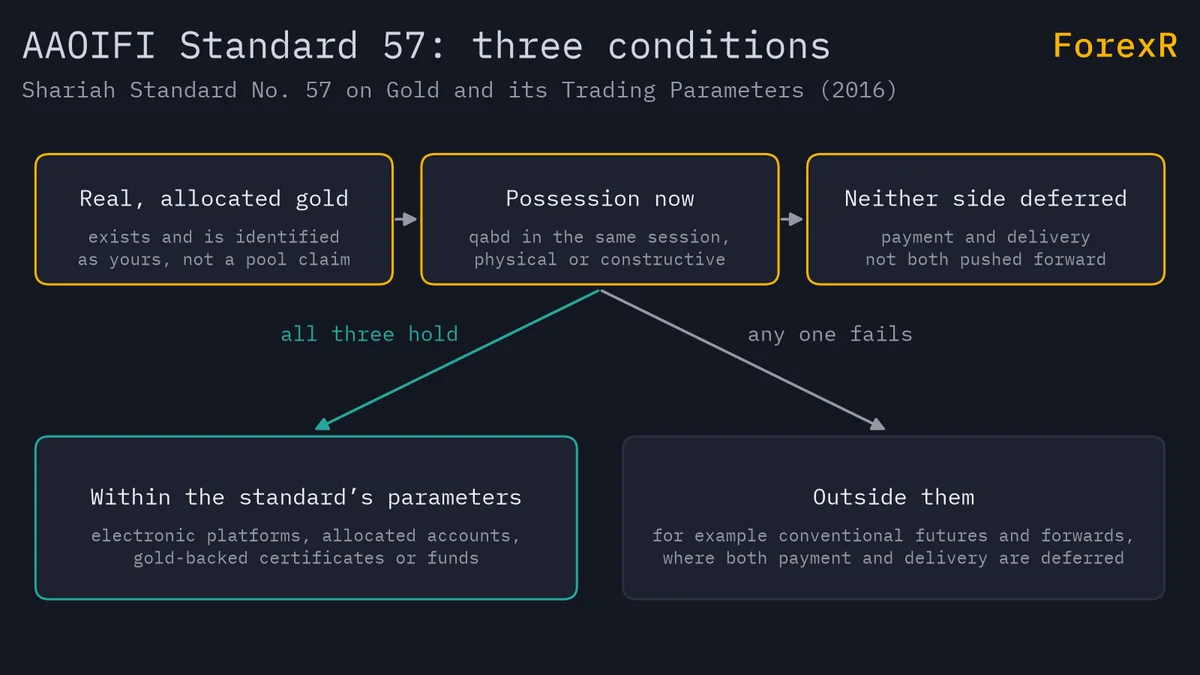
The standard does not permit conventional gold futures or forwards, where both payment and delivery are deferred. That line is the hinge for everything below, because a CFD is closer to a futures contract than to a coin in your hand.
Where Retail Gold CFDs Raise Concerns
A CFD (contract for difference) pays you the change in the gold price without any gold changing hands. Measured against those conditions, three features draw scholarly attention:
- No possession: no metal is allocated to you, and neither physical nor constructive qabd takes place. The contract is with the broker.
- Swap: the overnight charge on a position, usually paid by the long side on gold, is interest by construction. The gold swap guide shows how it is built from US rates and the lease rate.
- Leverage: at 1:100 you control $3,000 of gold with $30 of margin, so the broker finances the rest, and a loan tied to a trade raises its own questions; the leverage guide explains the mechanics.
Opinions among scholars differ on margin trading, and the site does not pick a side; the list tells you which questions to ask, in the order they matter.
A Worked Example: One Ounce vs 0.01 Lot
Use the example price of $3,000 an ounce (an example, not a forecast). One troy ounce of pure gold, 31.1 g, costs $3,000 at a bullion counter plus the dealer's premium. You pay in full and walk out with the metal, so payment and possession happen in the same session; nothing is borrowed and nothing is charged overnight, though the dealer will buy it back below spot.
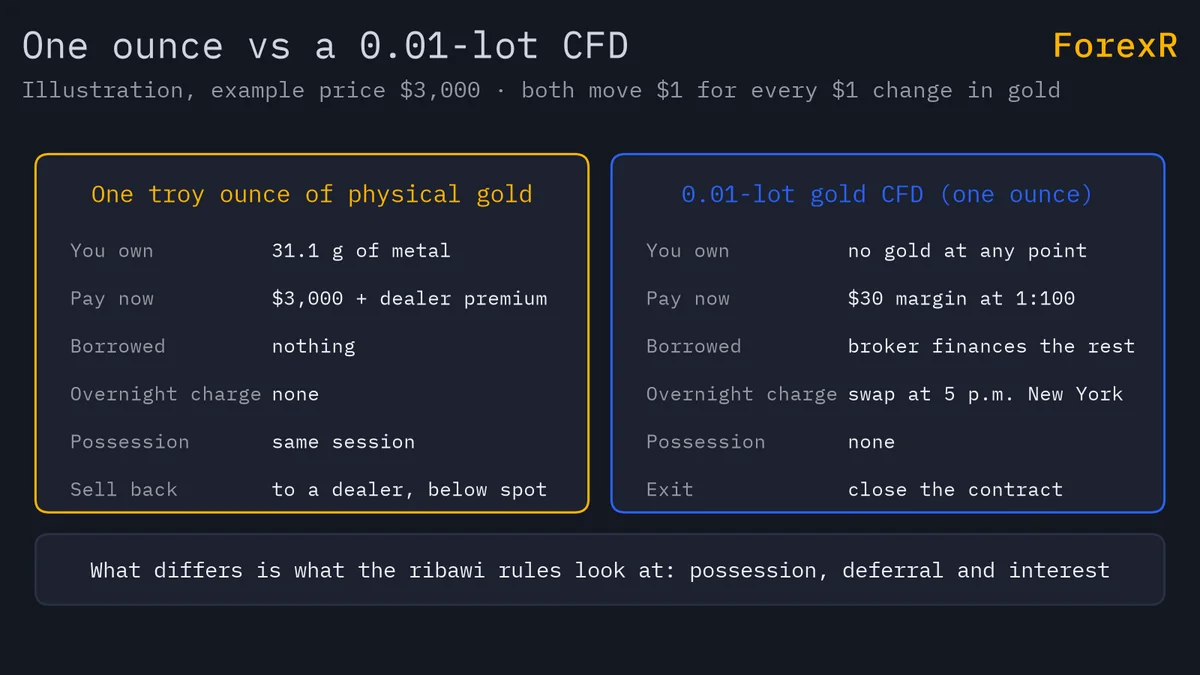
Now take a 0.01-lot gold CFD. One lot is 100 troy ounces, so 0.01 lot is one ounce, $3,000 of exposure. At 1:100 your margin is $30, the broker finances the rest, and a swap is charged at 5 p.m. New York for every night you hold. You own no gold at any point. Both positions move $1 for every $1 move in the price; what differs is everything the ribawi rules care about: possession, deferral and interest. The guide to ways to own gold compares the options in between, such as allocated accounts and gold-backed funds.
What a Swap-Free Account Changes, and What It Does Not
The belief that trips up most beginners is that a swap-free (Islamic) account settles the question by itself. It settles one part: it removes the overnight interest charge. It does not create possession of any gold, change the leverage or turn a CFD into a spot purchase. Some brokers replace the swap with an administration fee after a set number of days, so read how that fee is calculated and when it starts.
A swap-free account is therefore a necessary step for a trader who wants to avoid interest, not a certificate that the whole contract has been approved. Terms differ widely, so use the broker comparison to see which brokers offer a swap-free option on gold, and check the conditions, not the label.
What Malaysia and Indonesia Have Addressed
Two national bodies in South-East Asia have published on gold specifically.
- Malaysia: the 96th Muzakarah of the National Fatwa Council (October 2011) issued gold investment parameters (Parameter Pelaburan Emas) covering physical delivery, deferred payment and gold accounts. Bank Negara Malaysia issues the Kijang Emas bullion coin, and ar-rahnu (Islamic pawn, where gold jewellery secures a short-term loan for a safekeeping fee) is widely used.
- Indonesia: DSN-MUI fatwa No. 77/2010 addressed buying gold on instalments, permitting it under conditions as long as the gold is not being used as a medium of exchange.
Neither document was written about leveraged CFDs, so neither settles that question; read them for what they cover: instalments, accounts and delivery.
Questions to Ask a Scholar Before You Trade Gold
A shop owner in Kota Bharu wants to trade gold on the platform she already uses, and she is not sure what the swap-free label covers. She prints the contract specification, circles the swap line and the leverage line, and takes both pages to the ustaz at her surau after Maghrib. He asks her three questions she cannot answer, and she goes home to find out.
Bring answers to these:
- Is any gold allocated to me? If yes, where, and can I take delivery?
- When is each side settled? Do I pay in full now, and does possession, physical or constructive, pass now?
- Is there a swap, and what replaces it? How is any administration fee calculated?
- How much is borrowed? What is the leverage, and who is the lender?
- What is the alternative? Would an allocated account or physical coins meet my purpose at a cost I can accept?
Try this in five minutes: open the live gold page and your broker's contract specification side by side, and fill in the five answers on paper before you speak to anyone. A precise question gets a better answer.
Zakat on Gold and a Note on Risk
Whatever form you hold, gold above the nisab of 85 g is due zakat at 2.5% after one lunar year. The zakat guide covers how that applies to jewellery, accounts and trading balances, and the gold zakat calculator does the sum.
Halal or not is one question; risky or not is another. Physical gold carries buy-back spreads and storage risk, and leveraged gold CFDs carry a high risk of loss: gold can fall hard and fast, and ESMA-era disclosures show 74-89% of retail CFD accounts lose money. Only risk money you can afford to lose, whichever form you choose.
FAQ
Is buying physical gold halal?
The conditions most scholars apply are that the gold is real, you pay in full and possession passes in the same session, with no deferral of both sides. A bar or coin bought at a counter and taken away meets those conditions on their face. Instalment plans and accounts raise further questions, which is why Malaysia and Indonesia issued specific guidance on them.
Is a swap-free gold account halal?
A swap-free account removes the overnight interest charge, which answers one of the three concerns raised about gold CFDs. It does not create possession of gold and it does not remove the leverage, and some brokers replace the swap with an administration fee. Scholars differ on margin trading itself, so take the account terms to a qualified scholar rather than relying on the label.
Is gold trading halal in Malaysia?
Malaysia's National Fatwa Council issued gold investment parameters at its 96th Muzakarah in October 2011, covering physical delivery, deferred payment and gold accounts, and a separate forex ruling in 2012 that the forex halal guide covers. Neither was written about leveraged gold CFDs. For your own situation, ask the state mufti's office or a qualified scholar with the contract terms in hand.
Is a gold ETF or gold-backed fund halal?
AAOIFI Shariah Standard 57 covers gold-backed certificates and funds, and permits them when the gold is real and allocated, possession (physical or constructive) passes in the same session and neither side is deferred. Whether a specific fund meets that depends on its structure and its Shariah board, so read the prospectus and ask before assuming the gold behind it is allocated to unit holders.