Gold Trading Glossary: 40 Terms Explained in Plain English

What Do Gold Trading Terms Actually Mean?
Gold trading terms come from four worlds: the jeweller's counter (karats, 916), the London vault (troy ounces, Good Delivery bars), the CFD platform (lots, swap, margin) and the chart (ATR, pivots). This gold trading glossary puts more than 40 of them in one place, grouped so you can read one block at a time.
Units and Purity: Ounces, Grams and Karats
Start with a myth: a gold ounce is not the kitchen ounce. Gold uses the troy ounce, about 10% heavier, so a one-ounce coin weighs 31.1 g, not 28.35 g. The units and karats guide works through the conversions.
- Troy ounce (oz t): the unit gold is priced in: 31.1035 g, so 32.15 troy oz make a kilo.
- Gram price: the price per troy ounce ÷ 31.1035. At the example price of $3,000 (an example, not a forecast), a gram of pure gold is about $96.45.
- Tola: a South Asian unit of 11.664 g, three-eighths of a troy ounce.
- Karat (K): purity in parts of 24; 24K is pure, 22K is 22 parts gold.
- Fineness: purity in parts per thousand, stamped as a hallmark. 24K = 999, 22K = 916, 18K = 750.
- 916 gold: 22K jewellery gold, standard in Malaysia, Singapore, India and the Gulf; a 916 gram holds about $88.35 of gold at the example price.
- Kilobar: a 1 kg bar of 999.9 gold, the popular investment bar in Asia, about the size of a small smartphone.
- Good Delivery bar: the LBMA wholesale bar in central bank vaults, nominally 400 troy oz (about 12.4 kg), at least 995 fine.
Gold is dense enough that all of it ever mined, about 210,000-216,000 tonnes, would fit in a cube roughly 22 metres on each side.
Market and Pricing Terms
Most of these appear on the live gold page, so open it beside the list.
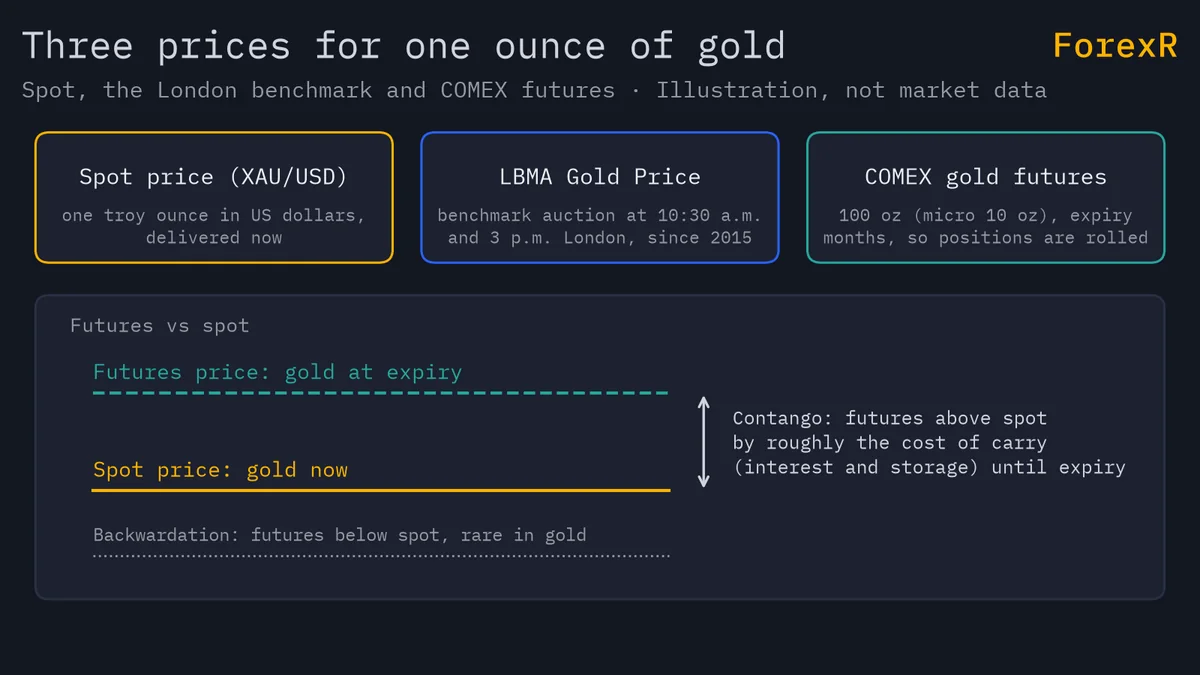
How the twice-daily benchmark auction works is covered in the LBMA Gold Price and the London fix.
- Spot price: the price for gold delivered now.
- XAU/USD: one troy ounce of gold (ISO code XAU) priced in US dollars.
- LBMA Gold Price: the London benchmark, set by electronic auction at 10:30 a.m. and 3 p.m. London time; it replaced the London Gold Fixing that began in 1919.
- Futures: COMEX contracts of 100 troy oz (10 oz for the micro) with expiry months, so they must be rolled.
- Gold-silver ratio: ounces of silver per ounce of gold: about 17 in January 1980, about 32 in April 2011 and a record of about 125 in March 2020. The ratio guide explains the extremes.
- Real yield: a bond yield minus expected inflation. Gold pays no interest, so rising real yields tend to push it down; since the mid-2000s this has been its most reliable relationship.
- Gold ETF: a listed fund that holds bars in a vault; you own units, not a bar with your name on it.
Contracts and Costs on a Gold CFD
A CFD pays you the price change without giving you the metal. The lot size and margin guide and the spread and swap guide go deeper on each cost.
- CFD (contract for difference): an agreement with your broker to exchange the difference between entry and exit price. You never own gold; you carry counterparty, leverage and swap costs instead.
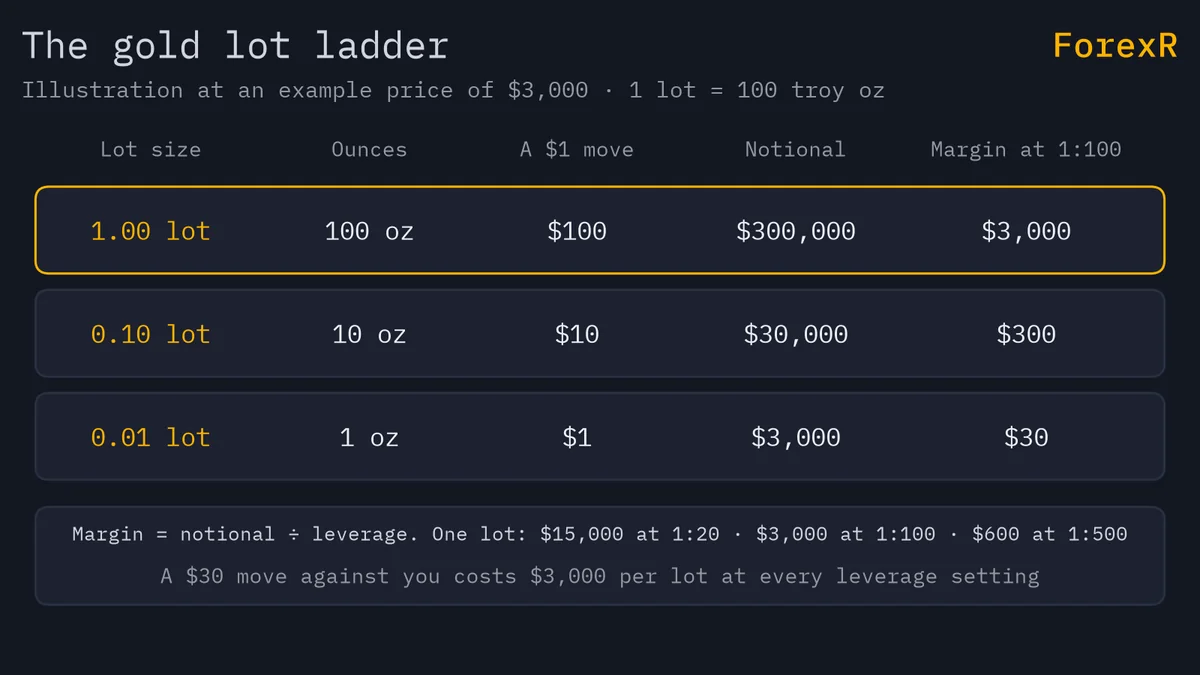
- Lot: the standard trade size, 100 troy oz at most brokers. A $1 move is worth $100 per lot, $10 per 0.10 lot and $1 per 0.01 lot.
- Point and pip: gold is quoted to two decimals. Some brokers call $0.01 a point and $0.10 a pip; others call $1 a pip. Think in dollars per lot instead.
- Notional value: lots × 100 × price. One lot at the example price of $3,000 controls $300,000 of gold.
- Margin: the deposit locked while a trade is open: notional ÷ leverage. Like a rental deposit, it is held while you use the flat and returned when you leave, minus any damage.
- Leverage: how many dollars of gold each dollar of margin controls; ESMA-style rules cap retail gold at 1:20, and many offshore brokers offer up to 1:500.
- Spread: the gap between buy and sell price, in cents; a $0.30 spread costs $30 per lot per round trip.
- Swap: the overnight charge at 5 p.m. New York, with one weekday (often Wednesday for metals) charging three nights to cover the weekend. Long gold usually pays, because holding gold costs roughly the US interest rate minus a small lease rate.
- Daily break: 5 to 6 p.m. New York, when gold does not trade and spreads are widest on either side.
Here is where beginners get caught: the belief that a pip on gold is a pip like any other. On gold there is no agreed pip, so a "20-pip stop" can mean $2 at one broker and $20 at another. The contract specification settles it.
Put three terms together. At the example price of $3,000, one lot is $300,000 of notional; the margin is $3,000 at 1:100 and $15,000 at 1:20. A $30 move against you costs $3,000 per lot either way: leverage changes the deposit, not the danger.
Chart and Risk Words Traders Use on Gold
Gold moves in dollars, so its chart words carry dollar values; a daily range of 1-2% is ordinary, $30-60 a day at the example price.
- ATR (average true range): the average size of a candle over 14 bars. On gold the daily ATR in dollars can more than double within a few months, so the ATR guide matters more here than on most pairs.
- Pivot points: levels calculated from the previous day's high, low and close; the pivot guide covers the formula.
- Round number: a $50 or $100 handle where orders cluster and gold often pauses or spikes.
- Stop-loss: the order that closes a losing trade at a set price; on gold, measure it against the ATR, not in pips.
- Gap: a jump from one price to the next with no trades between. Gold gaps on Sunday evening New York time after weekend news, and a stop fills at the first available price.
- Position size: lots = (account × risk %) ÷ (stop in dollars × 100); a $1,000 account risking 1% with a $20 stop needs 0.005 lots, below most brokers' minimum.
Physical Gold and Islamic Finance Terms
Buyers of bars, jewellery and gold accounts use a different vocabulary, and Muslim traders a third; the halal guide explains the religious terms neutrally, with no ruling.
- Bullion: gold in bar or coin form valued by weight and purity, such as a Krugerrand, a Maple Leaf or a Kijang Emas.
- Allocated and unallocated: allocated gold is specific bars held in your name; unallocated gold is a claim on a bank's or dealer's pool, so you are a creditor.
- Premium and buy-back spread: a dealer sells small bars and coins above spot and buys them back below it.
- Making charge: the workmanship fee on jewellery, often 5-25% of the gold value, not returned on resale.
- Ar-rahnu: Islamic pawn, common in Malaysia, where gold jewellery secures a short-term loan for a safekeeping fee.
- Ribawi items: the six goods named in a hadith (gold, silver, wheat, barley, dates, salt) with special exchange rules.
- Sarf and qabd: sarf is a currency exchange, how most scholars treat gold for currency, so both sides settle in the same session; qabd is that possession, physical or constructive.
- Swap-free (Islamic) account: a broker account with no overnight interest, sometimes with an administration fee after a set number of days; it removes swap but does not create possession.
- Nisab: the zakat threshold, 85 g of gold, with zakat due at 2.5% after one lunar year.
How to Practise These Terms in Five Minutes
Picture a first-week demo trader in Manila who opens MT5 at 9 p.m. and reads the XAUUSD specification for the first time. Contract size 100. Swap long, a negative number. Three-day swap: Wednesday. She writes the three numbers on a sticky note and finally sees why her test trade lost money overnight without the price moving.
Try the same thing. Open the XAUUSD specification on your platform and copy out the contract size, the swap long and short, the triple-swap day and the margin percentage. Then put the example price of $3,000 into the margin calculator at 0.01 lot and check that the answer is $30 at 1:100. General terms (order types, equity, free margin) live in the forex glossary, and since numbers differ by broker, compare gold specifications across brokers before you fund an account.
One last term: risk. Gold CFDs are leveraged, gold can fall hard and fast (it dropped about 30% in late 2008 as funds sold everything for cash), and ESMA-era disclosures show 74-89% of retail CFD accounts lose money. Trade only with money you can afford to lose.
FAQ
What is the difference between spot gold and gold futures?
Spot gold is the price for metal delivered now, and it is what a retail CFD tracks. A gold future is an exchange contract, 100 troy ounces on COMEX, for delivery in a set month, so it must be rolled before expiry and usually trades a little above spot to cover interest and storage. Retail traders rarely touch futures directly.
Why does gold usually fall when the US dollar rises?
Gold is priced in dollars, so a stronger dollar makes the same ounce cost more in euros or yen and demand softens, pulling the dollar price down. The same US interest rate moves also drive both. The link is usually negative but not fixed: in 2005 and 2010 gold and the dollar rose together for months as both were bought as havens.
What is the XAU/USD contract size on MT4 and MT5?
At most brokers one standard lot of XAUUSD is 100 troy ounces, so a $1 move is worth $100 per lot, $10 per 0.10 lot and $1 per 0.01 lot. A few brokers use different sizes, so right-click the symbol, open Specification and read the contract size, minimum lot and margin currency before your first trade.
Why is gold priced in troy ounces instead of grams?
The troy ounce is the historic unit of the London and New York bullion markets, and the world benchmarks and futures contracts are still written in it. Shops in Asia sell by the gram, so convert: divide the ounce price by 31.1035. At an example price of $3,000 an ounce, a gram of pure gold is about $96.45.