How Forex Brokers Make Money: Spreads, Swaps, IBs and B-Books

How Do Forex Brokers Make Money?
Every time you open a trade, the price you pay to buy is a little higher than the price you would get to sell. That gap is the first of four income lines: the spread markup, commission per lot, swap markups and, at many brokers, the losses of their own clients. Knowing each line tells you what your broker wants from you.
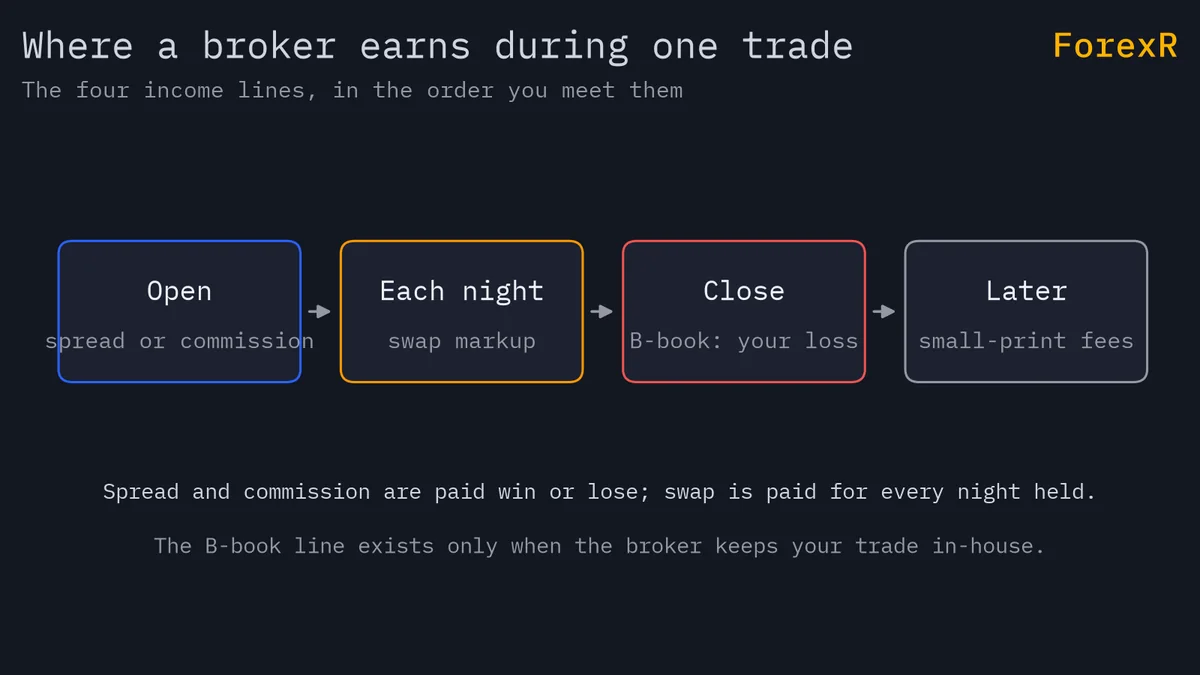
A forex broker is a company that gives you access to the currency market, usually through a platform such as MT4 or MT5, and prices every trade for you. It is a business, not a charity, and a well-run one is open about how it earns. This guide follows the money, from the fraction of a pip you never notice to the introducing broker who may have sent you there.
Revenue Line 1: The Spread Markup
The spread is the gap between the buy (ask) and sell (bid) prices. On a standard lot of EUR/USD, 100,000 units, one pip is worth about $10, so a 1.2-pip spread costs you $12 to open and close the trade. Spreads and pips explains the units; what matters here is who gets the $12.
Your broker does not pay $12 for that trade. It buys its prices from liquidity providers, the banks and large trading firms that quote both sides of the market, and in busy hours their spread on EUR/USD can be as little as 0.2 pips, about $2 per lot. The broker adds its own margin on top and shows you the wider figure. In this example $2 goes to the market and $10 stays with the broker. Across thousands of clients, that markup is the largest income line at most retail brokers.
Markups are not fixed. They widen in the Asian session, at the 5 p.m. New York rollover and in the seconds around big data releases, when the providers themselves pull back. A session indicator shows those hours on a chart; TradingView, the browser-based charting platform, has free session scripts in our Pine Script Library that shade them for you.
Revenue Line 2: Commission per Lot
A raw-spread account turns the markup into a visible fee. The broker passes the provider’s spread on with little or no addition and charges a commission per lot instead, say $7 for the round trip. The all-in cost is 0.2 pips plus $7, or $9 per lot, against $12 on the standard account. Neither account is free; one simply prints its price on the statement.
Commission accounts suit traders who trade often or in size; for a few 0.01-lot trades a month the difference is cents. The types of forex brokers guide compares the two account types in more detail.
Revenue Line 3: Swap and Financing Markups
Swap is the overnight charge or credit for holding a trade past the daily cut-off, based on the interest rate gap between the two currencies. The broker adds a margin here too, so the swap you see is usually a little worse than the interbank rate on both sides: you receive less when the swap is positive and pay more when it is negative. Hold a position for weeks and this line can outgrow the spread. The swap fees guide shows where to read your exact rate in MT4 or MT5.
Revenue Line 4: Client Losses on the B-Book
This is the line brokers talk about least. When a broker passes your order to a liquidity provider, it runs an A-book: its income is the markup or commission, and it does not mind whether you win. When it keeps your trade in-house and takes the other side itself, it runs a B-book: your loss is its profit and your profit is its loss.
B-booking is legal and widespread, and the business logic is plain. ESMA-era risk warnings show that 74-89% of retail CFD accounts lose money, so a broker that quietly holds the other side of small, inexperienced accounts earns from the average result. Many firms run both books, routing large or consistently profitable clients to the A-book and keeping the rest. Why most retail traders lose has the regulator data behind that.
What people get wrong is the next step: “my broker trades against me, so it must be rigging prices.” An honest B-book broker does not need to. It quotes fair prices, waits, and lets over-sized positions and missing stop-losses do the work. A dishonest one manipulates fills, and the forex scams guide lists the signs. Regulation is the dividing line: a strictly regulated firm must give best execution and publish a conflicts policy whichever book it uses.
The Small Print: Fees You Only Notice Later
- Deposit and withdrawal fees: a percentage on card or e-wallet withdrawals, or a flat charge on bank transfers. Often the broker is passing on its own payment costs, sometimes with a margin added.
- Currency conversion: if your account is in dollars and you deposit ringgit or rupiah, the exchange rate used may be a little worse than the market rate. The currency converter shows the mid-market rate to compare against.
- Inactivity fees: a monthly charge after a set period with no trades, taken from your balance.
- Interest on client money: brokers hold large balances in segregated accounts. In most places the interest earned on that pool stays with the broker.
Think of a budget airline. The headline fare is the spread. Baggage, seat choice and the card fee are the small print. The cheapest fare is not always the cheapest flight, and the same goes for a “0.0 pip” account.
Where IBs, Affiliates and Rebates Fit In
Most retail brokers do not find their clients alone. An introducing broker, or IB, is a person or company that refers traders to a broker in return for a share of what those traders generate: a slice of the spread markup, or a fixed sum per lot, for as long as the account stays active. An affiliate is similar but is usually paid a one-off amount per funded account instead.
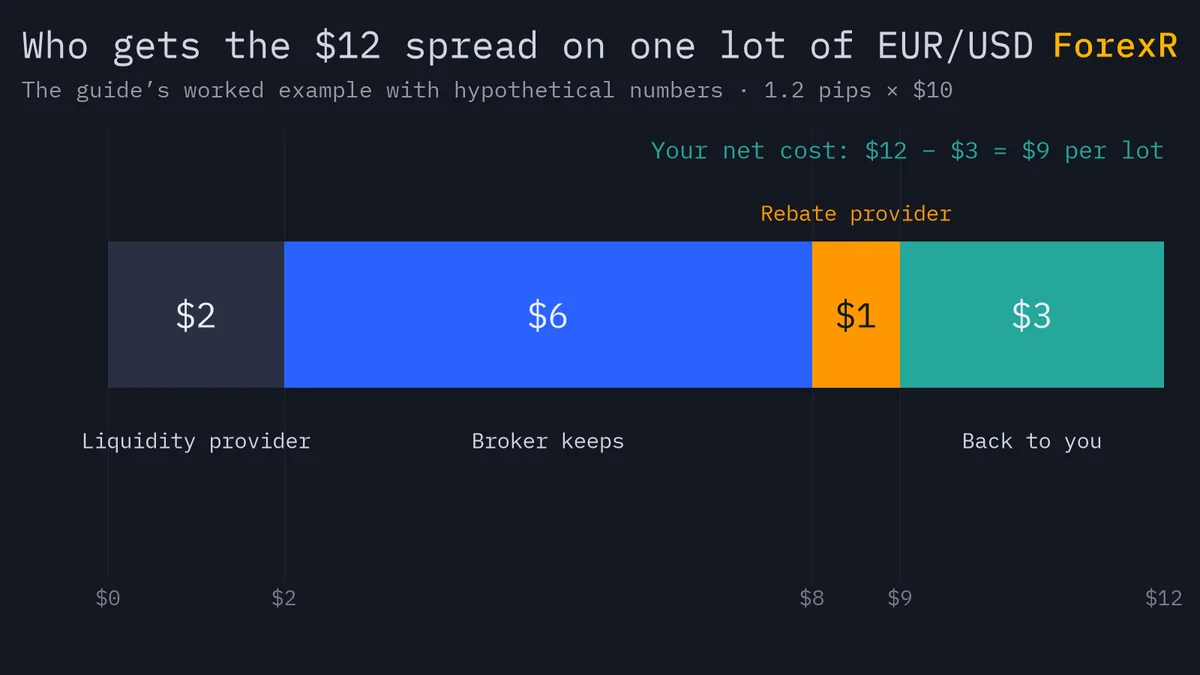
Take the $10 of markup from the EUR/USD example. The broker might pay $4 of it to the IB who referred you. Others, the rebate or cashback providers, hand part of it back: $3 to you, $1 to themselves. Your cost falls from $12 to $9 per lot, and the broker’s income is unchanged, because it was always going to pay that $4 to someone. Forex rebates and cashback explained covers the mechanics and the catch.
The catch is worth stating now. Because an IB earns per lot, it earns more when you trade more, whether you win or lose. A signal group that is also an IB has a reason to send you lots of signals. Ask anyone who recommends a broker how they are paid.
What This Means for You as a Client
A trader in Bandung who holds trades for two or three weeks should care most about swap and conversion fees, and barely at all about the spread. A scalper in Manila who opens thirty trades a day should care about the spread and commission above everything, and should be on a raw account. Knowing how the broker earns tells you which line to negotiate and which to ignore.
Three practical rules follow. First, add up every line for the way you actually trade before comparing brokers; the spread cost calculator does the spread part in seconds. Second, prefer a strictly regulated broker whatever its model, because regulation is what stops a B-book becoming a weapon; how to choose a forex broker shows how to check a licence. Third, treat anyone paid per lot, including a rebate site, as a salesperson with an interest in your volume. Compare regulated brokers side by side on the ForexR broker comparison before you let an introducer choose for you.
Try This: Work Out What Your Broker Earns From You
Open last month’s statement, from a demo account if you have not gone live. Count the lots you traded and multiply by the spread in dollars per lot for your main pair. Add any commission shown, then add the swap column. That total is roughly what your broker earned from you, before any rebate. If the figure surprises you, it is a sign that your trade count, not your win rate, is the thing to work on first.
Forex and CFDs are leveraged products and carry a high risk of losing money fast. The broker’s income lines are a cost you pay whether a trade wins or loses, so keep them small, trade less than you want to, and only risk money you can afford to lose.
FAQ
Do forex brokers make money when you lose?
Some do. A broker that keeps your trade on its own book (a B-book) earns your loss and pays your gain. A broker that passes your order to a liquidity provider (an A-book) earns only the markup or commission and does not mind whether you win. Many run both. Both models are legal; what protects you is strict regulation and best-execution rules, not the model itself.
Why do brokers offer zero-spread accounts?
A zero or raw-spread account passes on the near-market spread and charges a commission per lot instead of a markup. The broker still earns; the fee is simply printed on your statement rather than hidden in the price. These accounts suit frequent or larger traders. For a few micro-lot trades a month the saving is cents and may not justify a higher minimum deposit.
Is it bad if my broker is a market maker?
Not in itself. A market maker sets its own prices and may take the other side of your trade, which is normal and legal. The question is whether it does so fairly, and that depends on the regulator. A strictly licensed market maker must quote prices that track the market and give best execution. An unregulated one faces no such checks, whatever label it uses.
How much does a forex broker earn per lot?
Brokers do not publish it, so treat any figure as an estimate. On a standard account the markup is commonly a fraction of a pip to about a pip, which on EUR/USD is a few dollars to about ten dollars per standard lot, plus a small margin on swap. On raw accounts the commission, often several dollars per lot round trip, replaces most of that markup.