What Is AI Trading? A Plain-English Guide for Beginners

What Is AI Trading?
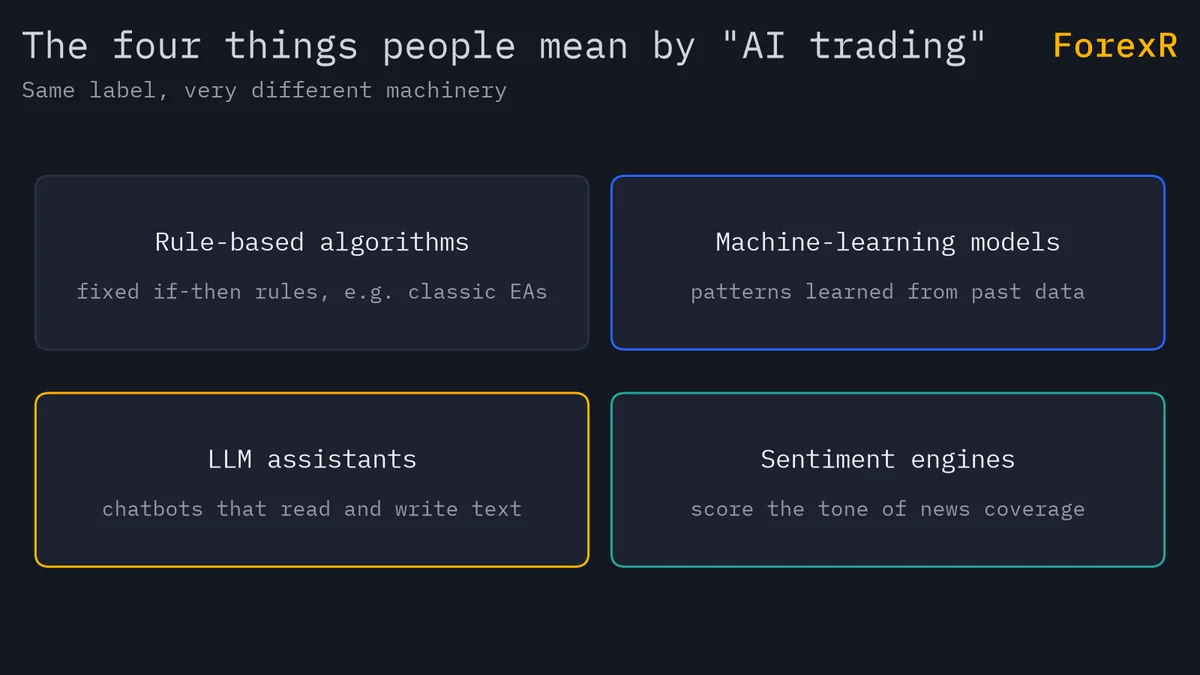
AI trading means using computer programs that learn from data, or that process language, to help make trading decisions. In practice the phrase covers four different things: rule-based algorithms, machine-learning models, AI chatbots used as assistants, and sentiment engines that read the news. Each one works differently and fails differently.
That spread of meanings is why AI trading feels confusing. A seller can put “AI-powered” on a program whose rules have not changed in ten years, and most buyers cannot tell the difference. This guide separates the four meanings, walks through a short history, and shows what retail traders actually receive once the marketing wears off.
The Four Things People Mean by AI Trading
Before you judge any AI trading product, work out which of these four things it really is:
- Rule-based algorithms. Programs that follow fixed instructions a human wrote in advance, such as “buy when the fast moving average crosses above the slow one”. On MT4 and MT5 these are called expert advisors, and forex robots and expert advisors have run on home computers for decades. Nothing is learned; the rules never change by themselves.
- Machine-learning models. Programs that find patterns in historical data on their own instead of following hand-written rules. They can adapt, but they also risk overfitting, when a model memorises the past instead of learning a rule that survives the future.
- Chatbot assistants. A large language model (LLM) is a program trained on huge amounts of text so it can read and write plain language. Traders use these chatbots to explain concepts, summarise long reports and pick holes in trading plans.
- Sentiment engines. Programs that read thousands of news headlines and turn the overall tone into numbers, such as the share of bullish coverage on a currency pair over the past day.
A Short History: From Fixed Rules to Chatbots
Algorithmic trading came first. Banks and funds began automating order execution in the 1980s and 1990s, and retail traders joined when MetaTrader made it simple to run an expert advisor at home. All of this was rule-based: fast and tireless, but only as clever as the person who wrote the rules.
Machine learning arrived next, first inside institutions with big data teams, later in retail tools. Instead of coding rules yourself, you feed a model thousands of examples and let it work out the pattern. Sentiment engines followed once computers could process news language at scale. Each wave reached institutions first and trickled down to retail years later, usually after the easiest gains had been competed away.
Chatbots built on large language models are the newest layer, and the reason everyone suddenly searches for AI trading. For the first time a beginner can ask a machine questions in plain English and get fluent answers back. Fluent is not the same as correct, though, and in trading that gap costs real money.
What Retail Traders Actually Get
Strip away the marketing and the retail toolbox is fairly short: expert advisors you can run on MT4 or MT5, chatbots you can question, sentiment dashboards you can read, and screeners that sort pairs by conditions you set. Some of it is genuinely useful. ForexR’s own directory of open-source AI and machine-learning EAs lists free code from GitHub, with stars and licences synced automatically, though it never tests, verifies or recommends any EA, so reading the code and judging the logic stays your job.
Chatbots are the easiest entry point, and getting real value from one is a skill in itself. Our guide on using AI chatbots for trading research covers the safe uses and the traps in detail.
What the Marketing Implies vs What You Get
Marketing implies a machine that predicts the market. What you actually receive is a machine that processes data faster than you can. Those are very different products, and the gap between them is where deposits disappear. A useful habit: whenever a pitch says “AI”, swap the word for “software” and read the claim again. “Our software never loses” sounds exactly as unlikely as it always did.
Numbers deserve the same scepticism. Suppose an advert shows a backtest, a replay of a strategy over past prices, with 100 trades and 90 winners. If the average winner made $10 and the average loser cost $95, the account won 90 × $10 = $900 and lost 10 × $95 = $950, so the strategy lost $50 overall despite a 90% win rate. A pitch that leans on the AI label instead of numbers you can verify is decoration; the worst cases cross into fraud, which we catalogue in our guide to AI trading scams.
Is AI Trading Profitable?
Not by default. ESMA-era disclosures show 74-89% of retail CFD accounts lose money, and those accounts already include plenty run by software. AI can strip out some human weaknesses, such as revenge trading after a loss, while adding new ones, such as trusting a confident wrong answer. Lasting results still come from a real edge, honest testing and sound risk management. None of those arrive with an AI label attached, and any product that claims otherwise is telling you what sells rather than what happens. The honest case for AI is smaller but real: it saves hours of routine work, applies rules consistently, and never gets tired or emotional at three in the morning.
Can AI Trade for Me?
Fully hands-off, reliably profitable AI is the promise that sells the most and delivers the least. Our advanced guide to AI forex trading explains why chatbots fail as live traders and what separates institutional systems from retail products, so we will not repeat that here. The short version: software can execute trades for you, but deciding what is worth executing, and how much to risk on it, remains your problem.
How to Start Exploring AI Trading Safely
You can learn a great deal about AI trading without risking a cent. Take the steps in order:
- Learn the vocabulary first. Start with the difference between learned rules and fixed rules, which our comparison of AI trading vs algorithmic trading covers in plain English.
- Practise on a demo account. A demo account lets you run any tool on live prices with imaginary money, so a bad tool costs you nothing but time.
- Demand method transparency. ForexR’s market analysis states the exact UTC time its data was taken and publishes its full method; expect the same openness from anything that wants your money.
- Choose the broker separately. Whatever tool you use, your deposit sits with a broker, so compare regulated brokers on their own merits rather than accepting whichever one a tool promotes.
- Start small when you go live. Trade the smallest size your account allows until months of your own records show the approach holding up.
One honest closing note. AI cannot see the future, cannot guarantee a single winning trade, and cannot remove the risk that leverage creates. Leveraged forex and CFD trading carries a high risk of losing money, whatever software sits between you and the market, so only ever trade with money you can afford to lose.
FAQ
Is AI trading legal?
Yes, in most countries. Using software to analyse markets or place trades is treated the same as manual trading, so it is legal wherever retail forex trading is legal. What matters is the broker’s regulation and your local rules, not the tool. Some regulators do restrict specific products, so check before you automate anything.
Do I need to know how to code to use AI trading?
No. Chatbots, sentiment dashboards and ready-made expert advisors all work without programming. Coding helps once you want to change how a tool behaves or build your own system, and basic reading knowledge makes it easier to spot when a downloaded robot does something dangerous. Start without code and learn it later if you need it.
Can AI predict the forex market?
No system, human or machine, can predict prices reliably. Markets move on news, policy decisions and crowd behaviour that no historical dataset fully captures. At best, a well-built model tilts probabilities slightly in specific conditions, and even that edge fades as conditions change. Treat any product claiming accurate prediction as a warning sign, not an opportunity.
What is the best AI for trading?
There is no single best AI for trading, because each type does a different job: assistants explain and summarise, sentiment engines score the news, and machine-learning models hunt for patterns. The honest question is whether a specific tool helps your specific process, shows its losing periods, and costs less than the value it adds.