Troy Ounces, Grams and Karats: How Gold Is Priced and Weighed

What Is a Troy Ounce of Gold?
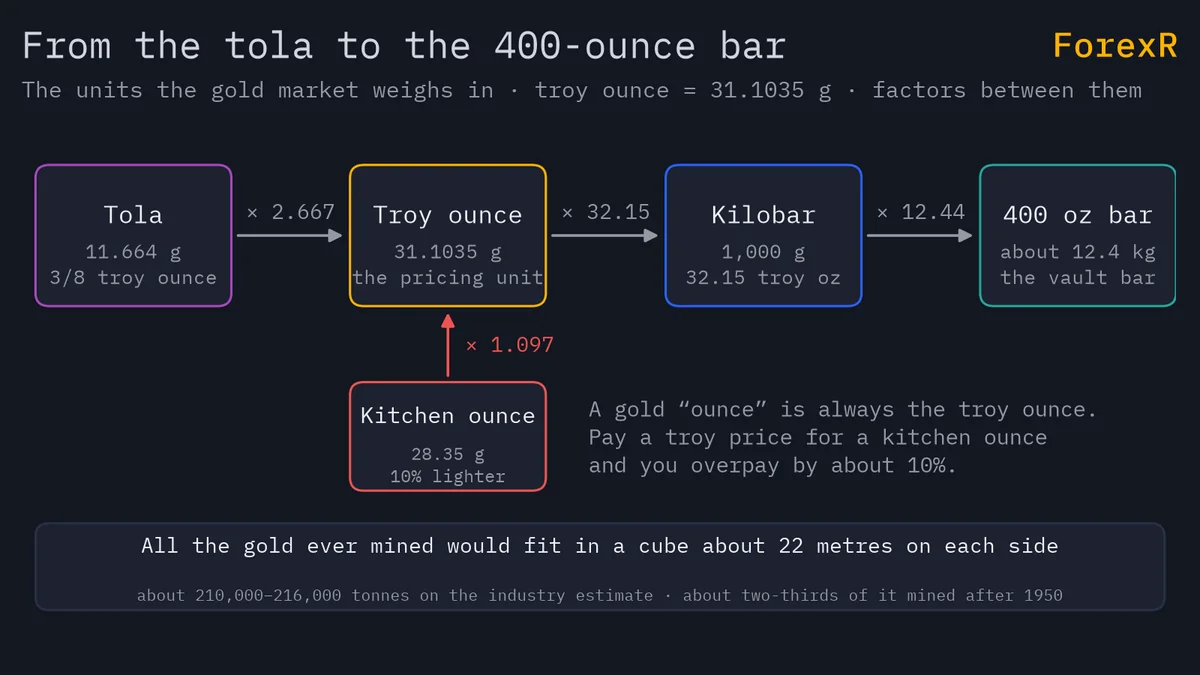
A troy ounce is the unit the gold market prices in: 31.1035 grams, about 10% heavier than the ounce on a kitchen scale (28.35 g). When a screen shows XAU/USD at an example price of $3,000, that is the dollar price of one troy ounce of pure gold; every gram, kilobar and 400-ounce bar price is worked out from it.
The arithmetic around it is simple, and once you can move between ounces, grams and karats you can read a bullion dealer’s list, a jewellery tag and a trading platform with the same eyes. Our gold trading glossary defines every term used here.
Troy Ounce vs Ordinary Ounce: Why the 10% Matters
People repeat that an ounce is an ounce. For gold it is not. The ordinary (avoirdupois) ounce used for food and body weight is 28.35 g. The troy ounce is 31.1035 g. Weigh a troy ounce of gold on a kitchen scale and it reads about 1.1 ounces; pay a troy-ounce price for an avoirdupois ounce and you have overpaid by about 10%.
Think of buying rice. A shop that sells a “kilo” that is really 900 g is short-changing you by 10%, and you would notice at the till. The two ounces do the same thing quietly, and the confusion turns up in real places: online listings that say “1 oz” without saying which, and home-made price-per-gram sums that divide by 28.35. Where the ounce is not named, ask. Bullion, coins and trading platforms always mean the troy ounce.
How to Work Out the Price per Gram
One division does it: price per gram = price per troy ounce ÷ 31.1035. Take the example price of $3,000 an ounce (an example for the sums, not a forecast or a current price):
- Pure gold (999): $3,000 ÷ 31.1035 = about $96.45 per gram.
- 22K (916): $96.45 × 0.916 = about $88.35 of gold content per gram.
- One kilobar: 32.15 troy ounces × $3,000 = about $96,450.
Go the other way with a multiplication: grams × 0.032151 = troy ounces, so a 10 g bar is 0.3215 oz and worth about $964.50 at the example price. Keep the live gold price open in one tab and a calculator in the other and you can price any weight in a minute. On a trading platform one standard lot of XAU/USD is 100 troy ounces, about 3.11 kg; the gold lot size guide does that arithmetic.
Karats vs Fineness: 24K, 22K, 18K and the 916 Stamp
Karat measures purity in parts of 24; fineness measures it in parts per thousand. They describe the same thing on two scales:
- 24K: 999 or 9999 fineness, 99.9% pure or better. Investment bars and most bullion coins.
- 22K: 916 fineness, 91.6% gold. The usual jewellery standard in Malaysia, Singapore, India and much of the Gulf.
- 21K: 875 fineness, 87.5% gold.
- 18K: 750 fineness, 75% gold.
- 14K and 9K: 585 and 375 fineness.
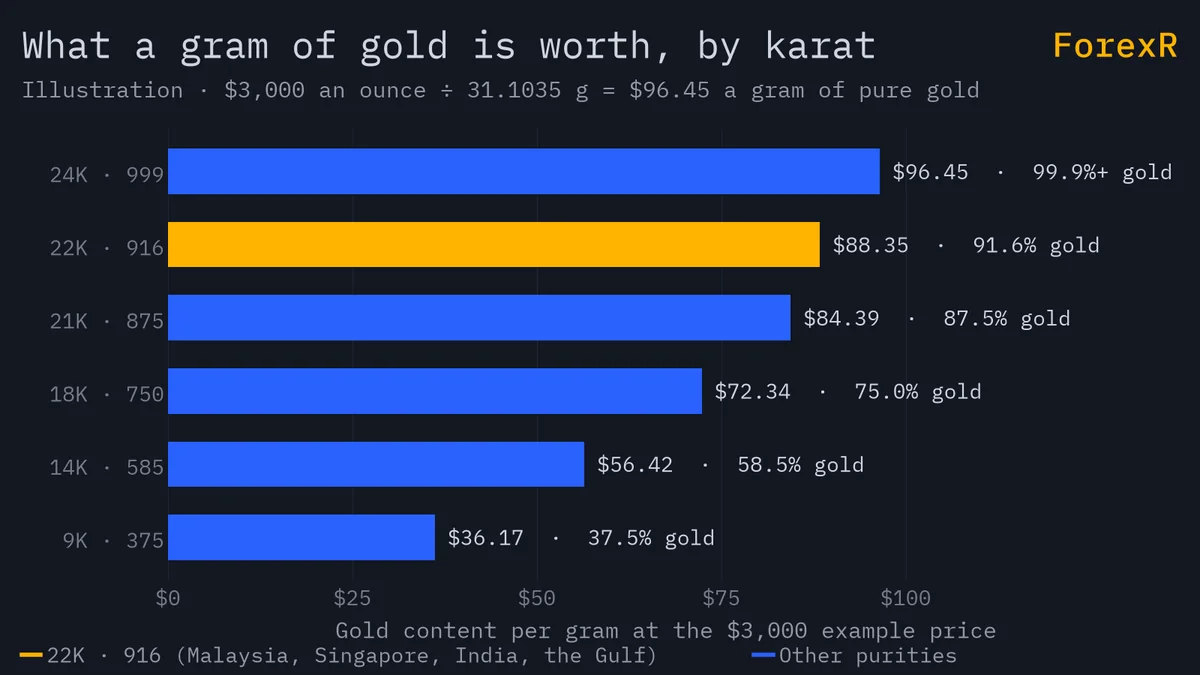
Why is so much Asian jewellery 916 rather than 999? Pure gold is soft. A 999 bangle bends and scratches in daily wear, so jewellers alloy it with a little copper or silver, and 22K is the compromise that keeps the deep yellow colour and a high resale gold content while surviving a wedding season. The stamp inside the piece, 916 or 999, is the hallmark: a mark certifying purity. India runs a hallmarking scheme that stamps the fineness number on jewellery, and Malaysian shops label pieces 916 or 999. No hallmark, no purchase.
The Tola, the Kilobar and the 400-Ounce Bar
Different corners of the market weigh gold in different units, and three of them are worth knowing:
- The tola: 11.664 g, three-eighths of a troy ounce, the traditional unit across South Asia. Ten tolas is 116.64 g, about 3.75 troy ounces.
- The kilobar: 1 kg at 999.9 fineness, 32.15 troy ounces, the popular investment bar across Asia. Gold is so dense, 19.3 g per cubic centimetre, that a kilobar is about the size of a small smartphone.
- The LBMA Good Delivery bar: the wholesale bar held by central banks and vaults, 350-430 troy ounces (nominally 400 oz, about 12.4 kg), minimum fineness 995.
The same conversion sizes a hedge for a shop’s stock; see hedging physical gold with XAU/USD.
Density leads to the fact that surprises everyone. All the gold ever mined, about 210,000-216,000 tonnes on the industry-body estimate, would fit in a cube roughly 22 metres on each side, about the height of a seven-storey building, and about two-thirds of it was dug up after 1950. Every ring, bar, coin and central bank vault on earth, in one cube you could walk around in a minute. Why so little metal carries so much value is the story told in why does gold have value.
Why the Shop’s Gram Price Is Not the Spot Price
Spot is the wholesale price of pure gold for immediate delivery, the number on the trading screen. Nobody on the high street sells at spot. Three layers sit on top of it:
- Premium: dealers sell small bars and coins above spot, often a few per cent for small bars and more for coins.
- Making charge: jewellery adds a charge for the workmanship, often 5-25% of the gold value.
- Buy-back spread: dealers buy back below spot, and jewellers buy back for the gold content only, at the 916 or 999 fineness, with the making charge gone.
A newly married couple in Penang stand at a shop counter comparing the tag on a 916 bangle with the live ounce price on a phone. The shop’s gram price sits above the $88.35 that the example price implies for 916 gold, and the buy-back price the assistant quotes sits below it. Neither number is a scam; the gap is the premium and the making charge, and the couple now know how much of what they pay is gold and how much is craft. Which form of gold suits which purpose, from coins to bank accounts to CFDs, is compared in ways to buy and trade gold.
Converting Gold Prices to Ringgit, Rupees or Rupiah
Gold is quoted in dollars, but you shop in your own currency, so there is one more step: multiply the dollar price per gram by the exchange rate. With the example price, $96.45 per gram of pure gold becomes 96.45 × the ringgit rate, the rupee rate or the rupiah rate, and the currency converter does the multiplication with a live rate. Two things follow: your local gold price can rise on a day gold did nothing, because your currency weakened against the dollar, and a shop’s gram price should be compared with the converted spot gram price, not the dollar figure.
Gram arithmetic has a religious use too. Zakat on gold falls due once your holding reaches the nisab of 85 g of gold, held for a lunar year, at a rate of 2.5%. The gold zakat calculator does the sum at the live price, and the zakat guide covers what counts and how to value it.
Try This: Price a Piece of Jewellery in Five Minutes
Find any gold item you own, or a shop tag online, with a weight and a stamp. Open the live gold price, divide by 31.1035 for the gram price, multiply by 0.916 or 0.999 to match the stamp, then by the weight in grams, then convert it to your currency. Compare your figure with the price on the tag. The difference is the premium plus the making charge, and if you ask the shop for its buy-back price you will see the other side of the spread too. Do this once and you will never look at a jewellery counter the same way.
If you would rather trade the price than own the metal, brokers quote XAU/USD per troy ounce in dollars, and you can compare their gold spreads and contract sizes on the broker comparison page.
Physical gold carries its own risks: you buy above spot and sell below it, so a piece must rise by the full spread before you break even, and bars and jewellery can be lost, stolen or mis-stamped, so storage and a trusted hallmark are part of the cost. Leveraged gold CFDs carry a high risk of loss and can fall hard and fast. Whichever you choose, use only money you can afford to lose.
FAQ
Is 916 gold a good investment?
It is 91.6% gold, so it holds real value, but jewellery is a poor way to hold gold. You pay a making charge and a shop premium on top of the gold content, and a buyer pays you for the gold content alone, so a piece must rise a long way before you break even. Bars and coins at 999 sit closer to the spot price both ways.
What does 9999 on a gold bar mean?
It is the fineness: 9999 means the bar is 99.99% pure gold, sometimes called four nines. A 999 bar is 99.9% pure, and the London Good Delivery standard for wholesale bars requires at least 995. For a small buyer the difference in gold content between 999 and 9999 is tiny; what matters more is that the stamp comes from a refiner the buyer will recognise when you sell.
How much does 1 kg of gold cost?
One kilogram is 32.15 troy ounces, so multiply the ounce price by 32.15. At an example price of $3,000 an ounce, a kilobar holds about $96,450 of gold. A dealer will charge a premium above that to sell and offer a little below it to buy back, and the exact figure in ringgit, rupees or rupiah depends on the exchange rate on the day.
Why is gold priced in troy ounces and not grams?
Because the wholesale market grew up in London and New York, where the troy ounce was the traditional unit for precious metals. The LBMA Gold Price and COMEX futures are both quoted per troy ounce, so the whole world takes its reference price in ounces. Shops in Asia and South Asia quote per gram or per tola for retail buyers, converted from that ounce price.