AI Trading Scams: How to Spot Fake Bots and Deepfakes

What Are AI Trading Scams?
AI trading scams are frauds that use the popularity of artificial intelligence to sell something fake: a bot that never trades, a celebrity video that was never filmed, or an account manager who simply steals deposits. The AI part is marketing. The scam underneath is old, and a few simple checks expose almost every version of it.
Fraud follows attention, and attention is on AI. The classic forex scam patterns have not changed in decades; the AI label is a fresh coat of paint on the same machinery. This guide walks through the five AI-flavoured scams you are most likely to meet, with the check that exposes each one.
Why Scammers Love the Word AI
Three reasons. First, AI feels too complex to question, so victims stop asking how the profit is actually made. Second, the claim is hard to test: you cannot inspect a hidden model, so “our AI does it” ends the conversation. Third, real AI headlines make impossible stories sound plausible — if machines can write essays, why not print money? For the honest picture of what the technology can and cannot do, start with what AI trading actually is.
One rule carries through this whole guide: the more a seller talks about the AI, the less they usually show of the results. Real tools explain their method. Scams show lifestyle photos.
The Guaranteed-Return AI Bot
The pitch: an AI robot trades for you and pays a fixed 2% or 3% a day. The word robot borrows credibility from expert advisors, rule-following programs that genuinely exist — and genuinely have losing runs.
Do the arithmetic and the story collapses. If a bot really made 3% a day, £100 compounded over 250 trading days would be 100 × 1.03 multiplied by itself 250 times: roughly £160,000 inside a year. Nobody who owned such a machine would sell it to strangers for a £99 licence fee. No market pays a fixed daily wage, so a fixed return promise is the scam confessing.
Real automated trading has losing days, losing weeks and drawdowns — a drawdown is the fall from an account’s peak to its next low. A seller who cannot show you a losing period is not showing you a track record; they are showing you an advert.
Deepfake Celebrity Endorsements
A deepfake is a video or voice clip generated by AI that shows a real person saying something they never said. Scammers mass-produce clips of famous investors, presenters and officials “revealing” an AI trading platform that made them rich, then run the clips as paid adverts on social media until they are taken down — and again under a new name the following week.
The same tools clone voices. A call that sounds exactly like a well-known analyst — or a family member asking you to move money urgently — is no longer proof of anything. Treat every unexpected financial request as unverified until you reach the person through a channel you already trust.
- Check the official source. If the person really backed a product, their verified accounts and mainstream press coverage would say so. Silence there means the clip is fake.
- Ask the obvious question. Why would a billionaire sell you a money machine for a small monthly fee?
- Search the platform name with the word scam. Victims usually post warnings within weeks of a campaign starting.
The AI Account Manager in Your DMs
This scam starts with a friendly stranger on social media or a messaging app. After days or weeks of small talk they mention an AI trading system run by their “analyst”. You deposit a little, a slick dashboard shows steady gains, and you are encouraged to add more. When you try to withdraw, a fee, a tax or a “verification” charge appears — and keeps appearing until you stop paying. The dashboard was fiction from the first day. The long build-up gives the scheme its grim nickname, pig-butchering: the victim is fattened before the slaughter.
The checks are blunt. Licensed firms do not recruit clients through private messages. Real gains can be withdrawn, so test with a small amount early and treat any blocked withdrawal as final proof. A genuine firm also appears on a regulator’s public register — you can compare regulated brokers in the open instead of trusting a stranger’s screenshots. And if you want someone else’s trades in your account, regulated copy trading at least shows a visible record, though it carries real risks of its own.
Fabricated Backtests and Screenshots
A backtest is a replay of a strategy over past prices. Honest ones are useful; fabricated ones are the cheapest proof a scammer can print. The common tricks: statements from a demo account presented as live money, edited screenshots, a test tuned until history looks perfect, and results shown only for one hand-picked window. Our guide to backtesting an EA properly shows what an honest test looks like — losing stretches included.
Demand verification you can check yourself: read-only investor access on MT4 or MT5, or an independently verified live record with timestamps. A screenshot proves only that someone owns image-editing software. Signal groups lean on the same screenshot economy, which the forex signals guide takes apart in detail.
Recovery Scams: The Second Hit
After you lose money, a “recovery agent” appears, often claiming AI tracing tools can follow your funds and get them back for an upfront fee. Some pose as law firms or regulators; many financial regulators publish warning lists of these clone firms, which are worth checking. They found you because victim lists are traded between scam operations, so being contacted at all is itself a warning sign.
The rule is absolute: no legitimate recovery service demands payment up front, and no regulator charges you to investigate. Report the original scam to your bank and the police, keep every message as evidence, and treat anyone promising your money back as the second wave of the same attack.
A Checklist That Exposes Most AI Scams
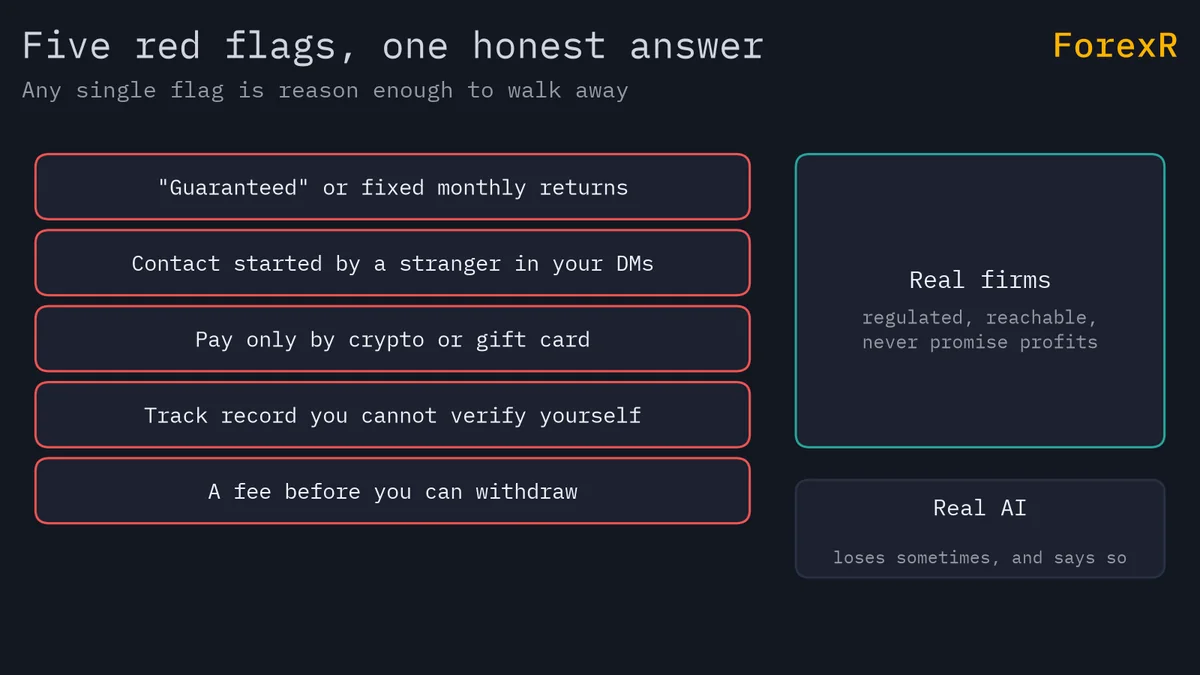
- Guaranteed or fixed returns. Markets do not pay salaries. This single line ends most pitches.
- Pressure to act now. Countdown timers and “last spots” exist to stop you thinking.
- Anonymous operators. No named people, no registered company, no licence number you can check on a regulator’s website.
- First contact by private message. Licensed firms do not cold-message strangers.
- Proof you cannot verify. Screenshots and testimonials instead of read-only account access.
- Withdrawal friction. Any fee, tax or release charge demanded before you can take out your own money.
- Payment in crypto or gift cards. Chosen because it cannot be reversed.
None of this makes AI itself the enemy. Used carefully, a chatbot is a decent study partner — see how to use AI chatbots for trading research — it simply cannot make anyone rich on demand.
What to Do If You Have Already Paid
Stop sending money immediately, whatever the platform threatens. Save everything: chat logs, wallet addresses, payment receipts, the website address. Contact your bank or card issuer at once, because quick chargeback requests sometimes succeed. Report the fraud to your local police and financial regulator, report the account that approached you, and tell someone you trust — secrecy is the scammer’s best friend, and shame is what keeps victims quiet. Above all, expect the recovery follow-up, and do not pay it.
No AI can remove the risk from trading, verify a stranger’s honesty or claw back stolen money. Even fully legitimate leveraged forex and CFD trading carries a high risk of loss — ESMA-era disclosures show 74-89% of retail CFD accounts lose money — so only ever trade with money you can afford to lose.
FAQ
Are AI trading bots legitimate?
Some are real software: rule-based or machine-learning programs that place trades automatically. Legitimate ones never promise returns, they publish their method or code, and they show losing periods. The moment a bot is sold with a guaranteed profit figure, rented lifestyle photos and no verifiable record, you are looking at marketing for a scam, not at software.
How can I tell if a trading platform is fake?
Search the operating company on your financial regulator’s public register — no licence, no deposit. Test withdrawals early with a small amount. Check how old the website domain is, whether the company address is real, and whether the platform name already appears in scam warnings. A fake platform usually fails several of these checks at once.
Can I get my money back after a trading scam?
Sometimes, but speed matters. Card payments and bank transfers can occasionally be reversed if you contact your bank quickly and report the fraud. Crypto payments are rarely recoverable. Report to the police and your regulator regardless, because reports shut operations down. Never pay an upfront fee to anyone promising recovery; that is a second scam.
Why do scammers use deepfake videos of celebrities?
Because trust transfers. A familiar face makes an unknown platform feel established, and video feels harder to fake than text, even though it no longer is. Deepfake adverts are cheap to produce, easy to run to millions of viewers, and profitable if even a tiny fraction of people click through and deposit before the advert is removed.