AI Trading vs Algorithmic Trading: The Real Difference

What Is the Difference Between AI and Algorithmic Trading?
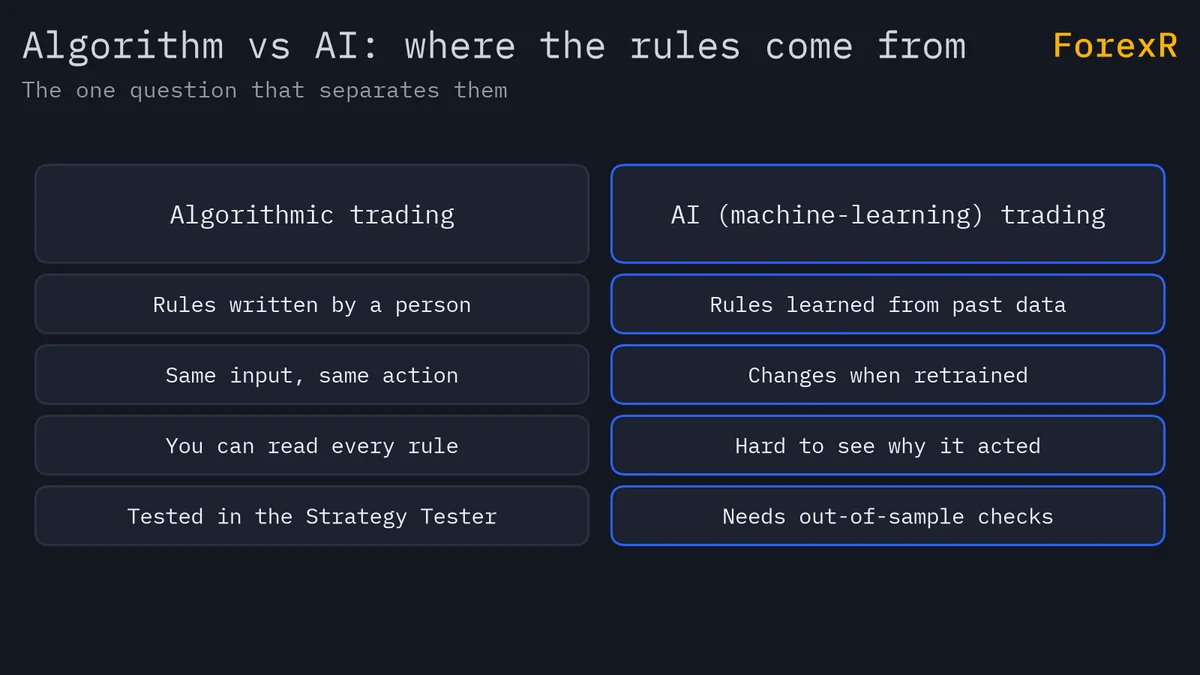
An algorithm follows fixed rules a human wrote in advance, and it never changes them on its own. An AI system learns its rules from data, so its behaviour can shift as the data shifts. Most retail products sold as AI are actually fixed-rule algorithms wearing a fashionable label.
The two overlap, which is why the terms get tangled. Both are software, both can run without you watching, and both fail when markets change character. The difference that matters is where the rules come from: a person’s head, or a pile of historical data. Knowing which one you are dealing with tells you what can go wrong with it. This guide walks through both, then hands you a quick test for any product that claims to be AI-powered.
What Algorithmic Trading Really Means
An algorithm is a recipe: a fixed list of steps a computer follows exactly. A simple trading algorithm might read: buy when price closes above the 20-day high, place a stop-loss 50 pips below the entry (a pip is the fourth decimal place on most currency pairs), risk 1% of the account per trade, and close the position at 100 pips of profit. Every rule is visible, and the program behaves the same way in the same situation every single time.
This is what expert advisors on MT4 and MT5 are: strategy recipes written in MQL4 or MQL5, the platforms’ programming languages. Our guide to types of expert advisors sorts them category by category, and most build their logic from ordinary technical tools such as moving averages, breakouts or support levels. The word to hold onto is fixed. An algorithm is frozen human judgement, automated so it can run all day without getting tired.
What Makes a System AI Rather Than an Algorithm
A machine-learning system is not handed rules. It is handed data and a goal, and it works out rules for itself. Show a model ten years of hourly price history, labelled with what happened next, and it searches for combinations of conditions that tended to come before rises or falls. The rules it finds are often too tangled for a person to read, which is why such systems are called black boxes, models whose inner logic you cannot inspect.
Learning from data sounds strictly better than fixed rules. It is not, because it carries its own specific danger: overfitting, when a model memorises the past instead of learning a rule that survives the future. Our guide to machine learning in forex looks at where learned models genuinely earn their keep and where they quietly fall apart.
Why Most AI Expert Advisors Are Plain Algorithms
Read the sales pages for AI forex robots carefully and a pattern appears. Most describe fixed logic: an indicator crossover, a grid of pending orders, a filter that pauses trading around news. Nothing in them learns anything. The AI label is there because it sells, not because a model is inside.
That is not automatically bad. A transparent fixed-rule EA is easier to test and easier to trust than a black box. With open-source code you can settle the question directly: ForexR’s listing of open-source AI and machine-learning EAs links to the actual GitHub code, though the library never tests, verifies or recommends an EA, so reading and judging remain your job. What is bad is paying an AI premium for a crossover robot that could have been written twenty years ago.
A Simple Test for Any AI-Powered Claim
You do not need to read code to filter most claims. Put four questions to the seller, or to yourself:
- What exactly does it learn? If nobody can name the data the system learns from and describe what changes as a result, it is an algorithm, not AI. “It uses advanced AI” is not an answer.
- When was it trained, and is it retrained? A model trained once, years ago, is as frozen as any fixed rule; it just froze in a more complicated shape.
- Are there out-of-sample results? Only performance on data the system never saw during training means anything, the same discipline behind backtesting an EA properly.
- Would the claim survive without the label? Swap “AI” for “software” and reread the pitch. If it collapses, the label was carrying all the weight.
The same test applies to signal services that advertise machine intelligence; our guide to AI trading signals applies it to that industry in detail.
Strengths and Weaknesses of Algorithmic Trading
Fixed rules bring real advantages, and real limits that no amount of polish removes:
- Transparent. You can read every rule, test it on history and know exactly what you own before it touches money.
- Consistent. No fear, no boredom, no revenge trades after a losing day; the recipe is followed to the letter, every time.
- Rigid. When the market changes character, fixed rules keep firing anyway. A breakout recipe that suited a trending year can bleed steadily through a quiet, ranging one.
- Crowded. Popular rules are run by thousands of traders at once, which thins whatever edge they once had.
Strengths and Weaknesses of AI Trading
Learned systems flip those trade-offs rather than escaping them:
- Adaptive. A model that is retrained on fresh data can pick up new behaviour no human thought to code.
- Wide. A model can weigh dozens of inputs at once, from volatility to the tone of news coverage, where a hand-written recipe uses a handful.
- Prone to overfitting. Here is the classic failure in round numbers. A model takes 100 practice trades on its training data and wins 80, an 80% hit rate. On 100 trades of data it has never seen, it wins 45. The 35-point gap is the part it memorised, and live money trades the 45, not the 80.
- Opaque. When a black box starts losing, you cannot tell whether it is broken or just unlucky, so you cannot fix it; you can only switch it off and wonder.
Where Algorithms and AI Work Together
The strongest systems usually combine the two. A fixed-rule strategy generates the trades, and a learned model sits on top as a filter, scoring conditions and standing the strategy down when they look wrong. Institutions have run this pairing for years; retail traders now copy it in miniature, sometimes with a chatbot drafting the code and a human testing every line before it runs.
Two practical notes before you build or buy anything. First, get the plain-English map of the whole field from our overview of what AI trading means, so a seller cannot blind you with vocabulary. Second, remember that execution costs decide marginal strategies: the same recipe can win where the spread, the built-in cost of each trade, is tight and lose where it is wide, so compare regulated brokers on costs before you blame the logic.
Neither a fixed algorithm nor a learned model removes market risk, and neither knows what tomorrow brings; ESMA-era disclosures show 74-89% of retail CFD accounts lose money whichever software they run. Leveraged forex and CFD trading carries a high risk of loss, so whatever you automate, only ever risk money you can afford to lose.
FAQ
Are expert advisors a form of artificial intelligence?
Usually not. The vast majority of expert advisors are fixed-rule programs: they follow instructions a human coded and never learn from data. A small number embed machine-learning models, but you cannot tell from the name or the price. Read the code if it is open source, or ask the seller exactly what the system learns and when it was last retrained.
Is high-frequency trading the same as algorithmic trading?
High-frequency trading is one branch of algorithmic trading, built around extreme speed: servers placed next to exchanges and holding times measured in fractions of a second. Retail traders cannot compete there and do not need to. Most retail algorithms are slow strategies that hold trades for hours or days, where the quality of the rules matters far more than speed.
Do banks use AI trading or algorithmic trading?
Both. Banks have used execution algorithms for decades to fill large orders without moving the market, and many now apply machine learning to execution quality, risk limits and research. Their advantage is not a crystal ball; it is data, infrastructure and teams of specialists. Nothing they run resembles the plug-and-play profit robots marketed to retail traders.
Which should a beginner learn first, algorithmic trading or AI trading?
Fixed-rule algorithmic trading, without question. Its rules are readable, so you can learn testing, risk control and honest record-keeping on a system you fully understand. Machine learning stacks statistics, coding and subtle traps like overfitting on top of everything an algorithm already demands. A trader who cannot evaluate a fixed rule cannot evaluate a learned one either.