How to Trade Gold (XAU/USD): A Beginner’s Six-Step Guide

How Do You Trade Gold (XAU/USD)?
One standard lot of gold is 100 troy ounces, about 3.1 kg, three bags of sugar, and a $1 price move changes it by $100. Retail traders trade it as XAU/USD, a CFD on the spot price, on the same platform as forex. Six steps take you from reading about the drivers to a small first trade.
A CFD, or contract for difference, is a deal with your broker that pays you the change in price; you never own any metal. Spot gold is the price for delivery now, quoted in US dollars per troy ounce, and a troy ounce is 31.1035 grams, about 10% heavier than an ordinary ounce. This guide is the map of the whole journey. Each stop has its own deeper guide, linked as you go.
What Is XAU/USD?
XAU is the ISO currency code for gold, so XAU/USD reads like a currency pair: one troy ounce of gold priced in US dollars. Brokers quote it to two decimals, so the last digits are cents. You buy if you expect the price to rise and sell if you expect a fall, exactly as with EUR/USD.
The market runs almost round the clock, from Sunday 6 p.m. to Friday 5 p.m. New York time, with a daily break from 5 to 6 p.m. New York when nothing trades and spreads are widest on either side. Because you hold a contract rather than metal, you carry three costs a coin in a drawer never has: the spread, the overnight swap and counterparty risk on your broker. The live chart, daily pivot points, ATR (average true range, the typical size of a day’s move) and a trend read across timeframes all sit on the live gold price page.
How Is Gold Different From EUR/USD?
Gold trades on the same screen as the euro, but it behaves like a different animal. Four differences matter to a beginner.
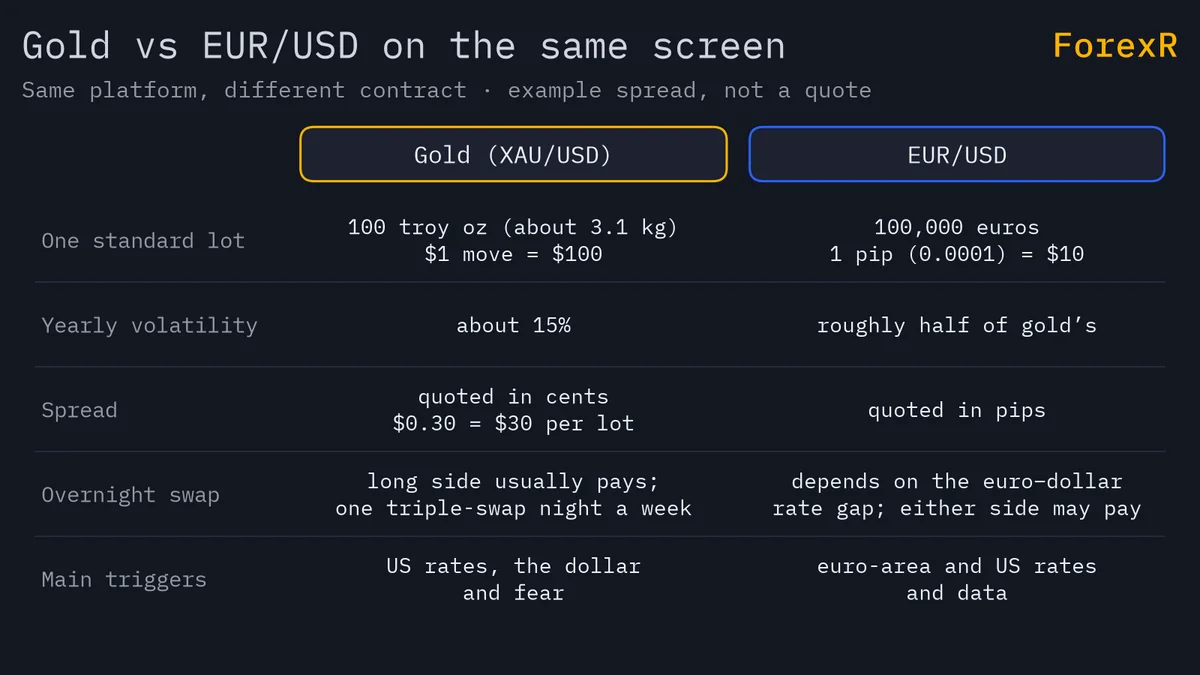
- Bigger swings per lot: gold’s yearly volatility has typically been about 15%, roughly double EUR/USD’s. A daily range of 1-2% is ordinary, and every $1 of it is $100 on a standard lot.
- Wider spread: the spread is the gap between the buy and sell price, and on gold it is quoted in cents. An example spread of $0.30 costs $30 per standard lot per round trip, and it widens at the daily break, at the Sunday open and in the seconds around US data.
- Higher swap: swap is the overnight financing charge. On gold the long side usually pays, because holding gold costs roughly the US interest rate minus a small lease rate, and one weekday each week carries a triple swap to cover the weekend.
- Different triggers: gold reacts to US inflation and jobs data through interest rates, and it reacts to fear. Slow-burning worry tends to lift it; a sudden scramble for cash can sell it.
The cost side is explained in gold spread and swap fees, and the driver side in what moves the gold price.
The Six-Step Path to a First Gold Trade
- Learn the drivers. Real yields (a bond yield minus expected inflation) and the US dollar move gold on most days. Spend a week reading before you place anything.
- Pick a regulated broker. Check the licence, the gold spread in cents, the swap and the maximum leverage on metals. Compare brokers on gold costs, not on bonuses.
- Trade a demo first. A demo account uses play money on live prices. Give it at least two weeks and the minimum lot size, 0.01.
- Size small. Risk at most 1% of the account per trade and work the lot size back from the stop distance in dollars. Gold lot size, pip value and margin has the tables.
- Test one setup. One entry rule, one stop rule, one exit rule, one timeframe. Gold trading strategies lists five to test, each with the conditions in which it fails.
- Keep a journal. Write down every trade: the reason, the size, the result and the mistake. A trading journal is the only tool that shows you your own habits.
A Worked Example on 0.01 Lot
Use an example price of $3,000 an ounce; it is a round number for arithmetic, not a forecast. The smallest lot, 0.01, is one ounce, so your position is worth $3,000. At 1:100 leverage, which means the broker asks for one-hundredth of the position’s value as margin, it locks $30, and every $1 move changes your balance by $1.
Margin works like a rental deposit. The landlord holds a small deposit, but you are responsible for the whole flat. The $30 is not what you can lose; the $3,000 position is what moves.
Now the stop. A daily range of 1-2% at this price is $30-60, so a $20 stop sits inside normal noise. On 0.01 lot that stop risks $20, which is 2% of a $1,000 account, above the 1% rule. On a $5,000 account, 1% is $50, and $50 ÷ ($20 × 100) = 0.025, so you would trade 0.02 lots. Redo this sum on paper before every trade until it is automatic; the position size calculator checks your answer.
What People Get Wrong About Gold Being Safe
The belief: gold is a safe haven, so a gold trade cannot lose much. It sounds reasonable, because gold has been money for about 2,600 years and central banks keep it in vaults.
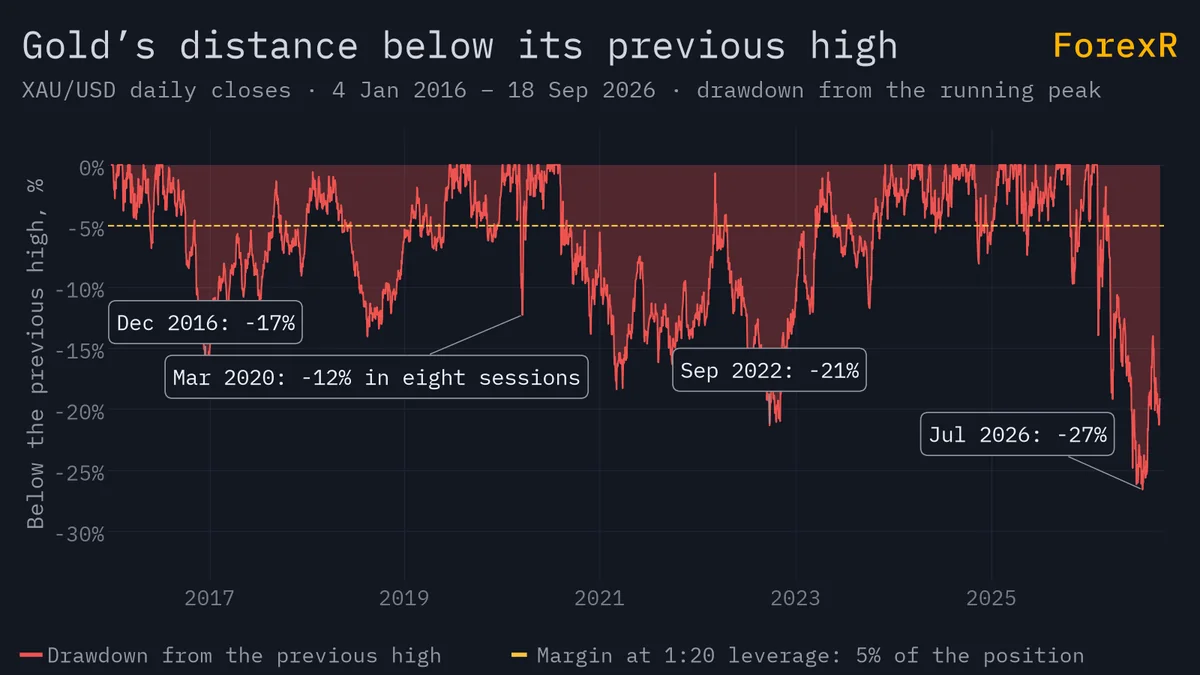
History says otherwise. In the March 2020 Covid crash gold fell about 12% in about eight trading days, because funds sold whatever they could to raise cash. In 2008 it dropped from about $1,000 to about $700, near 30%, before its later records. In April 2013 it lost about 13% in two trading days. On a leveraged CFD a 12% fall is not a bad week: at 1:20 leverage it is more than twice your margin. Safe-haven behaviour is real, but it is a tendency over months, not a promise for your stop-loss, and ESMA-era disclosures show 74-89% of retail CFD accounts lose money. The ten gold trading mistakes guide shows how those losses usually happen.
What Should Your First Month Look Like?
A nurse in Manila opens MT5 on her phone at 9 p.m., after her shift, when London and New York are both open. She checks the day’s range on the live gold page, sees that US jobs data is due in thirty minutes, and closes the app until the first candle after the release has finished. Her demo trade goes in the next evening, 0.01 lot, with the stop written down before the entry.
That is the shape of a good first month: routine before results.
- Weeks one and two: demo only. Note what gold does at the London open, in the 8-11 a.m. New York overlap and around the 5 p.m. New York break. Best time to trade gold converts those hours to Kuala Lumpur, Jakarta, Manila and Mumbai clocks.
- Weeks three and four: one setup, 0.01 lot, still on demo or the smallest live size you can afford to lose. Maximum 1% risk. No trades in the first fifteen minutes after US data.
- Every day: five lines in the journal, even on days without a trade.
Try This: A Five-Minute Demo Exercise
Open a demo account and place a 0.01 lot buy on XAU/USD with a $20 stop. Then place a 0.01 lot buy on EUR/USD with a 20-pip stop. Watch both for ten minutes and write down how many dollars each position moves. The gold position will usually swing further and faster for the same lot size. That feeling, in dollars rather than theory, is the lesson.
Gold CFDs are leveraged products and carry a high risk of losing money quickly. Gold can fall hard and fast, as 2008, 2013 and 2020 showed, and a weekend gap can take a stop past the price you set. Trade only money you can afford to lose, and keep the lot size small until your journal earns you the right to grow it.
FAQ
How much money do you need to start trading gold?
Margin is the wrong measure. At an example price of $3,000, 0.01 lot needs about $30 of margin at 1:100 leverage, but a sensible $20-30 stop at 1% risk implies an account of $2,000-3,000. Many people start with less and accept 2-3% risk per trade, which is why small gold accounts empty quickly. Start on demo and fund only what you can afford to lose.
Can you trade gold on MT4 or MT5?
Yes. Gold appears in Market Watch as XAUUSD or a similar symbol, and it uses the same order types as forex. Before your first trade open the contract specification and check the lot size (usually 100 troy ounces), the number of decimals, the swap for long and short, the triple-swap day and the trading hours, including the daily break at 5 p.m. New York.
Is gold trading good for beginners?
It is harder than the major currency pairs: bigger dollar moves per lot, wider spreads, an overnight swap that usually charges buyers, and sharp reactions to US data. Its drivers are clear and the market is deep, though, and mistakes show up in dollars fast, which teaches position sizing quickly. Learn on demo, trade 0.01 lot, and treat the first month as practice.
Can you lose more than you deposit when trading gold CFDs?
It can happen. Gold reacts to weekend news and often opens with a gap on Sunday evening New York time, and a stop-loss is filled at the first available price, not the price you set. Brokers that offer negative balance protection limit the loss to your account balance; others may ask you to cover the shortfall. Check the terms before funding an account.