Why Does Gold Have Value? A Plain-English History of Money

Why Does Gold Have Value?
All the gold ever mined, about 210,000-216,000 tonnes, would fit in a cube roughly 22 metres on each side, shorter than many office blocks. Gold has value because it is scarce, it never rusts, it divides into identical grams, and for about 2,600 years people have agreed to accept it as money. That agreement, not the metal, sets the price.
The last sentence matters most if you trade, so this guide builds up to it: first the physical reasons gold was chosen, then the history that made the choice stick, then what it means when you buy an ounce, a gram or a CFD today. If you want the day-to-day price drivers instead, they live in what moves the gold price.
How Rare Is Gold, Really?
Rare enough to matter, common enough to use. Picture the cube again: 22 metres a side, and about two-thirds of it was dug up after 1950. Mines add about 3,500-3,700 tonnes a year and recycling another 1,200-1,300 tonnes, so the pile grows by only about 1.5-2% a year. Nobody can print it, and no new mine changes the total quickly.
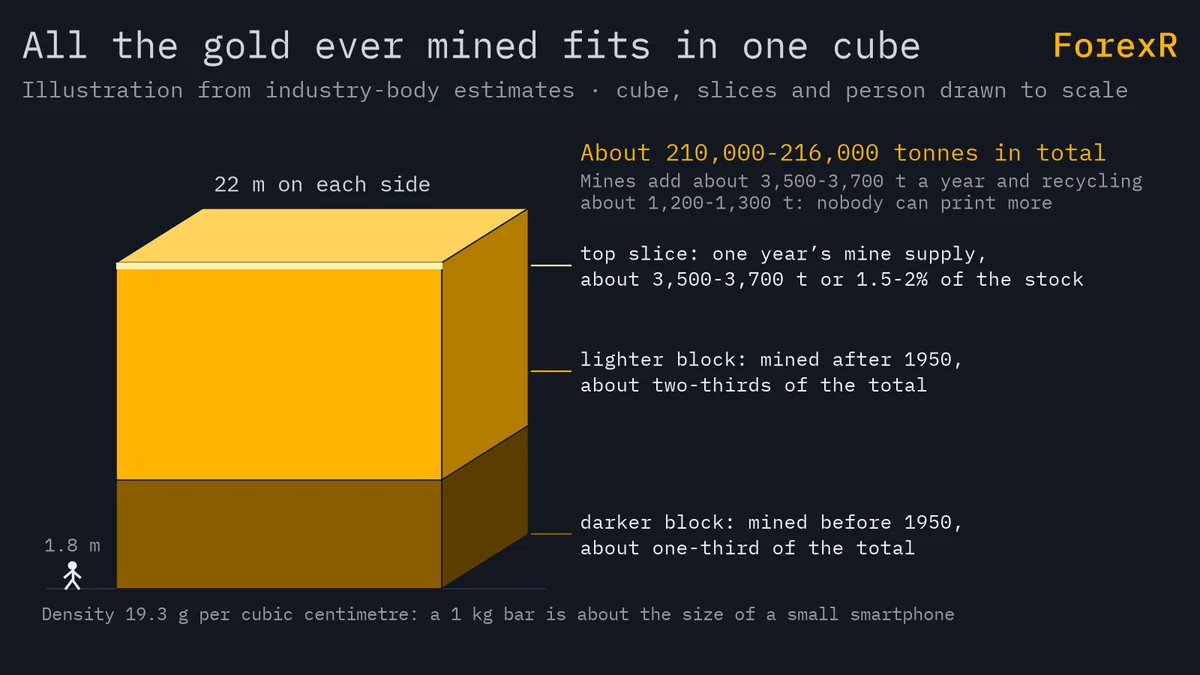
Density is the other surprise. Gold weighs 19.3 grams per cubic centimetre, so a 1 kg bar is about the size of a small smartphone, and the wholesale LBMA Good Delivery bar that central banks hold, nominally 400 troy ounces or about 12.4 kg, fits in two hands. A great deal of value in a very small space is exactly what you want from money you might have to carry.
Why Did Gold Become Money and Not Iron or Salt?
Chemistry chose it. Iron rusts, so a hoard of iron coins turns to powder. Salt dissolves in the first rain. Gold does neither: it does not corrode or tarnish, it can be hammered thin, it can be cut into tiny pieces, and every pure gram is identical to every other. A coin struck in Lydia still shines.
Divisibility is easy to test on paper. Take an example price of $3,000 an ounce, an example for arithmetic and not a forecast. One troy ounce is 31.1035 grams, so one gram of pure gold is $3,000 ÷ 31.1035, about $96.45. A gram of 916 jewellery gold, which is 91.6% pure, holds about $88.35 of gold. You can price a wedding bangle or a wholesale bar with the same division, which is exactly what a money needs. Troy ounces, grams and karats goes through the units and purities in detail.
2,600 Years as Money: From Lydia to the Gold Standard
The first gold coins were struck in Lydia, in today’s Turkey, around 600 BC. For most of the next two and a half thousand years, gold and silver coins were money, and paper was a receipt for them. Britain made the link formal in 1821 by adopting a gold standard, a system in which the currency is a fixed weight of gold, and the classical international version ran from the 1870s to 1914.
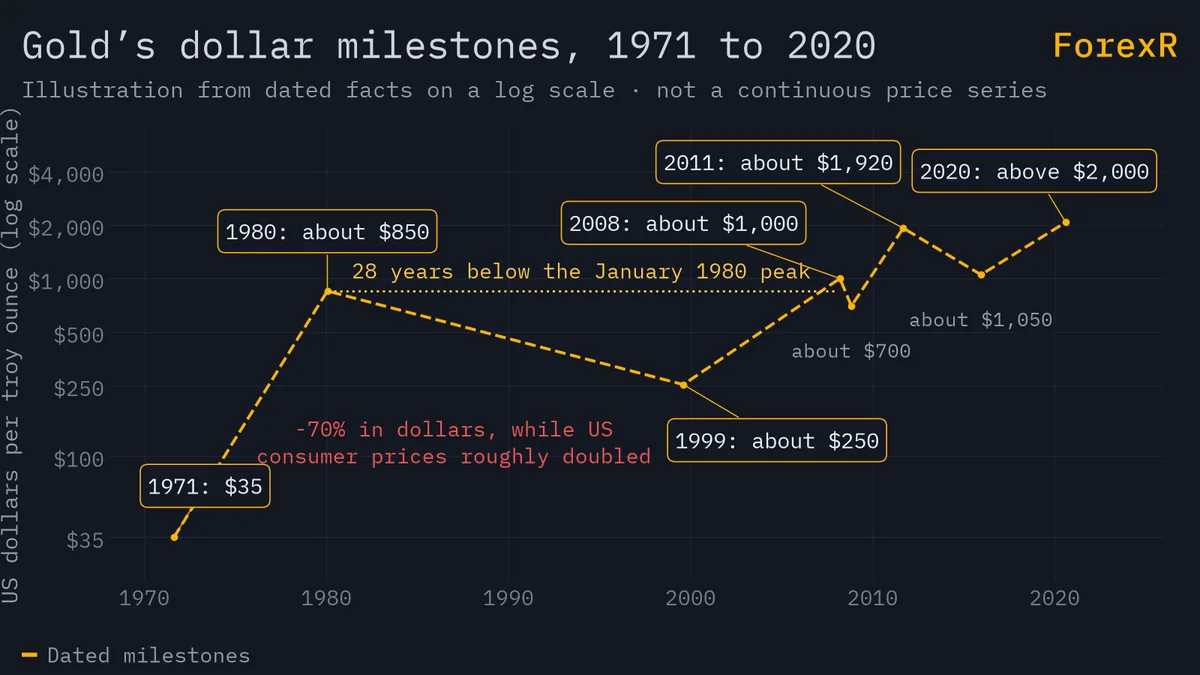
Over the twentieth century that system came apart in stages. In 1933 the United States restricted private gold ownership, and in 1934 it fixed the official price at $35 an ounce. The 1944 Bretton Woods agreement tied the major currencies to the dollar and the dollar to gold at that same $35. Then, on 15 August 1971, President Richard Nixon ended the dollar’s convertibility into gold. Since that day no major currency has been backed by metal, and gold has floated, rising more than 20-fold from $35 to about $850 by January 1980.
Why Do Central Banks Still Hold Gold?
Because the agreement outlived the gold standard. The United States holds about 8,100 tonnes, Germany about 3,350, the International Monetary Fund about 2,800, Italy and France about 2,450 and 2,440, and China and Russia each above 2,000. A central bank keeps gold because it is nobody’s liability: it cannot default, cannot be printed, and cannot be frozen by another government as easily as a foreign bond. Reserve managers surveyed by the World Gold Council cite diversification and, after 2022, the freezing of Russia’s foreign reserves. It is the same logic that makes gold a haven in slow-burning crises.
They have not always timed it well. Central banks were net sellers for about two decades up to 2009. The Bank of England sold about 395 tonnes between 1999 and 2002 at an average near $275, close to the 1999 low of about $250-255, a sale later nicknamed “Brown’s Bottom” after Chancellor Gordon Brown. Since 2010 central banks have been net buyers every year. The lesson for a trader is not that officials are foolish; it is that even the biggest holders cannot predict the price.
What People Get Wrong: “Gold Always Keeps Its Value”
The belief is that gold holds its purchasing power, full stop. Over centuries there is truth in it. Over a working lifetime there is not.
The full timeline, cycle by cycle, is in gold price history and cycles.
From the January 1980 peak of about $850, gold fell for about twenty years to roughly $250 in 1999, a loss of about 70% in dollars. Over the same years US consumer prices roughly doubled, so an ounce bought less than a fifth of what it had. The 1980 peak was not beaten in dollar terms until 2008, 28 years later. Someone who bought at the top to pay for a child’s university fees in 1999 lost most of the money. Is gold an inflation hedge? works through the full 50-year record, decade by decade.
Value Is an Agreement: What That Means for a Trader
A kilo of rice has value because you can eat it. A banknote has value because everyone agrees to take it. Gold sits closer to the banknote than to the rice: jewellery takes about 45% of yearly demand and technology about 7%, and the rest is bought because the buyer expects the next person to want it too.
Three things follow, and each one shapes a trade.
- Gold pays nothing. Ten ounces at the example price of $3,000 cost $30,000. A year later you still own ten ounces, no more, and if the price has not moved you have $30,000 minus storage or swap. No rent, no coupon, no dividend. That is why gold competes with interest rates, explained in gold and interest rates.
- The price is what the next buyer pays. There is no cash flow to value, so the fair price is whatever the market agrees today, and the agreement moves every second on the live XAU/USD page.
- A CFD is one step further from the metal. When you trade gold through a broker as a CFD, a contract that pays the price change, you own an agreement about gold rather than gold, so you rely on the broker as well as the market.
A retired teacher in Penang keeps her mother’s 916 bangles in a bank box. She has never sold them and does not plan to, but every Chinese New Year she checks the gram price out of habit. What strikes her is not the level but the movement: the same bangles, the same weight, a different number every year.
Try This: A Five-Minute Test of the Agreement
Ask three people why gold is valuable and write down their answers. Most will say “because it is rare” or “because it always goes up”. Then count how many say “because other people want it”. That third answer is the accurate one, and once you hear how few people give it, you will read gold headlines differently. If you want to act on this, the beginner path is in how to trade gold, and the ways to own the metal itself, from coins to bank accounts, are compared in ways to buy and trade gold.
A word on risk. Because gold’s value is an agreement, it can be revised sharply: the metal lost about 70% of its dollar price between 1980 and 1999 and about 30% in late 2008. Physical gold is bought at a premium and sold back below spot, and it must be stored. Leveraged gold CFDs carry a high risk of loss, and you should only risk money you can afford to lose.
FAQ
Is gold valuable because it is rare or because people want it?
Both, but demand does most of the work. Rarity alone is not enough, since many scarce materials are cheap. Gold’s price rests on an agreement, built over about 2,600 years, that it will be accepted later. Supply grows only about 1.5-2% a year, which keeps the agreement credible, yet the price still swings with demand, which is why it fell about 70% between 1980 and 1999.
Does gold have any practical use, or is it only for jewellery and investment?
It has real uses, but they are a small part of demand. Technology, mainly electronics, takes about 7% of yearly demand because gold conducts well and never corrodes. Jewellery takes about 45%, investment in bars, coins and funds about 25%, and central banks about 20%. Most gold is bought to be kept, not used, which is why its price behaves like money rather than like copper.
Why is gold priced in US dollars?
The dollar is the world’s main reserve currency, and the benchmark markets quote in it: COMEX futures in New York and the LBMA Gold Price, set twice a day in London at 10:30 a.m. and 3 p.m. by electronic auction. Your local price is the dollar price converted at the exchange rate, so a weaker dollar lifts the dollar price even when gold is unchanged in ringgit or rupees.
Could gold ever lose its value completely?
Nothing is guaranteed, but a total loss would need the world to stop wanting a metal it has wanted for about 2,600 years. Gold has no issuer that can default, which is different from a bond or a share. Its price can still fall a long way, as the 70% drop from 1980 to 1999 showed, and a leveraged position can be wiped out far sooner than that.