How to Use AI Chatbots for Trading Research Safely

How Do You Use AI Chatbots for Trading Safely?
Use a chatbot for jobs where a wrong answer is cheap to catch: learning concepts, summarising reports, turning your rules into checklists and reviewing your journal. Never use it as a price feed or a signal source, and verify every number and claim against the live market before you act.
That single habit, verify before you act, separates traders who get real value from chatbots from traders who get burned by them. This guide covers the five jobs worth doing, two worked examples you can copy tonight, and the checking routine that keeps mistakes cheap. If you are unsure what people even mean by the wider phrase, start with our plain-English overview of what AI trading means.
What an AI Chatbot Actually Is
A chatbot is built on a large language model (LLM), a program trained on huge amounts of text so it can read and write natural language. By itself it does not fetch live data when it answers you; it predicts, word by word, what a good answer probably looks like. That design gives it two flaws every trader must respect.
The first is hallucination, when a chatbot states something false with complete confidence, such as inventing a statistic or a source that does not exist. The second is stale data: training stopped at a cut-off date, so the model does not know today’s price, this week’s economic calendar, or the rate decision that broke last night. Our advanced guide to AI forex trading explains why these flaws make chatbots poor live traders; this guide is about the research habits that stay on the safe side of them.
Five Jobs a Chatbot Does Well
Used as a study partner rather than an oracle, a chatbot earns its place. Five jobs suit it:
- Learning concepts. Ask it to explain margin, swap fees or lot sizes in plain words, then keep asking follow-up questions until the idea sticks. Wrong answers here cost nothing, provided you confirm against a structured guide before trading on them.
- Summarising long reports. Paste a central bank statement or a broker’s terms and ask for the five points that matter to a retail trader, with the exact sentences quoted so you can verify each one against the original.
- Turning rules into checklists. A language task chatbots handle well; the worked example below shows the exact steps.
- Reviewing a trading journal. Counting patterns in your own trades is honest work for software, and the second worked example shows how.
- Explaining an indicator. Ask what an oscillator measures and where it gives false readings, then compare the answer with our guide to forex indicators to catch anything invented.
How to Turn Your Trading Rules Into a Checklist
Take your written trading plan and paste it into the chat with one instruction: turn these rules into a pre-trade checklist of yes-or-no questions. A vague plan line such as “manage risk properly” comes back as a hard question: is my stop-loss set so the worst case loses 1% or less?
Numbers make it concrete. If the account holds $1,000 and the plan risks 1% per trade, the checklist line reads: does my position size cap this trade’s maximum loss at $10, since 1% of $1,000 is $10? This is translation, not prediction, which is exactly what a language model is built for. Check every generated line against the original plan once, correct anything it softened or invented, then keep the checklist and close the chat.
How to Review a Trading Journal With a Chatbot
Paste your last 20 journal entries, with dates, direction, size, result and the rule you followed, and ask three questions: which rule do I break most often, what do my losing trades have in common, and at what time of day do I trade worst?
Suppose it finds you moved your stop-loss on 8 of the 20 trades. That is 8 ÷ 20 = 40% of your trading, a pattern you only half-feel in the moment but software counts precisely. A chatbot can only see what you logged, though, so an honest journal comes first; our guide to backtesting and trading journals shows what to record. Treat the chatbot’s reading as a starting point and confirm any surprising claim by counting the trades yourself.
Why a Chatbot Must Never Be Your Price Feed
Ask a plain chatbot for the current EUR/USD rate and it may answer 1.0800 from memory while the live market trades at 1.0950. That is an error of 150 pips (a pip is the fourth decimal place on most pairs), and on one standard lot of 100,000 units, 150 pips is 150 × $10 = $1,500 of difference. Worse, the stale number arrives in a confident, fluent sentence with no warning attached.
So the rule is absolute: prices, spreads and calendar times come from your trading platform or a live page such as our EUR/USD page, never from chat memory. There is a clean fix for this gap: the Model Context Protocol (MCP), an open standard released by a major AI company in late 2024 and adopted across the industry, lets an assistant read live data through vetted connections. Our guide to MCP for traders covers how it works and the security rules that come with it.
Verification Habits That Catch Bad Answers
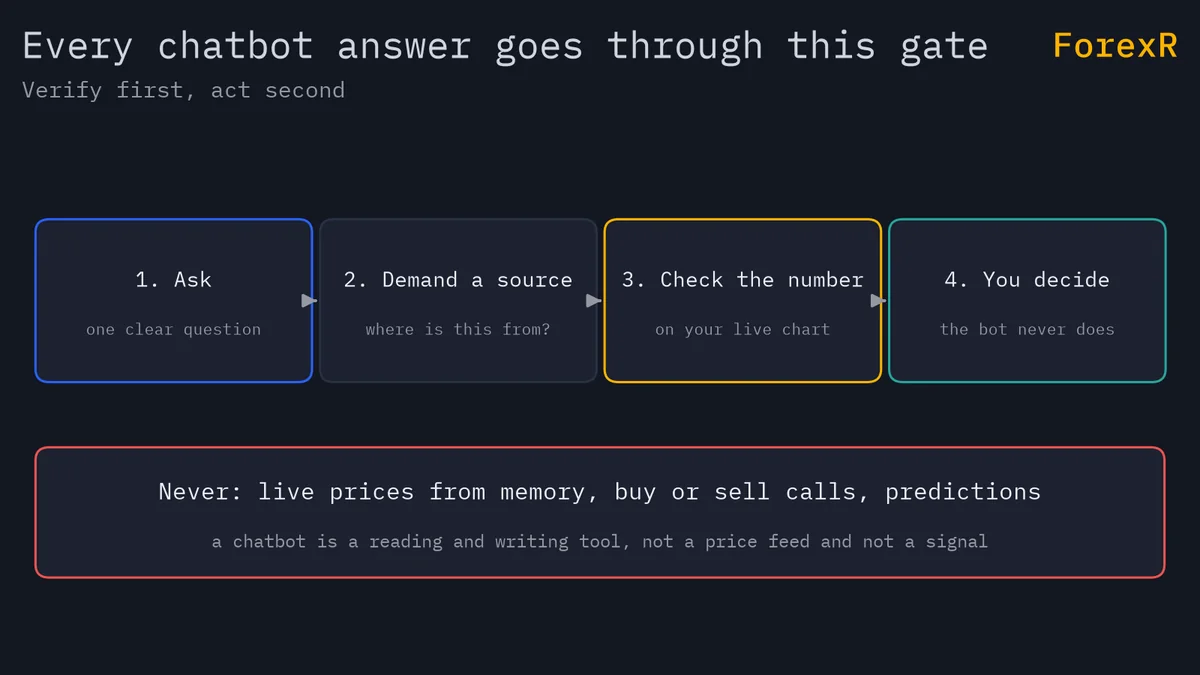
Five habits turn a risky tool into a useful one:
- Ask for the source. Then open the source. If the chatbot cannot name one, or names one that does not exist, treat the whole answer as a guess.
- Check every number. Prices against a live chart, dates against the calendar, quotes against the original document. Numbers are where hallucination hurts most.
- Ask twice, differently. Rephrase the question in a fresh conversation. Two confident answers that contradict each other expose a guess you would otherwise have trusted.
- Share nothing sensitive. No passwords, no account numbers, no API keys with trading permissions. Assume anything typed into a chat may be stored somewhere.
- Decide outside the chat. Write your own view first, then ask the chatbot to attack it. If the chatbot originates the trade idea, you have outsourced the one job that must stay yours.
What a Chatbot Cannot Tell You
Some questions sit beyond a chatbot however well you prompt it. It cannot tell you where price goes next, because nothing can. It cannot tell you whether your strategy makes money, because only testing it on data can answer that. And it cannot tell you which broker is trustworthy this month, because registers, licences and terms keep changing after its training ends; compare regulated brokers on live information and confirm details with the regulator instead.
Above all, a chatbot cannot carry your risk. It never holds the position, never sits through the losing streak, and answers just as smoothly when it is wrong. Leveraged forex and CFD trading carries a high risk of losing money, and no assistant changes that arithmetic, so verify everything, make your own decisions, and only ever risk money you can afford to lose.
FAQ
Can an AI chatbot give accurate trading signals?
No. A plain chatbot has no live prices, no view of your account and no memory of what it told the last person, so any entry or exit level it offers is guesswork dressed in confident language. If you want to evaluate signals, judge a provider’s live track record, sample size and costs, not the technology label on the marketing.
Is it safe to share my trading account details with a chatbot?
Never share passwords, account numbers or API keys that can place trades or move money. Assume anything you type may be stored and read later. If you want an assistant to see live account data, the safe route is a read-only connection through vetted tools, granted deliberately, never credentials pasted into a chat window.
Which AI chatbot is best for forex trading research?
The major general-purpose chatbots are more alike than different: all summarise and explain well, and all hallucinate and go stale in the same ways. Your verification habits matter far more than the brand. A free chatbot plus disciplined source-checking beats an expensive one trusted blindly, so pick any capable assistant and invest in the habits.
Can a chatbot write a trading robot for me?
It can draft working MQL4, MQL5 or Python code from a plain-English description, and that part is genuinely useful. But code was never the hard part. The draft may hide subtle bugs, and no chatbot can supply a profitable edge or test the strategy on real data. Treat generated code as a first draft to review and backtest before it touches money.