Physical Gold vs Gold CFDs, ETFs and Futures: 10 Ways to Own Gold

What Are the Main Ways to Buy and Trade Gold?
A 1 kg gold bar is about the size of a small smartphone, and only one of ten ways to own gold. The others range from a 916 bangle and a bank gold account to ETFs, futures, CFDs, mining shares, tokens and government gold bonds. Each gives you the metal, a claim on someone’s metal, or only the price move.
Ten routes follow, then a comparison. CFD lot and margin mechanics live in gold lot size, pip value and margin, and the question of what is permissible in is gold trading halal?.
Bars and Coins: Owning the Metal Outright
A bar or bullion coin is the simplest form: you own the gold outright. Investment bars are 999 or 9999 fine, meaning 99.9% or 99.99% pure; the kilobar, 1 kg at 999.9, is the popular investment bar in Asia. Sovereign coins such as the Krugerrand, the Maple Leaf and Malaysia’s Kijang Emas come in one troy ounce and fractions.
Costs are the premium, the amount above the spot price, and the buy-back. A dealer sells small bars a few per cent above spot, coins more, and buys back below spot, so every purchase starts behind. Storage is the risk, whether a home safe or a paid bank box. From 1933 until the end of 1974, private citizens in the United States were largely barred from owning gold bullion under Executive Order 6102, so even bars are not beyond the reach of governments.
Jewellery: 916 Gold and the Making Charge
In Malaysia, Singapore, India and much of the Gulf, jewellery is usually 22 karat, stamped 916. Karat measures purity in parts of 24, so 22 karat is 91.6% gold. You own the metal but pay for the craft: a making charge, often 5-25% of the gold value, is added and never returned, because the shop buys the piece back for its gold content only.
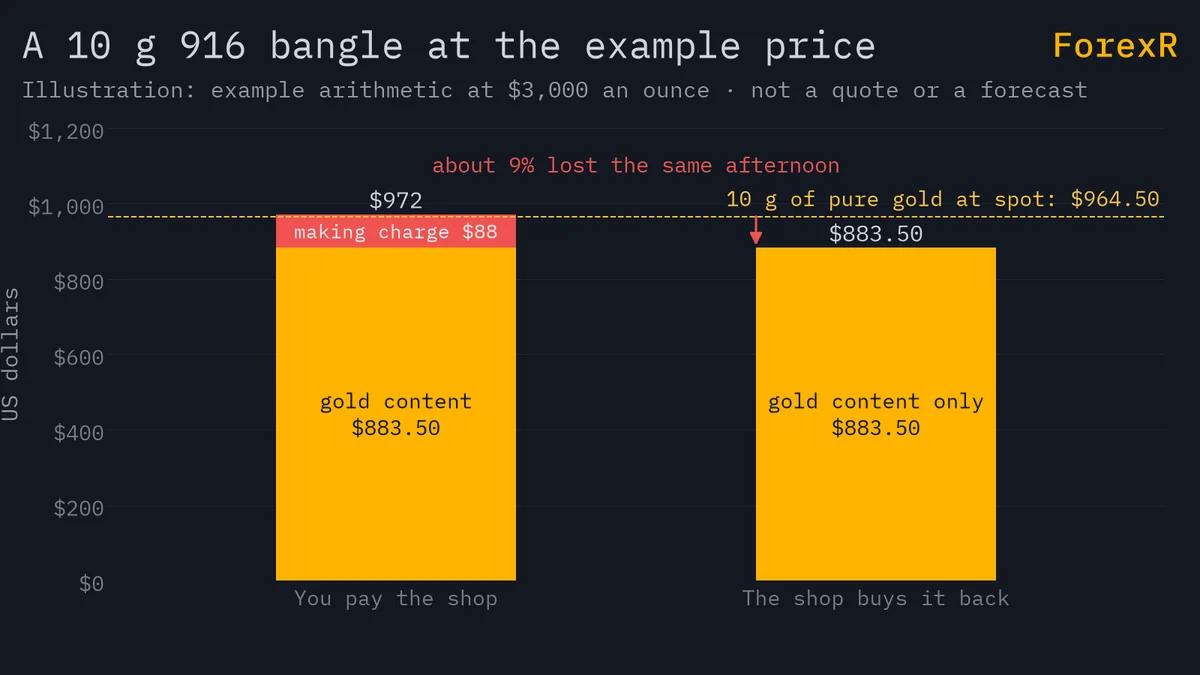
Work it through at the example price of $3,000 an ounce (an example, not a forecast). One gram of pure gold is about $96.45 and one gram of 916 about $88.35, so a 10-gram 916 bangle holds about $883.50 of gold. Add a 10% making charge, about $88, and you pay about $972. Sell it back the same afternoon and you receive about $883.50, roughly 9% less. Buying jewellery as savings is like buying a wedding dress as a way to save: you pay the tailor, and the tailoring has no resale value. Troy ounces, grams and karats covers the units and purities.
Bank and App Gold Accounts: Allocated vs Unallocated
A gold account lets you buy gold by the gram through a bank or an app and hold it as a balance. The word that matters is allocated: specific bars or coins set aside in your name. Unallocated gold means the institution owes you a quantity of gold on its own balance sheet.
Allocated is a bicycle with your name tag in a shed; unallocated is a ticket saying the shop owes you a bicycle, which is worth little if the shop closes. Islamic gold accounts add conditions from AAOIFI Shariah Standard 57 (2016): real, allocated gold, with possession passing in the same session. In Malaysia the National Fatwa Council’s 96th Muzakarah (October 2011) issued gold investment parameters covering gold accounts, and ar-rahnu, Islamic pawn, lets you borrow short-term against gold jewellery for a safekeeping fee.
A young engineer in Kuala Lumpur buys a few grams of 999 through a gold account each payday. Comparing her statement with a shop’s price board, she notices the buy-back price sits below the selling price, and that nothing says whether her grams are allocated. Her next call asks exactly that.
Gold ETFs and Government Gold Bonds: Paper Gold
An ETF, or exchange-traded fund, is a fund whose units trade on a stock exchange. A large gold ETF holds bars in a vault and each unit tracks a slice of an ounce. The first large US-listed gold ETF launched in 2004. You own fund units, not bars, pay a yearly fee, and usually cannot take delivery.
Government gold bonds are a different paper claim: a bond issued by a government whose value tracks the gold price, sometimes with a small yearly interest payment, repaid in currency rather than metal. The risk is the issuer and the lock-in, not storage.
Futures and CFDs: Trading the Price Without the Metal
Gold futures are standardised exchange contracts to buy or sell gold on a set date. On COMEX, part of CME Group, the standard contract is 100 troy ounces and the micro contract 10. They expire, so positions must be rolled. Futures usually trade a little above spot, a state called contango, reflecting interest and storage costs.
How spot, futures and CFD prices relate, and what a roll costs, is explained in gold futures vs spot vs CFDs.
A CFD, or contract for difference, is a deal with a broker that pays you the change in the spot price. It is how most retail traders trade gold, under the code XAU/USD. One standard lot is 100 troy ounces, so a $1 move is $100 per lot; at the example $3,000 price, 0.01 lot is a $3,000 position held with $30 of margin at 1:100 leverage, or 1:20 under ESMA-style retail rules. You never own gold. The costs are in gold spread and swap fees, the live price and daily levels on the XAU/USD page, and you can compare regulated brokers on their metal spreads and swaps.
Mining Shares and Gold-Backed Tokens
Mining shares give you a piece of a company, not an ounce. Miners tend to move with gold but two to three times as much, because their costs are largely fixed while their revenue is the gold price, and they carry company risk: strikes, floods, debt.
Gold-backed tokens are digital tokens whose issuer promises that each unit is backed by gold in a vault. What you own is a claim on the issuer, so the questions match an unallocated account: is the gold there, is it audited, what if the issuer fails? Lose the keys and the claim goes with them. Gold vs bitcoin compares the metal with the unbacked kind of coin.
Physical Gold vs Gold CFDs vs ETFs: Which Suits Whom?
What people get wrong is treating these as ten prices for the same thing. They are ten different contracts; each line below gives what you own, the cost, the risk and who it suits.
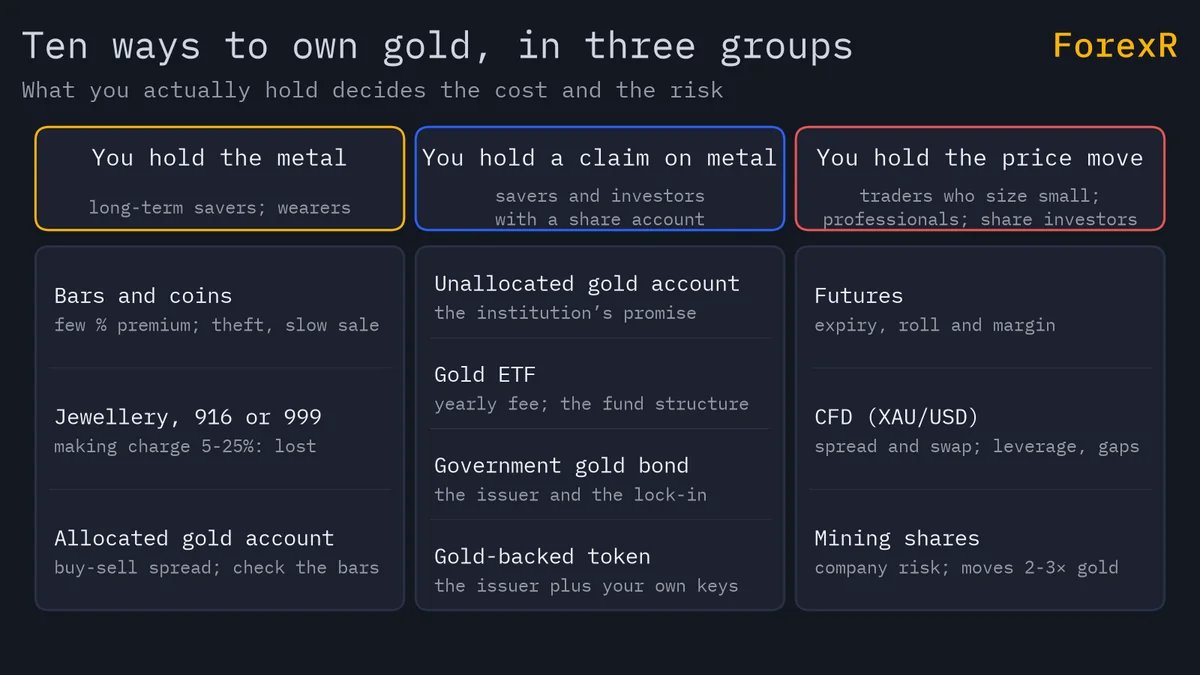
- Bars and coins: metal you hold; a few per cent premium and buy-back spread; theft and a slow sale; long-term savers.
- Jewellery: 916 or 999 metal; a 5-25% making charge lost on resale; wearers, not savers.
- Gold account: allocated is metal, unallocated is a promise; the buy-sell spread; the institution; savers who check the allocation.
- ETF: fund units backed by vaulted bars; a yearly fee; the fund structure; investors with a share account.
- Government gold bond: a state promise tracking the price; the issuer and the lock-in; patient savers.
- Futures: an exchange contract with expiry and margin; professionals and large accounts.
- CFD: a broker contract on the price move; spread and nightly swap; leverage, gaps and the broker; short-term traders who size small.
- Mining shares: company equity moving two to three times gold; the business itself; share investors.
- Token: an issuer’s claim plus your own keys; people who accept both risks.
For Muslim readers: gold above the 85-gram nisab is zakatable at 2.5% after one lunar year; zakat on gold explains which holdings count.
Try This: Price the Same 10 Grams Three Ways
On paper, price 10 grams of gold three ways. Spot: take the ounce price from the live gold page, divide by 31.1035, multiply by ten, and convert to ringgit, rupiah or rupees with the currency converter. Shop: a jeweller’s 916 or 999 gram price times ten. Account: a gold account’s selling and buy-back prices. The gaps between the numbers are the true cost of each route. If the CFD route fits you, start with how to trade gold and a demo account.
Whichever route you choose, gold can fall hard and fast: about 30% in late 2008 and about 12% in eight days in March 2020. Physical gold is bought above spot, sold back below it, and must be stored. Leveraged gold CFDs carry a high risk of loss. Put in only money you can afford to lose, and know what you own before you pay.
FAQ
Is it better to buy physical gold or trade gold CFDs?
They answer different needs. If you want to hold gold for years with no counterparty, bars, coins or an allocated account fit, and the cost is a premium plus storage. If you want to trade price moves over days or weeks, a CFD fits, and the cost is spread plus nightly swap on a leveraged position that can be lost entirely. Many people do both, in separate pots.
Is 916 gold a good investment?
As jewellery, no: the making charge of 5-25% is lost the moment you leave the shop, and buy-back pays for the 91.6% gold content only. If you want gold as savings, 999 bars or coins carry a smaller premium and are easier to resell. Buy 916 jewellery because you want to wear it, and treat its gold content as a partial refund rather than an investment.
Can I take delivery of gold from an ETF or a gold account?
Usually not from an ETF: units are settled in cash, and physical redemption is reserved for very large holders. Some gold accounts let you convert a balance into bars or coins for a conversion fee, often at set weights such as 1 gram or 1 kilobar, and only if the account is allocated. If holding metal matters to you, buy bars or coins from the start.
Do gold mining shares always go up when gold goes up?
No. Miners usually move two to three times as much as gold in either direction, but they are companies first. Rising costs, a strike, a flooded mine, heavy debt or a poor acquisition can drag a miner down while the metal rises. A mining share is a leveraged and imperfect stand-in for gold, not the same exposure, so check the company as well as the metal.