10 Gold Trading Mistakes That Empty Small Accounts Fast

Which Gold Trading Mistakes Empty Small Accounts?
A 0.10-lot gold trade moves $10 for every $1 the price moves, ten times what the same lot size earns or loses per pip on EUR/USD. Most gold trading mistakes on small accounts start there: forex habits carried onto a bigger, faster instrument. Below are the ten that do the most damage, each with the fix and the arithmetic.
- Lot sizes copied from EUR/USD.
- Pip value ignored in your own currency.
- Stops inside the daily noise.
- Swap on a long ignored.
- Weekends held without a calendar.
- Hours: the 5 p.m. break or dead Asian hours.
- News: gambling in the first minute.
- Losers added to, by hand or with a grid.
- Mixed motives: a ten-year thesis on a leveraged trade.
- Leverage: 1:500 because it is offered.
The human side (revenge trading, overconfidence, no plan) is covered in the general trading mistakes guide; this one sticks to the gold arithmetic.
Mistakes 1 and 2: Lot Sizes and Pip Value in Your Currency
Think of a lot as a fixed bag, like a kilo of rice: same bag, different contents. On EUR/USD a standard lot is 100,000 euros and a pip is worth $10. On gold it is 100 troy ounces and a $1 move is worth $100. The gold lot size guide has the full tables.
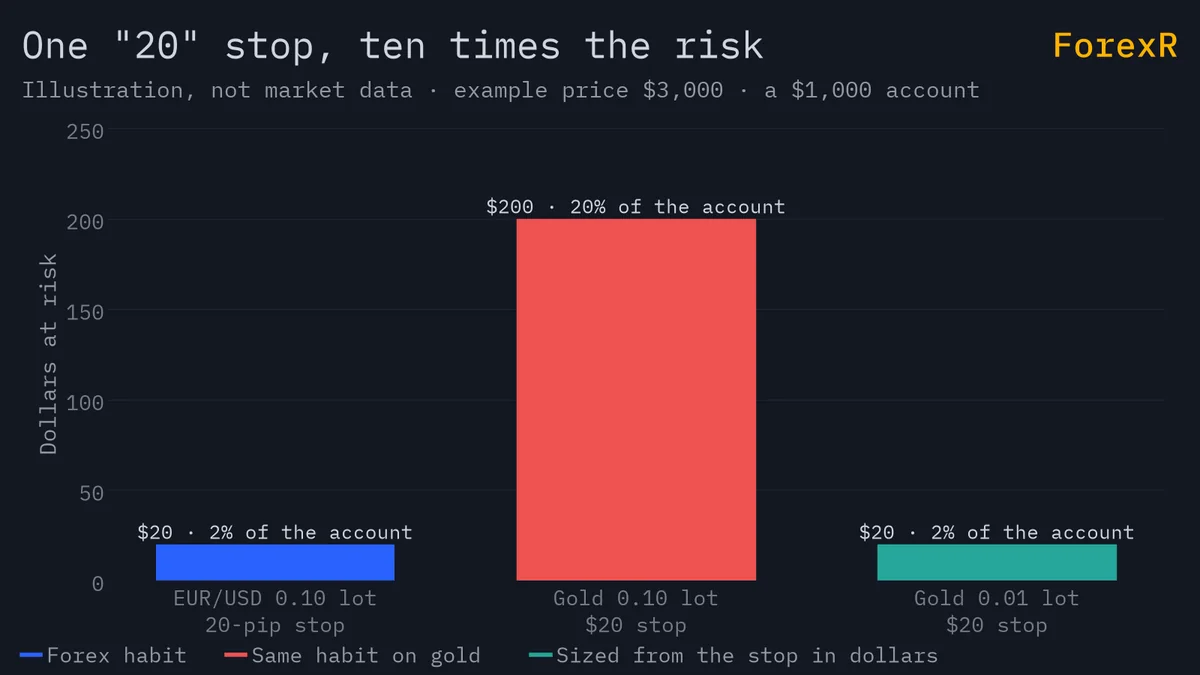
Redo this on paper. A trader used to 0.10 lot on EUR/USD, where a 20-pip stop risks $20, opens 0.10 lot on gold with a $20 stop. That stop risks $200, ten times more, 20% of a $1,000 account. The fix is to size from the stop in dollars: lots = (account × risk %) ÷ (stop in dollars × 100). For $1,000 at 1% with a $20 stop, that is $10 ÷ $2,000 = 0.005 lots, below most brokers' minimum, so either tighten the stop to $10 or accept 2% risk at 0.01 lot.
Mistake 2 hides inside mistake 1. A $1 move on 0.01 lot is $1, but your account is in ringgit, rupiah or rupees. Multiply the dollar risk by your exchange rate, or run the numbers through the position size calculator in your account currency.
Mistake 3: A Stop-Loss Inside the Daily Noise
Gold's daily range of 1-2% is ordinary, which at the example price of $3,000 (an example, not a forecast) is $30-60 a day. A $5 stop on a 4-hour trade sits inside the noise of one hour in the London-New York overlap (8 to 11 a.m. New York) and gets hit by the market breathing.
Measure the noise first. The daily ATR (the average size of a day's move over 14 days) is the ruler, and on gold it can more than double within a few months, so a stop that was sensible in a quiet spring is a coin toss by autumn. The ATR guide explains the indicator; for a day trade, use at least one ATR of your timeframe and cut the lot size until the dollar risk fits.
Mistakes 4 and 5: Swap and the Weekend Calendar
Long gold usually pays swap every night, because holding gold costs roughly the US interest rate minus a small lease rate, and one weekday charges three nights to cover the weekend. An example swap of −$40 per lot per night on a 1-lot long held ten nights, including one triple night, is 12 × $40 = $480; on 0.10 lot, $48. The gold spread and swap guide shows how the number is built.
Weekends add a second bill. Gold reacts to weekend geopolitics and opens with a gap on Sunday evening New York time (Monday morning in Asia), and a stop fills at the first available price, so a gap can cost more than the planned risk. Picture a delivery rider in Jakarta who finishes at 11 p.m. on Friday and leaves a small gold long open because it is ahead. He has not looked at the calendar, and a summit, an election and a payrolls print sit in the next 72 hours. Read the economic calendar on Friday afternoon, and hold or close on purpose.
Mistakes 6 and 7: The Daily Break, Dead Hours and the First News Minute
Gold does not trade from 5 to 6 p.m. New York (5-6 a.m. in Kuala Lumpur in US summer time, 6-7 a.m. in winter), and spreads are widest on either side. Most Asian hours are quiet too: on ForexR's own three-month sample of hourly candles, the biggest average ranges came from 8 to 11 a.m. New York. The best time to trade gold guide maps the day in local time.
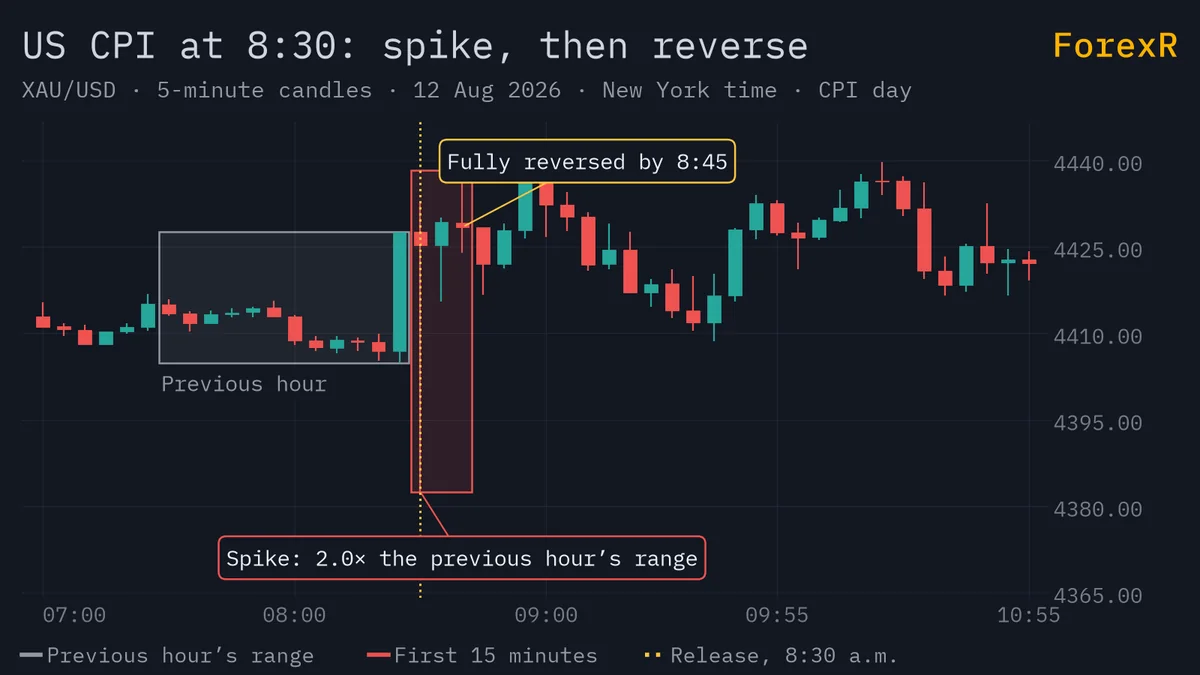
News is the opposite problem. In the first minute after CPI or payrolls at 8:30 a.m. New York, the spread widens, orders slip, and gold can move an hour's range in seconds and reverse. Entering on the first candle is guessing which way the spike breaks, not trading a view. The gold news guide explains the usual pattern (spike, retrace, then the real move).
Mistake 8: Adding to Losers and Running Grids
The belief goes: "adding lower cuts my average, so a smaller bounce gets me to break-even, so it is safer". The first half is true and the second is false. Averaging down halves the distance to break-even by doubling the size, so every further dollar against you costs twice as much, and gold trends for days when it trends.
Grids automate the same mistake at fixed spacing, and martingale doubles it. A grid that adds a doubled lot every $30 down holds 7 units after a $60 move, one ordinary day at the example price, and 31 units after $120, and the margin and swap bill grow with it. The martingale and grid guide has the full arithmetic, and the EA Library's low-risk filter hides grid and martingale robots.
Mistake 9: Mixing a Physical Thesis With a Leveraged Trade
"Gold is a safe haven, so I will hold my leveraged long through the panic." What people get wrong here is the timing. In the Covid crash gold fell about 12% in about eight trading days (9-19 March 2020) as investors sold anything to raise cash, before rallying to a record above $2,000 in August 2020. The long-term story may have been right; a 1:100 long opened two weeks earlier was stopped out long before it came true.
Keep the two ideas in two places. A long-term view belongs in physical gold, an allocated account or an unleveraged fund, where a 12% drop is uncomfortable rather than fatal. A leveraged CFD is a trade with a stop, a target and a swap bill, judged over days. Decide which one you are in before you click.
Mistake 10: Taking 1:500 Leverage Because It Is Offered
Leverage works like a car deposit: a small deposit lets you drive away, but you still owe the whole car if you crash it. At the example price of $3,000, one lot is $300,000 of gold. The margin at 1:20 is $15,000; at 1:100 it is $3,000; at 1:500 it is $600. A 2% move against you, $60, costs $6,000 per lot in every case. Leverage changed the deposit, not the damage.
The danger is what the small deposit invites. With $600 of margin per lot, a $2,000 account can open three lots, so each $1 move is $300 and a $5 move against it takes three-quarters of the account. ESMA-style rules cap retail gold at 1:20 for that reason; position size, not leverage, sets the risk. Metals leverage differs by broker, so compare gold contract terms across brokers before you fund.
Try This: A Five-Minute Fix on Paper
Take one sheet of paper and your last five gold trades, demo or live. For each, write the lot size, the stop in dollars, the dollar risk (stop × lots × 100) and that risk as a percentage of the account. Then note the daily ATR on the day of the trade from the live gold page and mark any stop smaller than half an ATR. That sheet is your first trading rule.
Gold can fall hard and fast, as March 2020 showed, and leveraged gold CFDs carry a high risk of loss: ESMA-era disclosures show 74-89% of retail CFD accounts lose money. Only risk money you can afford to lose, and fix the arithmetic before the strategy.
FAQ
Why do most gold traders lose money?
ESMA-era disclosures show 74-89% of retail CFD accounts lose money, and gold makes the usual reasons worse. It moves many dollars a day, so oversized lots and tight stops are punished faster than on a major currency pair, the long side pays swap every night, and weekend gaps can jump past a stop. Most losses come from sizing and costs, not from a wrong view of the market.
What is a good stop-loss size for gold?
Measure it against the ATR, not in pips. For a day trade many traders use at least one ATR of the timeframe they trade, and for a swing trade a share of the daily ATR, then cut the lot size until the dollar risk fits their rule. A fixed stop of a few dollars sits inside an ordinary hour's noise and gets hit by nothing more than normal movement.
Is it better to trade gold with high or low leverage?
Leverage does not change the dollar risk of a trade; the lot size and the stop distance do. What high leverage changes is how large a position a small deposit can open, which is how accounts get emptied. On a small account, leverage of 1:20 to 1:50 leaves enough margin for ordinary swings and forces you to size properly.
Can I hold a gold CFD position for weeks?
You can, but count the cost first. Long gold usually pays swap every night, with a triple charge once a week, so a multi-week hold can cost more than the spread many times over. You also carry every weekend gap. If your idea is really a long-term view on gold, an unleveraged form such as physical metal or an allocated account fits it better.