Gold Lot Size, Pip Value and Margin Explained (XAU/USD)

What Is a Lot in Gold Trading?
One standard lot of gold is 100 troy ounces, about 3.1 kg of metal, roughly three kilobars stacked in your hand. On MT4 and MT5 you never touch the bars: you trade a CFD (a contract that pays you the price change without owning gold), and the lot only sets how many dollars each price move is worth.
The order ticket offers three sizes. Our lot sizes and order types guide covers the forex version; gold uses the same ticket with a much heavier weight behind each number.
- 1.00 lot: 100 troy ounces, the standard lot.
- 0.10 lot: 10 troy ounces, often called a mini lot.
- 0.01 lot: 1 troy ounce, often called a micro lot and the smallest size most brokers allow.
New to XAU/USD altogether? The beginner’s guide to trading gold explains the symbol and what a first month should look like.
Why a $1 Move Is $100 per Lot
The maths is one line long. A lot is 100 ounces, so when gold moves $1 per ounce, a 1-lot position moves 100 × $1 = $100. Scale that down and you have the whole table.
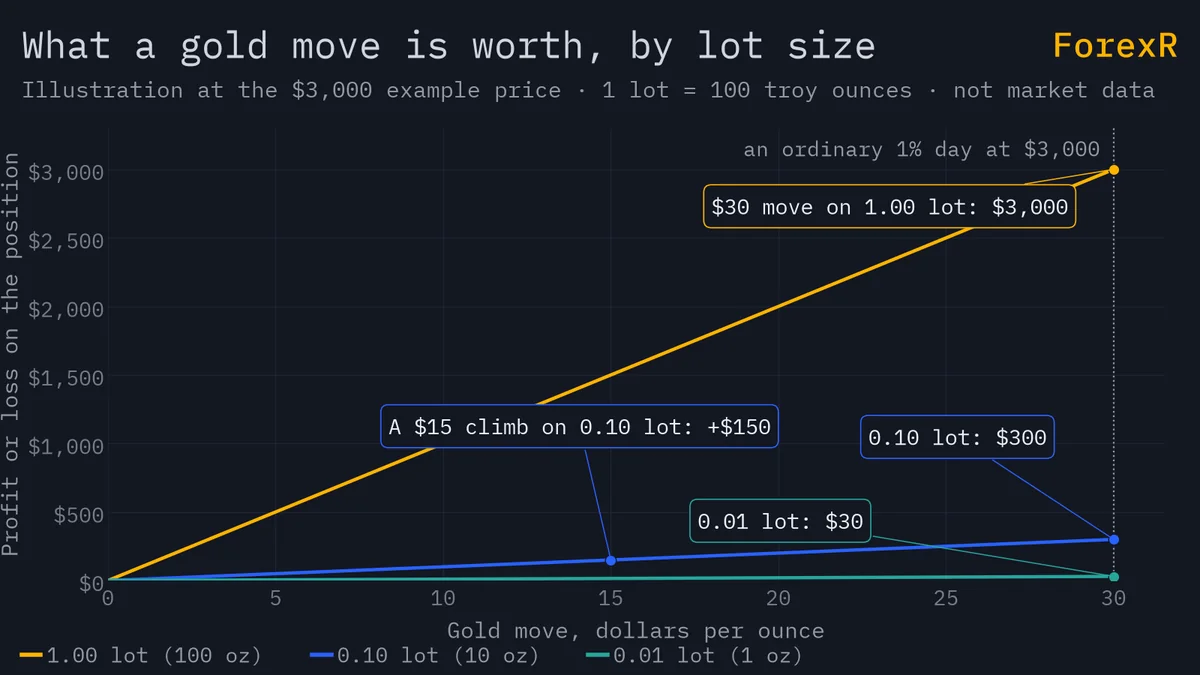
- 1.00 lot: $100 for every $1 the price moves, so $1 for every cent.
- 0.10 lot: $10 per $1 move, $0.10 per cent.
- 0.01 lot: $1 per $1 move, one cent per cent.
Put an example price on it. Say gold is at $3,000 an ounce (an example for the sums, not a forecast) and climbs $15. A 0.10-lot long gains 15 × $10 = $150, a 0.01-lot long gains $15, and a full lot gains ten times the mini lot. Now check the day’s range on the live gold page. A day where gold travels 1% from low to high, $30 at the example price, is ordinary, and that is $300 per 0.10 lot.
Points vs Pips: Why Gold Traders Talk in Dollars
Here is the trap. Brokers quote gold to two decimals, such as 3,000.25. Some call the last digit ($0.01) a point and $0.10 a pip. Others call a full $1 a pip. Two traders can say “gold moved 50 pips” and mean $5 or $50, and both are right by their own broker’s definition.
The fix is to stop counting pips on gold and count dollars per ounce, then multiply by 100 per lot. When you read a forum post or a signal that says “30-pip stop on gold”, ask “thirty what?” before you copy it. The contract specification in MT5 (right-click the symbol, choose Specification) shows the tick size and contract size and settles the argument.
How to Calculate Margin on Gold
Margin is the deposit your broker locks while a trade is open. Think of a car deposit: you hand over a slice of the price to drive the car away, but the car is worth its full price and every dent costs full price too. Margin is not the cost of the trade and it is not your risk.
Two steps give you the number:
- Notional value = lots × 100 × price. At the $3,000 example: 1 lot = $300,000, 0.10 lot = $30,000, 0.01 lot = $3,000.
- Margin = notional ÷ leverage.
So for 1 lot at the example price, margin is $15,000 at 1:20, $3,000 at 1:100 and $600 at 1:500. For 0.01 lot at 1:100 it is $30. ESMA-style rules cap retail gold leverage at 1:20, below the 1:30 for major forex pairs; many offshore brokers offer 1:100 to 1:500. Higher leverage does not change what the trade can lose. It only shrinks the deposit, which makes it easier to open a position too big for the account. Free margin and margin level are covered in the leverage and margin guide; the margin calculator gives the figure for any lot, price and leverage.
Why 0.10 Lot on Gold Is Not a Small Trade
Most people who arrive at gold from forex believe a mini lot is a mini risk. Fair enough: on EUR/USD 0.10 lot is 10,000 euros and a 20-pip move is about $20. On gold, 0.10 lot at the example price controls $30,000 of metal, and a $20 move, which gold can make in an ordinary afternoon, is $200. Same number on the ticket, ten times the swing.
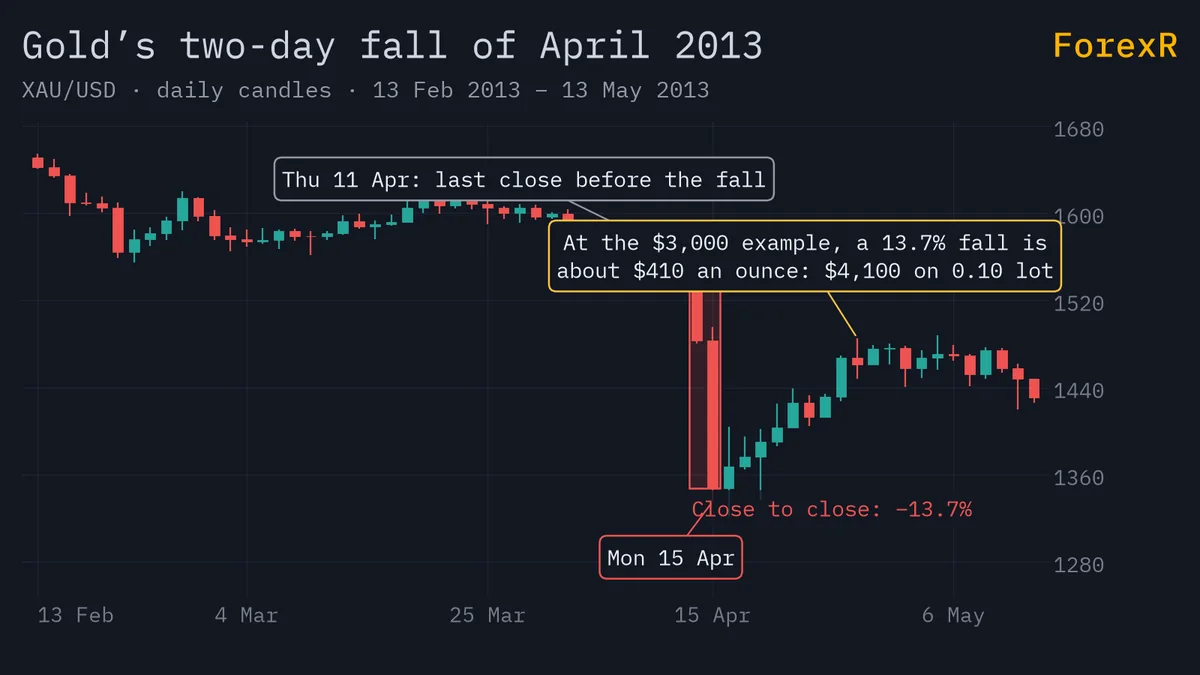
Gold’s annualised volatility has typically been about 15%, roughly double that of EUR/USD. On 12-15 April 2013 it fell about 13% in two trading days, the largest two-day drop in about 30 years. At the example price a 13% fall is $390 an ounce: $390 on 0.01 lot and $3,900 on 0.10 lot, on a “small” position opened with a $300 margin deposit at 1:100.
A nurse in Manila who trades on her days off met this on a demo account. She opened 0.10 lot of gold, her usual EUR/USD size, went to make tea, and came back to a floating loss that had moved further in ten minutes than her forex trades moved in a week. Nothing was lost but her calm, and she cut her gold size to 0.01 lot before going live.
How to Size a Gold Trade From Your Stop
Work backwards from the stop, never forwards from the margin. The rule from our position sizing guide is:
Lots = (account × risk %) ÷ (stop distance in dollars × 100)
Take a $1,000 account risking 1%, which is $10 a trade, with a stop $20 below entry. $10 ÷ ($20 × 100) = 0.005 lots. Most brokers cannot trade 0.005, so you have two honest choices: tighten the stop to $10 and trade 0.01 lot, or keep the $20 stop on 0.01 lot and accept that the risk is $20, which is 2% of the account. What you cannot do is round up to 0.01 and pretend the risk is still 1%.
Redo it with a $5,000 account: $50 ÷ $2,000 = 0.025, which rounds down to 0.02 lots. The gold price never appears in this formula, because the stop is already in dollars per ounce. Where the price does matter is the margin: at 1:20 that 0.02 lot locks $300, while 0.10 lot would lock five times as much, almost a third of the account. Run out of free margin and the broker closes trades for you, as the margin call and stop out guide explains.
Ringgit, Rupiah and Rupee Accounts: Converting the Risk
Everything above is in US dollars because gold is priced in dollars. If your account is in ringgit, rupiah or rupees, the platform converts every profit, loss and margin figure at the live exchange rate, and that rate moves too.
Keep one habit: do the risk sum in dollars, then convert once. A $20 stop on 0.01 lot is a $20 risk; put it through the currency converter to see it in your own money. Convert the balance to dollars before you use the formula, because 1% of a ringgit account is 1% of the ringgit balance. And if your currency weakens against the dollar over the months, the same $20 stop costs more in local money, and the margin your broker locks rises with it, even though gold has not moved.
Try This Before You Trade Gold Live
Open the position size calculator, select XAU/USD, and enter your real balance, 1% risk and a $20 stop. Read the lot size it returns. Halve the stop to $10 and run it again. In five minutes you will know whether your account can trade gold at 0.01 lot with a stop wide enough to breathe. If it cannot, save more or trade a slower instrument; do not shrink the stop into the noise.
Then place one 0.01-lot trade on a demo account and watch the profit column tick by $1 for every $1 the price moves. Once that feels normal, read the XAU/USD contract specs guide for the advanced picture, and compare gold spreads, minimum lots and metal leverage across brokers on our broker comparison page.
Leveraged gold CFDs carry a high risk of loss. Gold can fall hard and fast, as it did in April 2013, and a lot size that looks small on the ticket can empty a small account in an afternoon. Trade only money you can afford to lose, and size every trade from the stop, never from the margin.
FAQ
What is the minimum lot size for gold on MT4 and MT5?
At most brokers the minimum is 0.01 lot, which is one troy ounce, so a $1 move in the gold price changes your balance by $1. A few brokers set a higher minimum on metals or use a different contract size on cent accounts. The contract specification for the XAU/USD symbol shows the minimum lot, the step and the contract size.
How much money do I need to trade 0.01 lot of gold?
The margin is small: at a $3,000 example price and 1:100 leverage it is $30. Margin is not the answer, though. To risk 1% with a $20 stop on 0.01 lot you need a $2,000 account, because $20 must be 1% of the balance. With less, the same trade risks a larger share of your money, and a normal daily swing can trigger a stop out.
Does higher leverage make a gold trade riskier?
Not on its own. The dollar risk of a trade is the lot size multiplied by the stop distance, and leverage does not appear in that sum. What leverage changes is the deposit locked, and a smaller deposit tempts traders to open more lots than the account can survive. That is where 1:500 accounts fail. Regulators in Europe cap retail gold leverage at 1:20 for that reason.
Is the gold lot size the same at every broker?
Usually, but not always. Most brokers set one lot of XAU/USD at 100 troy ounces, which is the same size as the standard COMEX futures contract. Some offer smaller contracts or quote gold in other currencies. Before trading, open the symbol’s contract specification and confirm the contract size, the tick value and the currency, then base every calculation on those numbers.