Best Time to Trade Gold: Sessions, Hours and the Daily Break

When Is the Best Time to Trade Gold?
The best time to trade gold is the three hours when London and New York are both open, 8 to 11 a.m. New York time, which is 8 to 11 p.m. in Kuala Lumpur and Manila during US summer time. On ForexR’s own three-month sample of hourly candles, that window carried gold’s largest hourly ranges.
Think of a night market: open from five until midnight, but the crowd, the freshest food and the sharpest prices all arrive between seven and nine. Gold is open almost all day and has a peak too. This guide finds it on your clock and marks the dead hour you should never trade.
Gold’s 23-Hour Day and the 5 P.m. New York Break
Spot gold CFDs follow the futures clock. Trading runs from Sunday 6 p.m. to Friday 5 p.m. New York time, with a daily break from 5 to 6 p.m. New York when nothing trades and spreads are widest just before and after. That break sits in the early morning for most of Asia:
- Kuala Lumpur, Singapore, Manila (UTC+8): 5-6 a.m. in US summer time, 6-7 a.m. in US winter time.
- Jakarta, Bangkok, Hanoi (UTC+7): 4-5 a.m. summer, 5-6 a.m. winter.
- Mumbai (UTC+5:30): 2:30-3:30 a.m. summer, 3:30-4:30 a.m. winter.
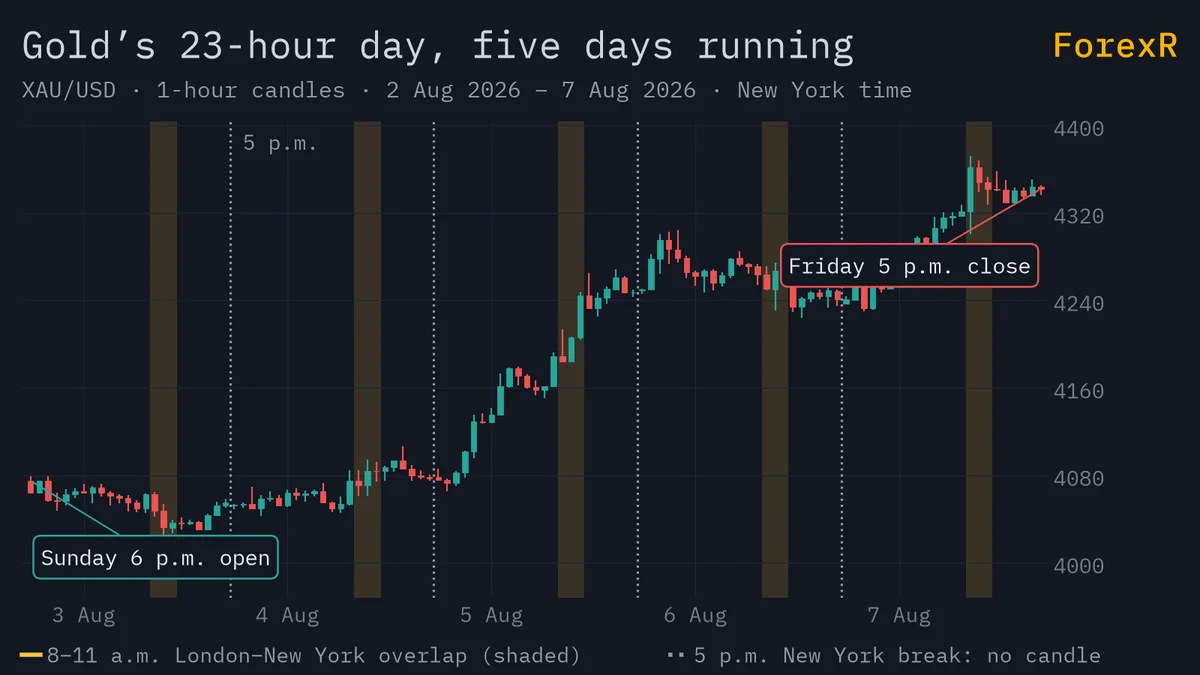
Plot the average hourly range across that 23-hour day and it is not flat. On our sample it was small through most Asian hours, lifted when London opened, peaked between 8 and 11 a.m. New York and thinned again into the break, where the 5 p.m. hour showed nothing at all. Swap is also charged at 5 p.m. New York, with a triple charge on one weekday, so the break is the moment a held position gets more expensive; the gold spread and swap guide prices that out.
Why London and New York Set the Gold Price
Gold’s price has been made in London for more than a century. The London Gold Fixing began in 1919, and its successor, the LBMA Gold Price, is still set twice a day by electronic auction at 10:30 a.m. and 3 p.m. London time, run by an independent benchmark administrator since March 2015. That afternoon auction lands inside the overlap, when New York’s COMEX futures market, home of the standard 100-ounce contract, is also at its busiest.
The 10:30 a.m. and 3 p.m. London benchmark auctions are explained in the LBMA Gold Price guide.
Two things happen in those hours and nowhere else. The largest pool of dealers, funds and futures traders is awake at once, so big orders pass without moving the price far and spreads stay tight, and the US data that moves gold most lands in the same window. The general forex trading sessions guide covers how the three sessions hand over; gold simply leans harder on the last two.
Asian Hours: Big Buyers, Thin Screens
A common belief runs like this: China and India are the two largest jewellery markets in the world, so Asian hours must be the busiest time for XAU/USD. The first half is true. The second does not follow. Jewellery buyers purchase grams from shops over months and years; they do not trade CFDs at 10 a.m. in Bangkok. The dealers who set the world price and the funds that move it work in London and New York.
Asian hours are not useless. The Shanghai Gold Exchange has run a yuan benchmark since 2016, and Asian physical demand matters over years. For a CFD trader, though, most Asian hours in our sample showed smaller hourly ranges, so a target that took one overlap hour may take an entire Asian morning. Quiet is not the same as safe: a single headline into a thin market travels further than it should.
The Overlap in Your Local Time
Eight to eleven in the morning in New York is 12:00 to 15:00 UTC in US summer time and 13:00 to 16:00 UTC in winter. The US changes its clocks in March and November, so your gold hours shift by an hour twice a year while your clock stays put.
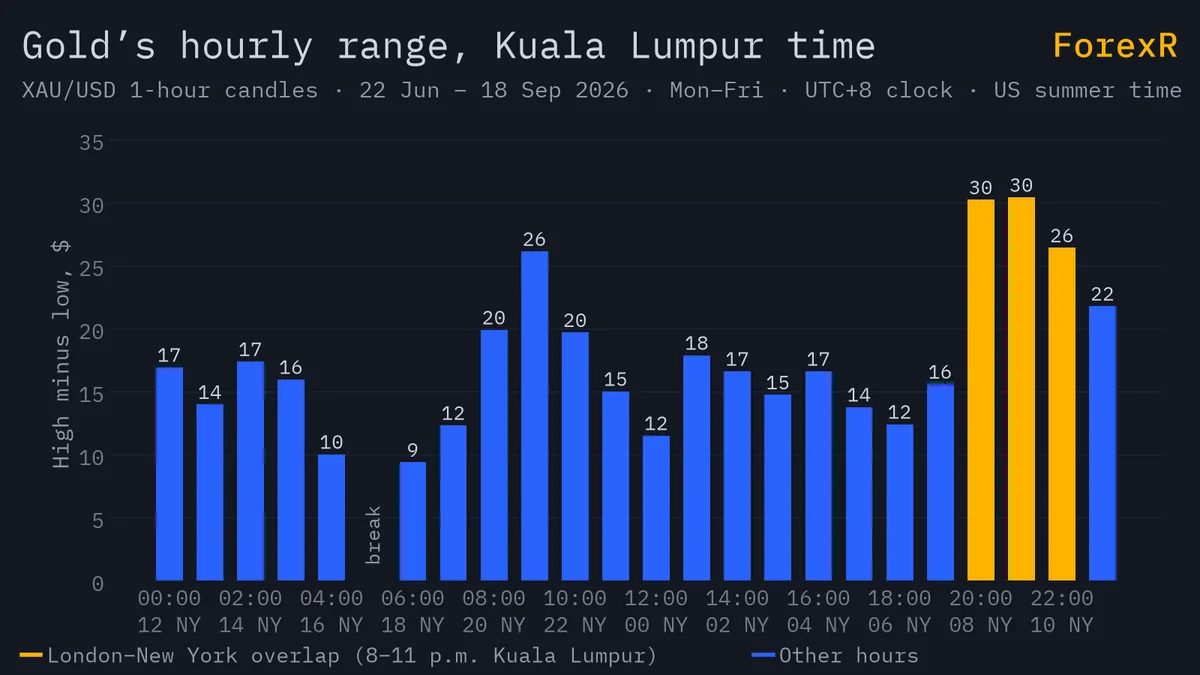
- Kuala Lumpur, Singapore, Manila: 8-11 p.m. in summer, 9 p.m. to midnight in winter.
- Jakarta, Bangkok, Hanoi: 7-10 p.m. in summer, 8-11 p.m. in winter.
- Mumbai: 5:30-8:30 p.m. in summer, 6:30-9:30 p.m. in winter.
For South-East Asian and Indian traders with a day job, that is a gift: the busiest gold hours fall after dinner. An accountant in Bangkok trades gold from about 7:30 to 10 p.m. once her children are asleep. She opens the live gold page for the pivot levels and the day’s ATR, takes at most one trade in the overlap, and flattens everything before bed, because the 1 a.m. Fed decision is not a time she wants to be awake. The market hours tool shows the sessions in your own time zone.
Which US Releases Land at Which Local Time
Gold reacts to US data because it is priced in dollars and dislikes rising yields. The big releases come at two fixed New York times:
- 8:30 a.m. New York (NFP, CPI): 12:30 UTC in summer, 13:30 UTC in winter. That is 8:30 p.m. summer / 9:30 p.m. winter in Kuala Lumpur, 7:30 / 8:30 p.m. in Jakarta, Bangkok and Hanoi, and 6 / 7 p.m. in Mumbai.
- 2 p.m. New York (FOMC decision): 18:00 UTC summer, 19:00 winter, press conference 30 minutes later. That is 2 a.m. summer / 3 a.m. winter in Kuala Lumpur, 1 / 2 a.m. in Jakarta, Bangkok and Hanoi, and 11:30 p.m. / 12:30 a.m. in Mumbai.
Once a month the People’s Bank of China also reports its reserves, including gold, usually around the 7th, and that lands in Asian hours. Mark all of these on the economic calendar before the week starts. Put the example price of $3,000 an ounce on it: a 1% day is a $30 range, ordinary for gold, and a data release can deliver a large share of that range in its first fifteen minutes. On 0.10 lot, $30 is $300. How to handle those minutes is its own subject, covered in how to trade gold during news.
Friday Close, Sunday Open and the Days Between
The week ends at 5 p.m. New York on Friday, which is Saturday morning in Asia, and opens again at 6 p.m. New York on Sunday, Monday morning in Asia. Anything that happens in between, an election, a strike on a pipeline, a bank rescue, is priced in one jump at the open. Gold gaps on weekend geopolitics more than most instruments, and a stop-loss is filled at the first available price, not at your level. Holding a leveraged gold position over the weekend is a decision, not a default.
Within the week, treat the days loosely. Monday’s Asian hours often spend the morning digesting weekend news, and Friday afternoon in New York thins out as desks close positions before the weekend. None of this is a rule you can trade on its own. The best time to trade forex guide covers the day-of-week patterns in general, and the site’s gold session briefs say what is on the calendar for each session.
Try This: Build Your Own Gold Clock
Take a piece of paper and write four times in your local time for this month: the daily break, the start and end of the London-New York overlap, the 8:30 a.m. New York data slot and the 2 p.m. Fed slot. Set a phone alarm for the start of the overlap and a second fifteen minutes before the break, then spend a week on a demo account watching the spread and candle size at each alarm. By Friday you will have a feel for gold’s day that no article can give you.
Choose the broker with the same care. Trading hours, the exact triple-swap day and how wide the spread goes at the break differ from firm to firm, and the broker comparison lets you check gold spreads and hours side by side. The advanced XAU/USD guide has the deeper numbers on hourly volatility and ATR.
Whatever hour you choose, leveraged gold CFDs carry a high risk of loss. The busiest hours are also when gold moves fastest against you, and a position held into the break, the weekend or a data release can lose more than the planned stop. Risk only money you can afford to lose.
FAQ
Can you trade gold 24 hours a day?
Almost. Spot gold CFDs trade about 23 hours a day from Sunday evening to Friday evening New York time, with a one-hour break from 5 to 6 p.m. New York every weekday. Nothing trades in that hour, and spreads are widest just before and after it. Unlike bitcoin, gold is closed over the weekend, so news that breaks then is priced at the Sunday open.
Is the gold market open on Saturday and Sunday?
No. Trading stops at 5 p.m. New York on Friday, which is Saturday morning in Asia, and restarts at 6 p.m. New York on Sunday, which is Monday morning in Asia. Physical shops and some digital gold apps may still sell over the weekend, but the world price does not update, so any weekend event shows up as a gap when trading reopens.
What time does the gold market open in Malaysia?
The week opens on Monday at 6 a.m. Kuala Lumpur time in US summer time and 7 a.m. in US winter time. Each weekday the market pauses for the New York break at 5 to 6 a.m. in summer and 6 to 7 a.m. in winter. The busiest hours are the London–New York overlap, 8 to 11 p.m. in summer and 9 p.m. to midnight in winter.
Which day of the week is best to trade gold?
There is no reliable best day. The hour of the day matters far more than the day of the week, because the London–New York overlap repeats every weekday. What changes between days is the calendar: days with a US jobs report, an inflation print or a Fed decision move gold more than others, so check the economic calendar for the week rather than trusting a day-of-week rule.