Forex Rebates and Cashback Explained: Who Pays and What You Get

What Are Forex Rebates and Cashback?
A forex rebate is a slice of your own trading cost paid back to you, usually a fixed sum per lot, by the introducing broker who referred you. The money comes out of the commission the broker already pays that introducer, so your broker’s price does not change; your net cost does. Cashback is the same thing under a friendlier name.
Think of a cashback credit card. The shop pays the card company a fee on every purchase, and the card company hands part of that fee back to you. Prices in the shop are the same whichever card you use. A rebate provider is the card company, your broker is the shop and the lots you trade are the purchases. This guide explains where the money comes from, how the sums work, where rebates are not allowed and the one habit that turns a small saving into a large loss.
Where the Rebate Money Comes From
Brokers pay to find clients. One of the oldest ways is the introducing broker, or IB: a person or company that sends traders to the broker and is paid a share of what they generate, for as long as they keep trading. The share is typically a fixed amount per lot or a fraction of the spread markup. How forex brokers make money follows that chain in full.
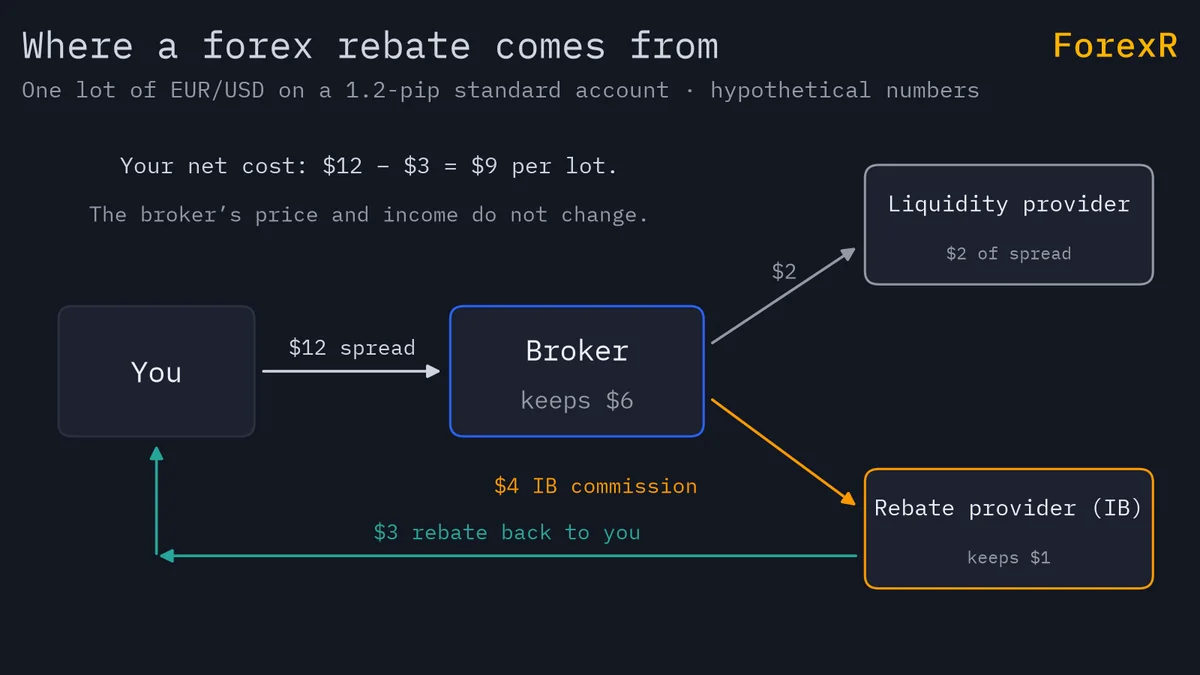
A rebate provider is an IB that competes on generosity. Instead of keeping its whole commission, it passes most of it to the trader and keeps a thin margin. On a standard account with a 1.2-pip EUR/USD spread, the broker might pay its IB $4 per standard lot; a rebate provider could return $3 of that to you and keep $1. The broker’s income is unchanged, the IB still earns, and your cost per lot falls from $12 to $9.
Three things follow. The rebate is only ever a share of what you paid in the first place, so it can reduce a cost but never create a profit. It is paid per lot, so it grows with your volume, not with your results. And somebody between you and the broker is earning from every trade you place.
How a Forex Rebate Is Calculated
Providers quote rebates in three ways, and the units hide a lot:
- Dollars per lot: the clearest form. $3 per standard lot is $0.30 per mini lot (0.10) and $0.03 per micro lot (0.01).
- Pips per lot: 0.3 pips on EUR/USD is $3 per standard lot, because a pip is worth about $10 on 100,000 units. On gold, where one lot is 100 ounces, a rebate is usually quoted in dollars per lot instead; $6 per lot is six cents of a thirty-cent spread.
- Percentage of spread or commission: “25% of the spread” sounds large, but on a raw account with a 0.2-pip spread it is $0.50 per lot. Always convert to dollars per lot for your pair before you compare.
A worked example, with example numbers you can redo on paper. You trade 0.10 lots of EUR/USD, 40 trades a month, on a 1.2-pip standard account. Spread cost: 40 × 0.10 × $12 = $48. Rebate at $3 per lot: 40 × 0.10 × $3 = $12. Net cost $36, a quarter off the spread. The spread cost calculator gives the first figure for any spread and lot size; the rebate is your lot count times the rate.
Rebates on Standard vs Raw-Spread Accounts
Rebates are larger on standard accounts, because the broker’s markup is larger and there is more to share. On a raw account the broker earns a commission of perhaps $7 per lot, pays the IB a smaller slice, and the rebate might be $1.50. So: standard account $12 − $3 = $9 per lot; raw account $9 − $1.50 = $7.50 per lot. In this example the raw account still wins, rebate or no rebate. The types of forex brokers guide explains the two account types; the rule here is simply to compare net cost, spread plus commission minus rebate, never the rebate on its own.
When Rebates Are Not Allowed: ESMA, FCA and ASIC Rules
Here is the fact most rebate adverts leave out. In August 2018 the European regulator ESMA restricted CFDs for retail clients: leverage limits, negative balance protection and a ban on benefits offered to encourage trading. The UK’s FCA made the rules permanent in 2019, and Australia’s ASIC brought in a similar order in 2021 that bars CFD issuers from offering inducements such as trading credits or rebates to retail clients.
In practice a retail account at a broker’s EU, UK or Australian entity usually cannot receive a per-lot rebate. The offers you see online are mostly for the same brands’ offshore entities, licensed in smaller jurisdictions, or for professional clients. The trade-off: the rebate may come packaged with weaker client-money protection and higher leverage. The offshore entity caveat in how to choose a forex broker explains what you give up. Check the regulator before the rebate, every time.
What People Get Wrong: A Rebate Cannot Rescue a Losing Strategy
The belief: “with a rebate I only need to break even on the trades, and the rebate is my profit.” It feels logical, and it is why rebate sites attract scalpers and grid-trading robots.
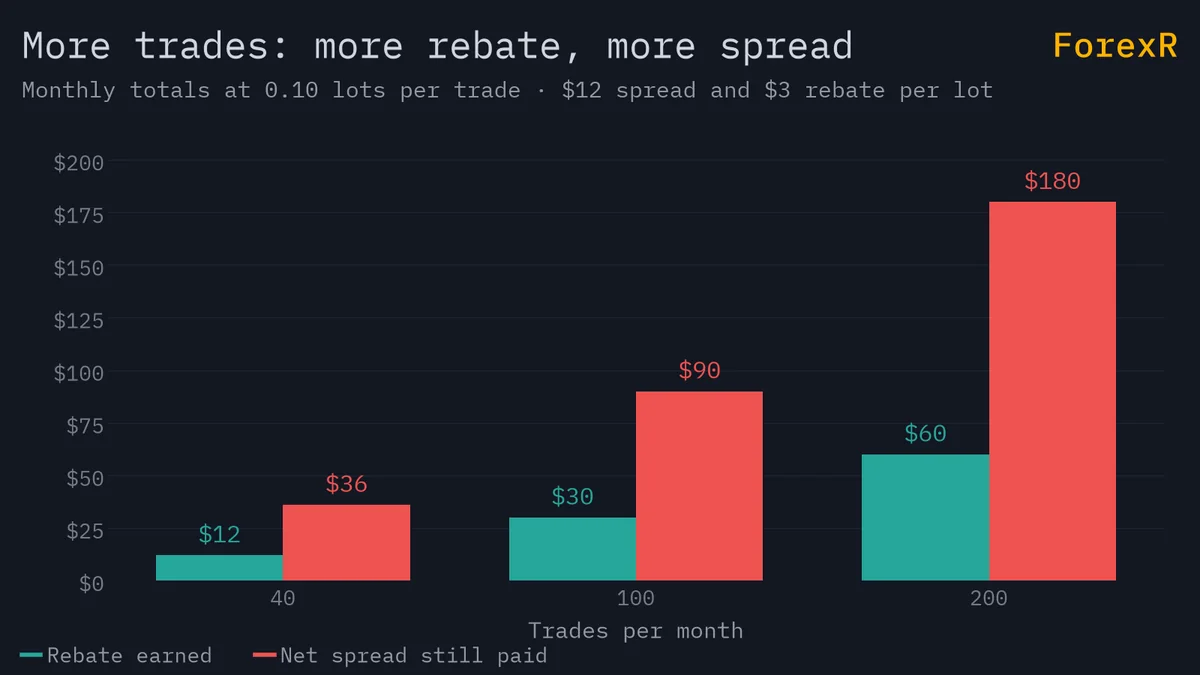
Arithmetic says otherwise. A rebate of $3 on a $12 spread leaves $9 of cost on every lot; the trade still starts 0.9 pips in the hole, and a strategy that cannot beat 0.9 pips per trade still loses, only more slowly. Worse, the trader who believes in the rebate takes more trades to earn more of it, and each extra trade pays the remaining $9. Over a month, 200 extra 0.10-lot trades earn $60 of rebate and pay $180 of net spread. Expectancy, the average result per trade after costs, is the number that decides, and is forex trading profitable shows how to work it out. A rebate is a small term in it.
The Overtrading Trap
A part-time trader in Penang checks EUR/USD after dinner and usually places two or three trades a week. After joining a rebate site, the weekly email shows what she has earned, and the number only goes up with more lots. Within a month she is trading every evening, in bigger size, and the rebate total looks good. Her account balance tells a different story, because each extra trade paid the broker three times what the rebate returned.
The provider is not cheating her. Its incentive simply points the wrong way: it earns from her volume, so every nudge it sends is a nudge to trade more. Keep the rebate out of your trading decisions entirely. Size trades from the stop-loss distance and your risk rule, never from the rebate, and let the position size calculator set the lot.
How Rebates Are Paid and Taxed
Most providers pay daily, weekly or monthly, either straight into your trading account or to an e-wallet, once a minimum balance is reached. Watch for minimum payout thresholds that small accounts never reach, rebates withheld on trades closed within a few minutes, and terms that cancel the rebate if you also take a broker bonus.
On tax, a rebate is a reduction of your trading cost or a small income, depending on where you live, and a trading loss does not make it disappear in every system. Keep the payout statements and ask a local adviser if the sums become material. How to choose a forex rebate provider turns all of this into a checklist, including the sites to avoid.
Try This: Price Your Rebate Against Your Spread
Take any rebate offer and convert it to dollars per standard lot for the pair you trade most. Now open your platform and note the spread on that pair at the time you usually trade, in dollars per lot. Divide the rebate by the spread. If the answer is 25% you are getting a quarter of your spread back; if it is 5%, the rebate is a rounding error and the broker’s regulation and execution should decide alone. To see what commission and slippage do to a system, a strategy script from our Pine Script Library on TradingView, the browser-based charting platform, lets you set both in its Strategy Tester and watch the result change.
Compare regulated brokers on the broker comparison first, then ask whether a rebate is available on that account, never the other way round. Forex and CFDs are leveraged products with a high risk of rapid loss; a rebate reduces one cost and changes none of the risk, so trade only with money you can afford to lose.
FAQ
Are forex rebates legitimate?
Many are. A legitimate rebate is simply part of the introducing broker’s commission passed back to you, and the broker can confirm the provider is its registered partner. The risks are a provider that cannot be verified, a rebate account that carries a wider spread than a direct account, or a site that asks for your trading login. Verify the broker’s licence first and the provider second.
Does a forex rebate affect my spread?
It should not, but it can. A standard rebate is paid from the broker’s existing partner commission and leaves the spread unchanged. Some partner programmes, however, let the introducer add a markup to the accounts it refers, and the rebate is then paid out of that extra cost. Compare the spread on a rebate account with a direct account at the same minute before you move.
Can I get a forex rebate on an existing account?
Sometimes. Brokers usually link an account to an introducing broker only when it is opened, so most providers ask you to open a new account under their link. Some brokers will transfer an existing account to a partner on request, often with conditions such as a period of inactivity. Ask the broker in writing before you assume either answer.
Is forex cashback taxable?
It depends on where you live. Tax authorities may treat a rebate as a reduction of your trading cost, as miscellaneous income, or ignore it below a threshold, and the treatment can differ from how your trading profits are taxed. Keep every payout statement and, if the amounts become meaningful, ask a local tax adviser rather than relying on the provider’s website.