Forex Scams: How to Spot, Avoid & Report Trading Fraud

Is forex trading a scam?
No — forex itself is a legitimate market where banks, companies, funds and individuals exchange currencies, with about $7.5 trillion changing hands every day according to the BIS 2022 survey. The scams are not in the market itself but in the layer around it: unregulated brokers, signal sellers, fake “account managers” and investment schemes that use forex as a cover story. Learn the patterns below and most of them become easy to spot.
If you are still getting to grips with the basics, start with what forex trading actually is, because understanding how the real market works is your first line of defence.
Why scams cluster around forex
Forex attracts fraudsters for simple reasons. It is global, runs online, sounds technical and really does involve leverage and fast-moving prices, so big claims seem plausible to newcomers. Anyone can put together a professional-looking website and a trading app, and money sent abroad to an unlicensed firm is very hard to get back. Scammers also exploit an honest fact: most retail traders lose money, so “let an expert do it for you” is an attractive pitch.

The most common forex scams
- Unregulated and clone brokers — an unregulated broker holds your money with no oversight, no client-money rules and no independent complaints process. A clone firm goes further: it copies the name, licence number and address of a genuine authorised firm but uses its own website, email and phone number, so your deposit goes to the fraudsters.
- Signal sellers and “account managers” — someone with screenshots of huge profits sells trade alerts, or offers to trade your account for a share of the gains. Screenshots are easily faked, demo results can be passed off as live, and many of these sellers are paid commission by a broker for every deposit or trade you make, so they earn whether you win or lose.
- Guaranteed-return and Ponzi schemes — you are promised a fixed return, such as 10% a month, from a “forex fund”. Early investors are paid with later investors’ deposits, which makes the scheme look real and encourages you to bring in friends and family. It collapses when new money slows.
- Fake robots — automated systems sold with flawless backtests. The results are often curve-fitted: the settings were tuned until they matched past data perfectly, which says nothing about the future.
- Romance and social-media lures — a friendly stranger on a dating app or in a messaging group builds trust over weeks, then casually mentions a trading platform that made them rich. The dashboard you are shown is fake: the balance grows on screen, but the numbers are simply typed in by the scammers.
- Withdrawal blocking — deposits are instant, but withdrawals never arrive. You are told to pay a “tax”, an “unlock fee” or a “verification deposit” first, or that a bonus you accepted requires an impossible amount of trading before any money can leave.
- Recovery scams — after you have lost money, a “recovery agent”, “lawyer” or fake official contacts you, promising to get it back for an upfront fee. These are often the same criminals, or people who bought your details from them.
Why “guaranteed returns” cannot be real
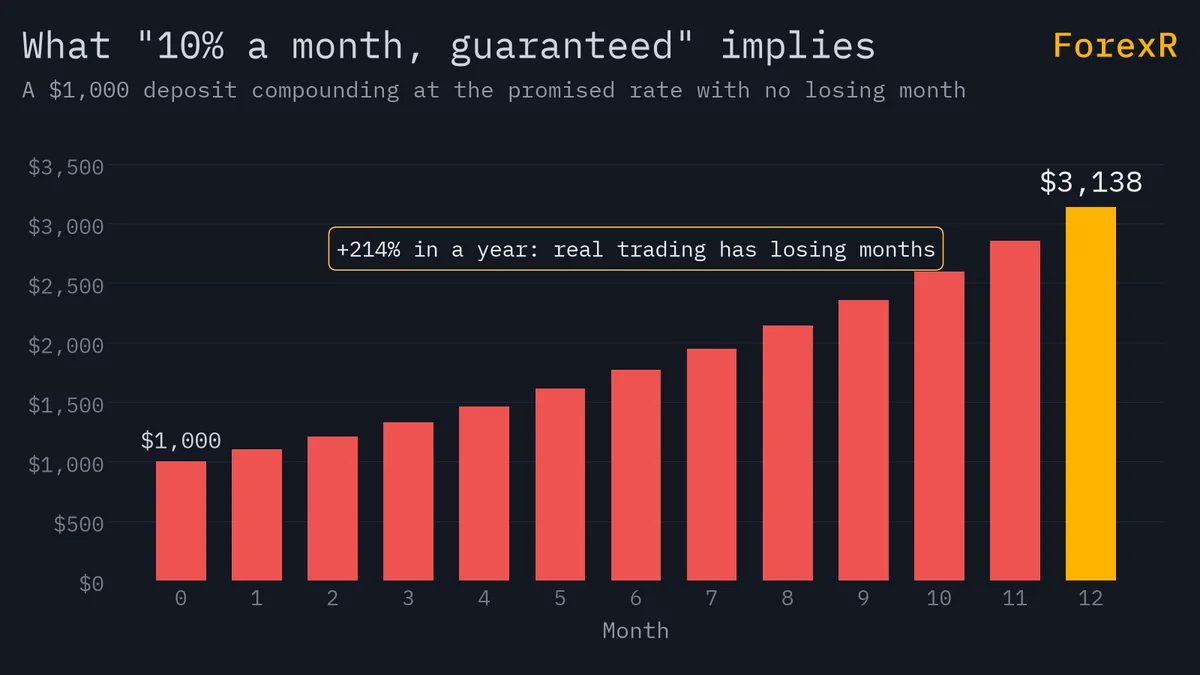
Real trading results are uneven: good months, flat months and losing months. Nobody can promise a profit in a market that moves on unpredictable news, and no properly regulated firm will. The maths is also a giveaway. A steady 10% a month compounds to about 214% a year, because 1.10 multiplied by itself 12 times is roughly 3.14. If anyone could do that reliably, they would not need your $500; large investors would be queuing to fund them.
The same scepticism applies to automated systems. A genuine strategy shows losing streaks and drawdowns, and its seller can explain how it was tested on data it was not tuned on. Our guides to forex robots and expert advisors and honest backtesting explain what real test results look like.
Red-flag checklist
Walk away if you see any of these:
- Guaranteed, fixed or “risk-free” returns, or a track record with no losing months.
- Pressure to act now: countdown timers, “last few places”, repeated calls and messages.
- The firm or person contacted you first, through social media, a dating app, a messaging group or a cold call.
- No licence number, or a licence from a regulator you cannot find or verify.
- Payment only by crypto, gift cards or transfer to a personal or unrelated company account.
- Someone asks for remote access to your computer or for your account login details.
- Large deposit bonuses with conditions attached to withdrawals.
- Extra fees or taxes demanded before a withdrawal is released.
- Lifestyle marketing — cars, beaches, cash — instead of verified results.
- Rewards for recruiting other people.
How to verify a broker on the regulator’s register
Serious financial regulators publish a free, searchable public register of the firms they authorise. Checking it takes five minutes and defeats most broker scams, provided you do it the right way:
- Type the regulator’s web address yourself. Never follow a link from the broker’s site, an email or a chat message, because fake regulator pages exist.
- Search for the licence number shown in the broker’s website footer and confirm that the firm name matches exactly.
- Match the domain and contact details. Registers commonly list the firm’s approved website, email and phone number. If the site you are using is not the one listed, assume it is a clone.
- Check which legal entity will hold your account. A group may be licensed in one country but open your account under an offshore entity with far weaker protection.
- Search the regulator’s warning list for the firm’s name as well.
Our guide on how to choose a forex broker covers regulation, client-money protection and costs in more depth, and the independent broker comparison is a sensible place to build a shortlist — but always run your own register check before depositing.
What to do if you have been scammed
- Stop sending money. No legitimate firm needs a payment to release a withdrawal. Every extra “fee” is simply more money lost.
- Document everything. Save chats, emails, website addresses, wallet addresses, bank details and transaction receipts, with dates. Take screenshots before accounts and profiles disappear.
- Contact your bank or card provider straight away. Ask whether the payment can be recalled or disputed. Time limits apply, so speed matters.
- Report it to your national financial regulator and to the police or your country’s fraud-reporting service. It may not recover your money, but it creates an official record and helps shut the operation down.
- Secure your accounts. Change passwords, remove any remote-access software and watch for identity misuse if you sent copies of your ID.
- Beware recovery agents. Genuine authorities do not cold-call victims asking for upfront fees.
Being scammed is not a sign of stupidity; these operations are run by professionals who do it all day. Tell someone you trust, because shame and secrecy are exactly what the scammers rely on.
The safer way to get started
You never need to hand money to a stranger to learn forex. Open a free demo account with a properly regulated broker, practise with virtual money and learn basic risk management before you risk a cent. When you do go live, start small, make a small test withdrawal early and keep control of your own account at all times.
Finally, remember that avoiding scams does not make trading safe. Forex and CFDs carry a high risk of loss even with an honest, regulated broker, so only ever risk money you can afford to lose.
FAQ
Is forex trading a scam or legit?
Forex trading itself is legitimate: it is the global market where currencies are exchanged, used every day by banks, businesses and investors. The scams come from unregulated brokers, fake account managers and schemes promising guaranteed returns. Using a properly regulated broker avoids most fraud, although you can still lose money through normal market risk.
How do I check if a forex broker is regulated?
Find the licence number on the broker’s website, then type the regulator’s web address into your browser yourself and search its public register. Confirm that the firm name, licence number, website domain and contact details all match. If the domain you are using is not the one listed, you may be dealing with a clone firm.
Can I get my money back after a forex scam?
Sometimes, but it is difficult and never certain. Contact your bank or card provider immediately to ask about recalling or disputing the payment, then report the fraud to your financial regulator and the police. Be very wary of anyone who contacts you offering to recover the money for an upfront fee, as this is usually a second scam.
Are forex signal groups and account managers legitimate?
Some are honest, but the field is full of fraud. Profit screenshots are easy to fake, and many sellers earn commission from a broker whenever you deposit or trade, so they gain even when you lose. Never share your login details or send money to an individual who offers to trade on your behalf.