Gold Spread, Swap Fees and Weekend Gaps: What Gold Costs

What Do Gold Spreads and Swap Fees Cost?
An example gold spread of 30 cents sounds like nothing until you multiply it by 100 ounces: $30 every time you open and close one standard lot. Swap is the second bill, charged every night you hold, and on gold the long side usually pays. Together they are the rent you pay to be in the trade.
Think of a phone contract. The spread is the one-off handset fee. Swap is the monthly line rental that keeps ticking whether or not you use the phone. New traders study the handset and never read the monthly line. This guide reads both, then adds two costs no contract mentions: weekend gaps and slippage.
How a Gold Spread Is Quoted and What It Costs per Lot
Gold is quoted to two decimals, so the spread (the gap between the buy and sell prices) is a number of cents, and because one lot is 100 ounces every cent of spread is $1 per lot:
- Cost per round trip = spread in dollars × 100 × lots.
- $0.30 spread: $30 per standard lot, $3 per 0.10 lot, $0.30 per 0.01 lot.
Set that against the example price of $3,000 an ounce (an example, not a forecast). A $0.30 spread is 0.01% of the price, 1% of an ordinary $30 daily range, and 30% of a $1 scalp target. The spread matters in proportion to how far you expect to go, which is why spreads and pips are a short-term trader’s first comparison and a swing trader’s last worry. The spread cost calculator turns any spread and lot size into dollars; the gold lot size guide explains the 100-ounce contract behind it.
Why Gold Spreads Widen at 5 P.m. New York and at News
A spread is not a fixed fee. It is the distance between the best buyer and seller at that second, and it stretches whenever one side steps away. Three moments do that to gold every week:
- The daily break: trading stops from 5 to 6 p.m. New York, and spreads are widest in the minutes before and after.
- The Sunday open: at 6 p.m. New York on Sunday, Monday morning in Asia, the market reopens on thin volume with a weekend of news to price.
- US data: in the seconds around NFP, CPI or a Fed decision, dealers pull quotes and the spread can jump to many times its normal width.
The rule: do not open or close trades at those moments unless the wider spread is in the plan, and never leave a pending order to trigger into them. Slippage, the gap between the price you asked for and the price you got, is worst at the same moments, so use limit orders and leave the first fifteen minutes of any reopen alone. The best time to trade gold guide gives the break and the data slots in your local time.
What Is Swap on Gold and Why Long Gold Usually Pays
Swap (also called rollover) is the overnight interest adjustment on a position held past 5 p.m. New York. On a currency pair it comes from the gap between two interest rates. On gold it comes from one: holding gold costs roughly the US dollar interest rate minus a small gold lease rate, the fee earned by lending gold out. Gold pays no interest to offset that, so long swap is nearly always negative, while the short side may receive a little or may also pay, depending on the broker’s mark-up.
Time, in other words, has a price on gold, and it can be a long time. Gold peaked at about $850 in January 1980 and did not beat that level in nominal terms until 2008, 28 years later. Nobody holds a CFD for 28 years, but a swing trader who keeps buying dips and holding for weeks pays rent through every one of those nights. The general mechanics are in forex swap fees explained; the rest of this guide is gold-specific.
Triple-Swap Day and a 10-Night Holding Cost Example
Many traders repeat that swap is a rounding error next to the spread. On a two-hour trade, true. On a position held for weeks it is the other way round.
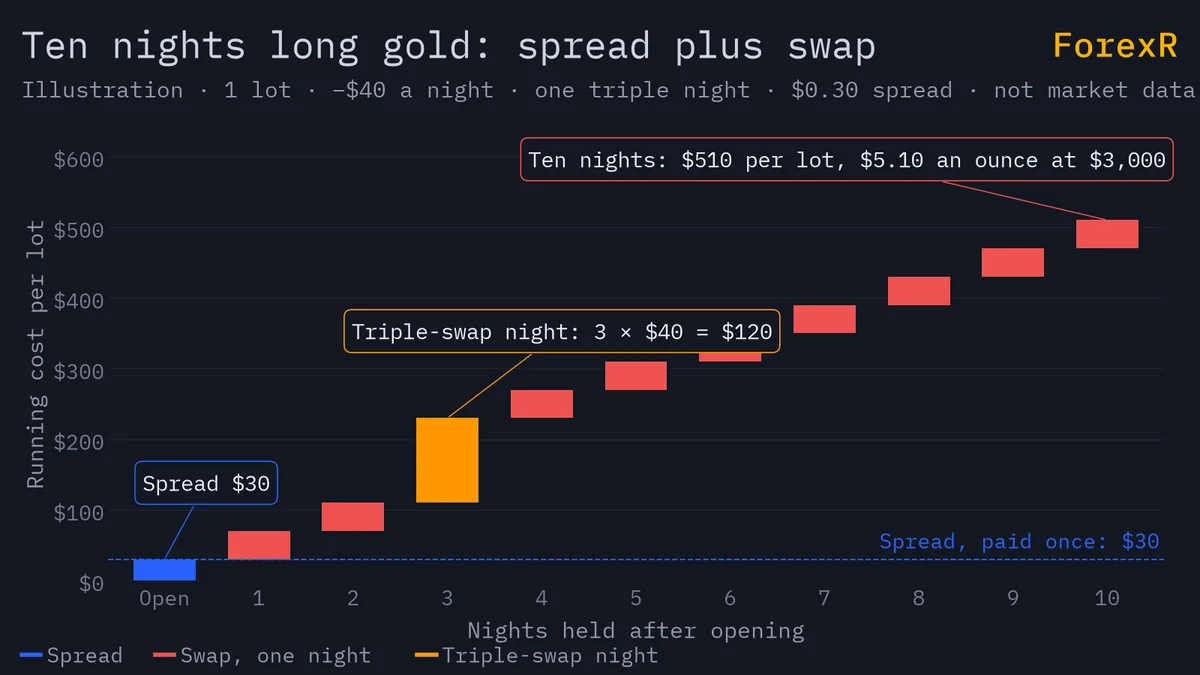
Swap is charged on weekday nights only, but the weekend still counts as two nights of financing, so one weekday carries a triple swap: Wednesday for metals at many brokers, Friday at some; the contract specification says which. Take an example swap of −$40 per lot per night on a 1-lot long held ten nights, including one triple night:
- Nights charged: 10 nights + 2 extra for the triple night = 12 charges.
- Swap total: 12 × $40 = $480 per lot, or $48 per 0.10 lot.
- Spread: $30 per lot at a $0.30 spread, or $3 per 0.10 lot.
- Total rent: $510 per lot, $51 per 0.10 lot. The swap is sixteen times the spread.
At the example price of $3,000, that $510 on one lot is $5.10 an ounce: the trade must move $5.10 in your favour just to break even. A swing trader in Ho Chi Minh City who holds gold longs for two or three weeks never looked at the swap column until a month-end statement made him. He now reads the swap-long figure and the triple day before every hold, and adds the expected swap to his target distance.
Swap-Free Accounts: What Changes and What Does Not
A swap-free (Islamic) account removes the overnight interest line. Some brokers replace it with an administration fee after a set number of days, so swap-free does not always mean cost-free: compare totals over your usual holding period. It does not change what you own, a contract rather than metal, and it does not remove leverage. The religious questions are in the is gold trading halal guide, which gives no ruling and explains what scholars and standards bodies have said.
Weekend Gaps: Why Gold Jumps on Sunday Night
Gold is what the world reaches for when a weekend headline turns ugly. A missile strike, a sanctions announcement or a bank rescue between Friday 5 p.m. and Sunday 6 p.m. New York cannot be traded until the open, so the first Sunday price can sit far above or below Friday’s close. That jump is a gap, and it goes straight through stop-losses, because a stop closes at the first available price, not at your level.
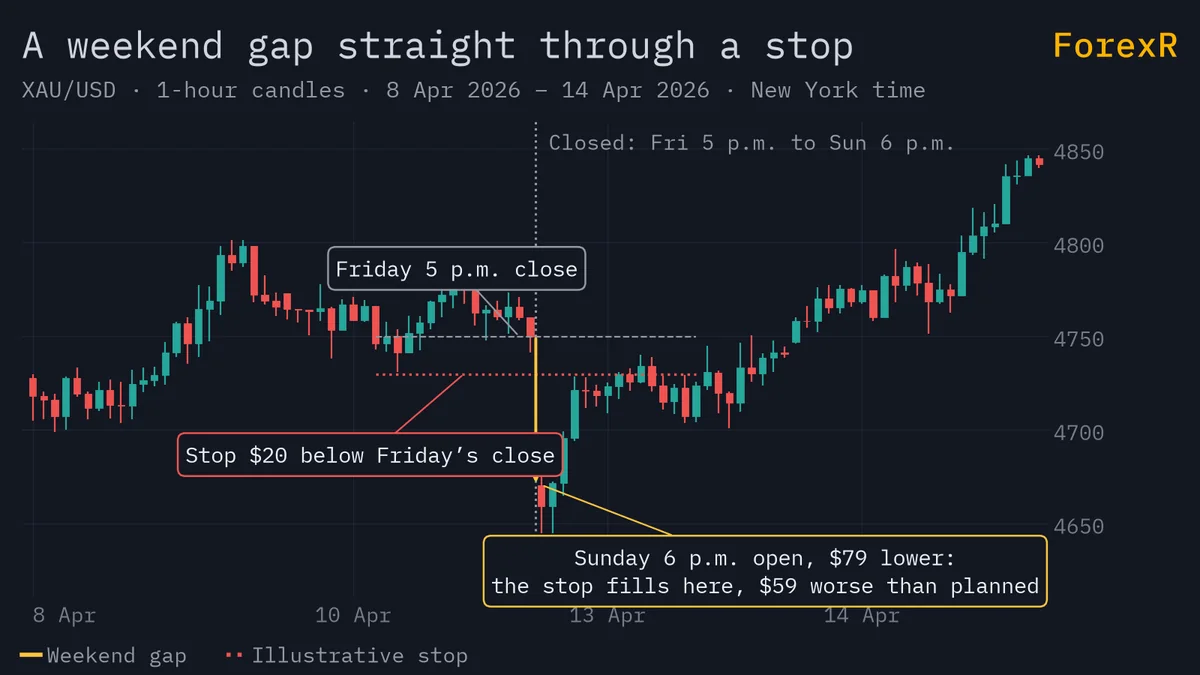
Put numbers on it. You are long 0.10 lot with a stop $20 below entry, a planned risk of $200. Gold opens $50 lower after a weekend shock, your stop fills at the open, and the loss is $500, two and a half times the plan. Negative balance protection, where offered, caps the loss at your account balance, not at your stop. Before holding through a weekend, check the economic calendar for elections, summits and central bank speeches, then close, reduce or accept the gap knowingly. And read the day’s ATR on the live gold page before placing any stop: a stop inside the normal noise gets hit, and slipped, by ordinary movement far more often than a headline reaches a sensible one.
Try This: Read Your Own Swap Line
On a demo account, open a 0.01-lot long in gold on a Tuesday evening and leave it through Wednesday’s 5 p.m. New York rollover. On Thursday morning find the swap column in the account history, compare it with the specification’s swap-long number, and note whether Wednesday was the triple day. Then run the same 0.01 lot through the spread cost calculator with your broker’s typical gold spread. In five minutes you will know what a night of gold costs.
Spreads, swap and the triple-swap day vary widely between brokers and matter more on gold than on any major pair. The guide to choosing a gold broker lists nine things to check, and the broker comparison puts gold spreads and swap policies side by side.
Leveraged gold CFDs carry a high risk of loss. Gold can fall hard and fast, spreads can widen without warning, a weekend gap can cost more than your stop, and nightly swap turns a patient trade into an expensive one. Risk only money you can afford to lose, and know the full rent before you pay it.
FAQ
Do you pay swap on gold every day?
You pay it for every weekday night your position is open at 5 p.m. New York time. Nothing is charged on Saturday or Sunday, but one weekday, often Wednesday for metals, carries three nights of swap to cover the weekend. A trade opened and closed inside the same trading day, before the 5 p.m. rollover, pays no swap at all.
Why is gold swap negative on both sides at some brokers?
The underlying cost of holding gold, the dollar interest rate minus the gold lease rate, means the long side pays and the short side should in theory receive. Brokers add a mark-up to both sides, and that mark-up is often larger than the small amount the short side would earn, so both longs and shorts end up paying. Compare the swap-long and swap-short figures in the contract specification.
Is a wider gold spread always a worse deal?
Not always. Some accounts show a narrow raw spread but charge a commission per lot, while others build everything into a wider spread. The fair comparison is the total round-trip cost per lot: spread in dollars times 100, plus any commission. For a trader who holds for days, swap will usually matter more than a few cents of spread either way.
Can I avoid weekend gap risk on gold?
Only by being flat before 5 p.m. New York on Friday. Once the market closes, nothing protects a position from the Sunday opening price. Guaranteed stop-losses are rare on gold and cost extra where they exist. Reducing the size you hold over the weekend, or choosing a broker with negative balance protection, limits the damage but does not remove the gap itself.