Total Trading Cost Explained: EUR/USD vs Gold After Rebates

What Is the Total Cost of a Trade?
The total cost of a trade is everything you pay to be in it: spread, commission, swap for each night held and slippage on the way in and out, minus any rebate paid back. One lot of EUR/USD on a standard account might cost $12 to open and close; one lot of gold held for ten nights can cost over $500. Both are “one lot”.
In one line: total cost = spread + commission + swap + slippage − rebate. Each term is in money, not pips, because EUR/USD and gold use different units and only dollars put them side by side. The five steps below build the sum, then a worked example prices the same two trades on both markets.
Step 1: Spread in Money, Not Pips
On EUR/USD a pip is 0.0001 and is worth about $10 per standard lot, so a 1.2-pip spread is $12 per lot per round trip. On gold, quoted in dollars and cents per ounce, one lot is 100 ounces, so every cent of spread is $1 per lot: a $0.30 spread is $30. In dollars, gold’s spread is two and a half times EUR/USD’s in this example, and the ratio changes with the hour. Measure both at the time you trade; spreads and pips shows how to read them and the spread cost calculator converts any spread and lot size into money.
Step 2: Add the Commission
Raw-spread accounts charge a commission per lot in place of most of the markup. Typical examples: 0.2 pips plus $7 per lot on EUR/USD, $9 all-in; a $0.20 spread plus $6 per lot on gold, $26 all-in. Commission is quoted per side at some brokers and per round trip at others. Make sure you know which, and double the per-side figure before adding it.
Step 3: Swap for Every Night You Hold
Swap is the overnight financing charge or credit, and it is the term that separates the two markets most. On EUR/USD the long side might pay an example $5 per lot per night. On gold the long side usually pays far more, an example $40 per lot per night, because gold earns no interest while the dollars used to buy it do. One weekday carries three nights of swap to cover the weekend, so a ten-night hold typically pays twelve nights. Swap fees explained and gold spread and swap fees show where to read the exact rates in MT4 and MT5.
Step 4: Slippage, the Cost Nobody Quotes
Slippage is the gap between the price you clicked and the price you got. In a quiet London morning it is close to zero on EUR/USD. In the first minute after US data, or across the 5 p.m. New York break on gold, it can be several pips or several dollars, in either direction. It appears on no price list, so estimate it from your own statement: compare requested and filled prices over twenty trades and average the difference. For a swing trader it is noise; for a news trader or a scalper it can exceed the spread.
Step 5: Subtract the Rebate
A rebate is a share of the broker’s income returned to you by the introducing broker who referred you, usually a fixed sum per lot. In this example: $3 per lot on the EUR/USD standard account, $6 per lot on gold, and about half that on raw accounts. It reduces the cost but never removes it, and it is paid on volume, so it tempts you to add trades that each cost more than they return. Forex rebates and cashback explained covers the detail and the trap.
Worked Example: One Lot of EUR/USD vs One Lot of Gold
Two trades, both 1 standard lot, both long, on standard accounts, with example numbers you can redo on paper. A two-hour trade pays no swap; a ten-night swing pays twelve nights. Slippage is left at zero to keep the sums clean.
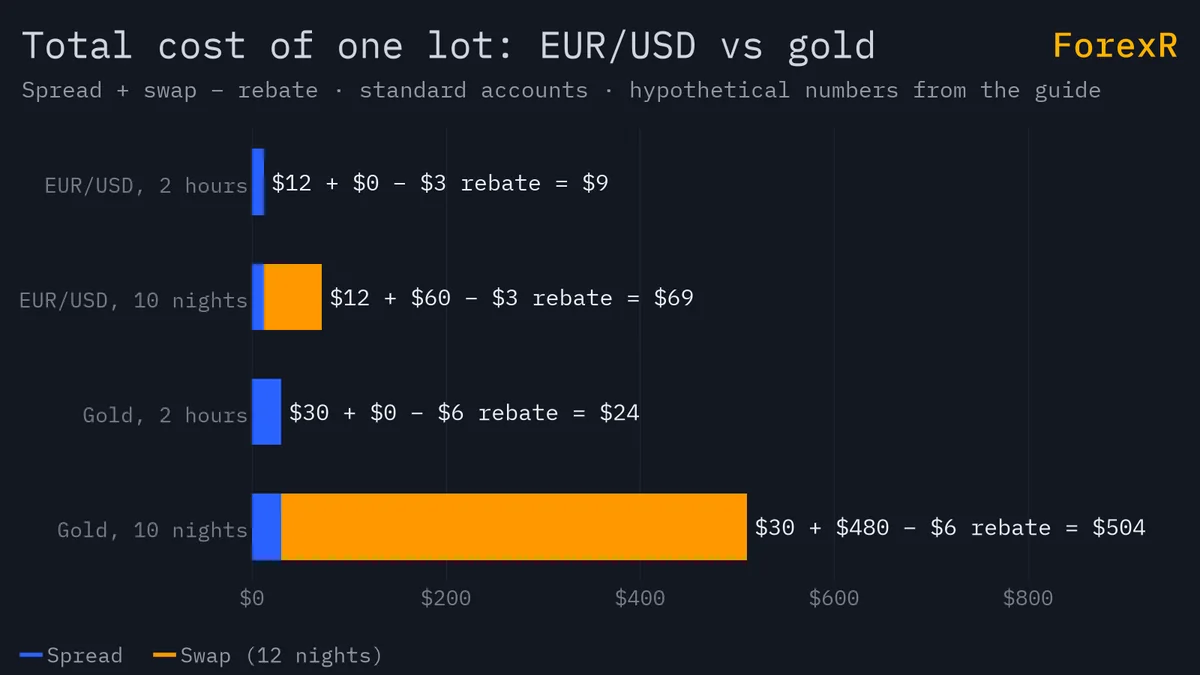
- EUR/USD, two hours: spread $12 + commission $0 + swap $0 − rebate $3 = $9.
- EUR/USD, ten nights: $12 + $0 + (12 × $5 = $60) − $3 = $69.
- Gold, two hours: spread $30 + $0 + $0 − rebate $6 = $24.
- Gold, ten nights: $30 + $0 + (12 × $40 = $480) − $6 = $504.
Gold costs just under three times as much as EUR/USD for the short trade and about seven times as much for the swing, and the swing cost on gold is more than sixteen times its own spread. The rebate is a quarter of the short EUR/USD trade’s cost and about 1% of the long gold trade’s. Whoever sells you a gold rebate is selling the smallest term in the sum.
Cost per Month for Three Trading Styles
Scale the same numbers to a month, at 0.10 lots per trade, so divide the per-lot figures by ten:
- Scalper, 200 trades, no overnight holds: EUR/USD $180 ($240 spread − $60 rebate); gold $480 ($600 − $120). The rebate is worth having; a raw account is worth more.
- Day trader, 40 trades, no overnight holds: EUR/USD $36; gold $96.
- Swing trader, 8 trades held ten nights: EUR/USD $55 ($9.60 spread + $48 swap − $2.40 rebate); gold $403 ($24 + $384 − $4.80).
Read the pattern. The scalper’s bill is all spread, so spread, commission and rebate decide the broker. The swing trader’s bill is nearly all swap, so the swap rate and a swap-free option decide it. The forex scalping guide takes the first case further and swing trading forex takes the second.
What People Get Wrong: Gold Is Too Expensive to Trade
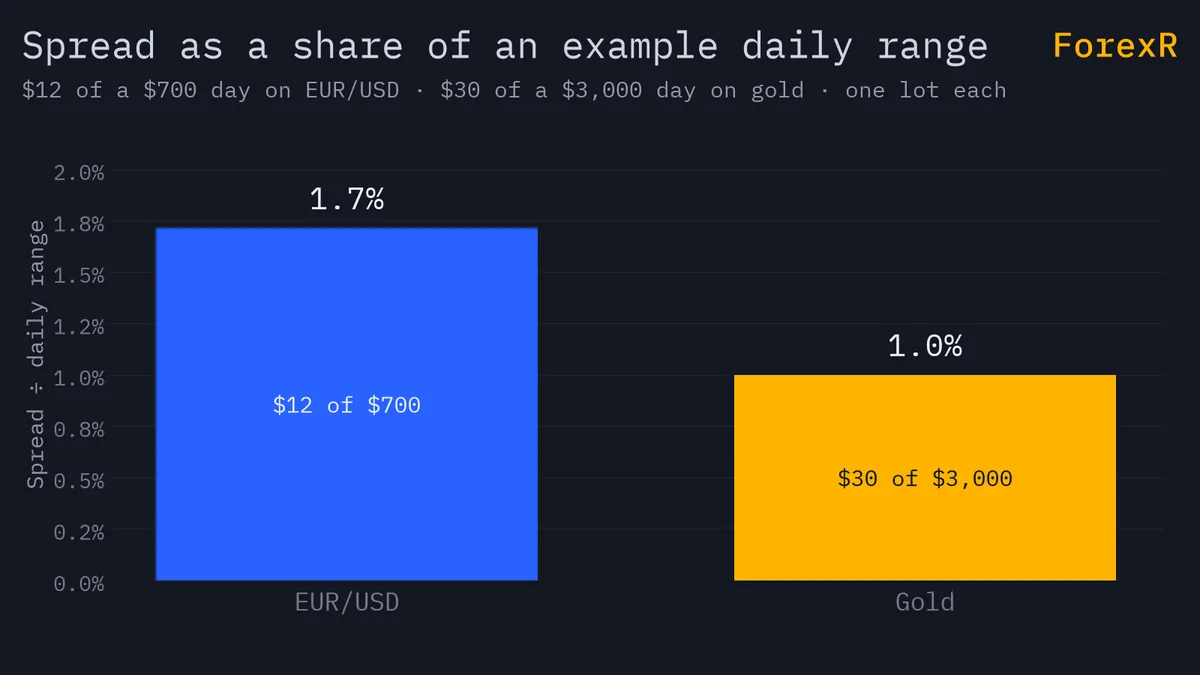
Gold’s $30 spread looks greedy next to EUR/USD’s $12, and the belief that gold is “expensive” is common. Set each cost against how far the market moves and it reverses. On an example 70-pip day on EUR/USD, one lot moves $700, so the $12 spread is 1.7% of the day’s range. On an example $30 day on gold, one lot moves $3,000, so the $30 spread is 1% of the range. For a short trade, gold is the cheaper market relative to its movement; for a ten-night hold, the swap makes it the dearer one. Neither “gold is expensive” nor “gold is cheap” is true without the holding period. To see a market’s typical range on a chart, TradingView, the browser-based charting platform, has free average daily range scripts in our Pine Script Library.
A day trader in Ho Chi Minh City who moved from EUR/USD to gold because “it moves more” found her monthly costs quadrupled while her trade count stayed the same. The move itself was not wrong. Pricing it before the switch, rather than after, would have changed her lot size on day one.
Try This: Price Your Last Ten Trades
Export the last ten closed trades from your platform, demo or live. For each one, write down the spread at entry in dollars for your lot size, any commission, the swap column and the rebate if you receive one. Add them up, then set the total against the gross profit or loss of those ten trades. If costs were larger than your gross result, your edge is being eaten before it reaches you, and the fix is fewer, longer trades or a cheaper account rather than a new indicator. Watch the live spread on EUR/USD and gold at your usual trading hour before deciding which market to concentrate on, and compare the all-in cost of regulated brokers on the broker comparison.
Leveraged forex and gold CFDs carry a high risk of losing money quickly, and every term in this guide is a cost you pay whether the trade wins or loses. Keep costs small, keep trades few, and only risk money you can afford to lose.
FAQ
Is it cheaper to trade gold or EUR/USD?
In dollars per lot, EUR/USD is cheaper: an example $12 spread against $30 on gold, and far lower swap. Relative to how far each market moves in a day, gold’s spread is often the smaller share. For short trades the two are closer than they look; for trades held overnight, gold’s swap makes it clearly the more expensive market in most conditions.
How do I calculate my cost per trade in forex?
Convert the spread to money: spread in pips times pip value for your lot size, where a pip is about $10 per standard lot on EUR/USD. Add any commission for the round trip and the swap for each night held, including the triple-swap day. Estimate slippage from your statement, then subtract any rebate. The result is your all-in cost for that trade.
Why is swap so much higher on gold than on EUR/USD?
Swap reflects the gap between the interest earned on what you hold and what you borrowed. Gold earns nothing, so a long gold position pays close to the full dollar funding rate plus the broker’s margin. In a currency pair the two interest rates partly offset each other, so the net charge on EUR/USD is usually a small fraction of gold’s for the same lot size.
Does a rebate make a standard account cheaper than a raw account?
Usually not. In the example figures a standard account costs $12 per lot and returns $3, net $9; a raw account costs $9 and returns about $1.50, net $7.50. The raw account still wins. Rebates are bigger on standard accounts only because the markup being shared is bigger. Compare the net cost of both, never the rebate alone.