Gold vs Bitcoin: Which Is the Better Store of Value?

Gold vs Bitcoin: Which Is the Better Store of Value?
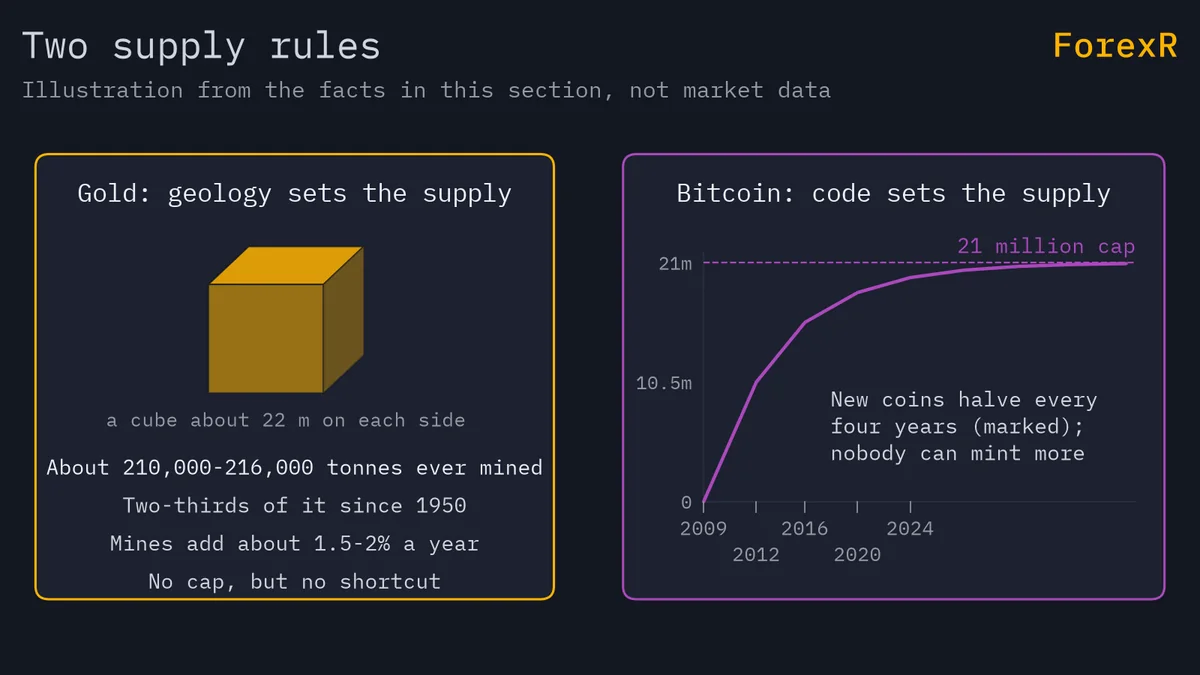
All the gold ever mined would fit in one 22-metre cube. Bitcoin is capped at 21 million coins. Both are scarce, both pay no income. For a store of value, gold has the longer record and far smaller swings: money since about 600 BC, volatility about 15% a year. Bitcoin dates from 2009 and has often moved 60-80%.
A store of value is like the money you set aside for a wedding two years away: you care less about it growing and more about it still being there, in roughly the same amount, on the day. Judged that way, the question is which asset holds its purchasing power over your horizon, not which rose more last decade. Gold lost about 70% in dollar terms from 1980 to 1999; bitcoin has had deep, fast falls throughout its short history.
Supply: A 21 Million Cap vs a Growing Cube
Bitcoin’s supply rule is written in code. There will only ever be 21 million coins, and the flow of new coins halves about every four years, as it did in 2012, 2016, 2020 and 2024. Nobody can vote to mint more.
Gold supply and demand breaks down where each year’s gold comes from and goes.
Gold’s supply rule is written in geology. All the gold ever mined is about 210,000-216,000 tonnes, and about two-thirds of it was dug up after 1950. Mines add about 3,500-3,700 tonnes a year, plus about 1,200-1,300 tonnes of recycling, which grows the above-ground stock by only about 1.5-2% a year. There is no cap, but no shortcut either: a higher price brings more mines, slowly.
Which is scarcer? Bitcoin, on paper. But scarcity alone does not make a store of value; plenty of scarce things are worthless. What matters is whether enough people will still want the thing later, a question of history and trust, not supply.
History: Lydia in 600 BC vs a Software Release in 2009
Gold coins were first used as money in Lydia, in today’s Turkey, around 600 BC. Britain put its currency on gold in 1821, and even after Richard Nixon closed the gold window in 1971 central banks kept their bars: the United States still holds about 8,100 tonnes, Germany about 3,350. Central banks have been net buyers every year since 2010, and in 2022 they bought about 1,080 tonnes, the most on record. The history of why gold has value tells the full story.
Bitcoin launched in 2009. Its record is short but genuinely new: the first scarce digital thing that can be sent anywhere without a bank. A short record is not a flaw in itself. It does mean bitcoin has not yet been tested by the conditions gold has survived: world wars, hyperinflations, deflations and confiscations, including the US restriction on private gold ownership from 1933 to 1974.
Volatility: How Far Each One Moves in a Day
Gold’s annualised volatility has typically been about 15%: roughly double EUR/USD, about half silver, and a fraction of bitcoin’s, which has often run 60-80%. A daily range of 1-2% is ordinary for gold. For bitcoin, a day like that is quiet.
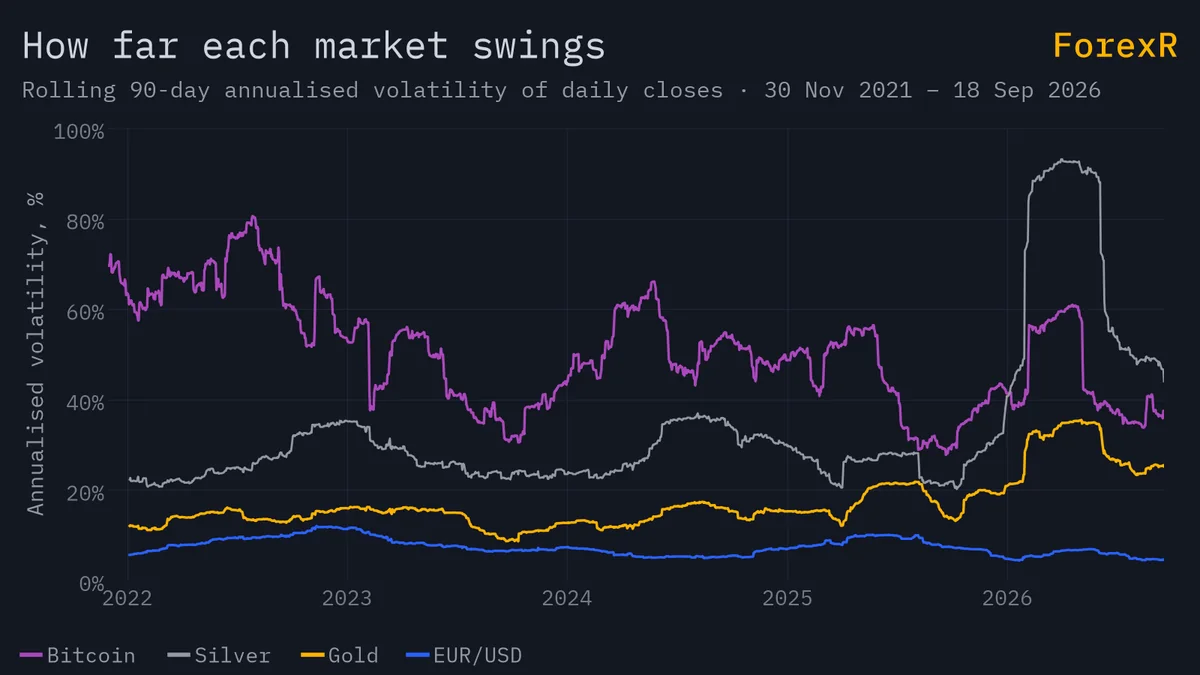
Put it in dollars at the example gold price of $3,000 an ounce (an example, not a forecast). A 1.5% day is a $45 move per ounce, or $45 on a 0.01 lot. Suppose you risk $50 per trade from a $5,000 account. On gold you can place a $25 stop and trade 0.02 lots: $50 ÷ ($25 × 100) = 0.02. If bitcoin’s ordinary day is four times gold’s in percentage terms, its stop must be four times as wide, so the position must be about a quarter of the notional to risk the same $50. The position size calculator does the arithmetic for either.
Correlation: Does Bitcoin Trade Like Gold?
What people get wrong: “bitcoin is digital gold, so it hedges the same risks.” It is understandable: both are scarce, neither is anyone’s debt. The evidence does not support it. The correlation between gold and bitcoin has been unstable and mostly near zero, and in 2022 bitcoin fell alongside technology shares while gold behaved like gold. On the days a hedge was needed most, bitcoin traded like a risk asset. The gold correlations guide covers what gold does move with; the safe-haven guide covers gold in a crash, including its fall of about 12% in March 2020.
Custody and Counterparty Risk
Owning either asset outright means holding it somewhere, and each has its own way to go wrong.
- Bitcoin: keys, not coins, are what you own. Lose the keys and the coins are gone for ever; leave them on an exchange and you carry that exchange’s risk of failure or theft.
- Gold: bars need storage and insurance and can be stolen. Gold in an unallocated bank account is a claim on the bank, not a bar with your name on it; allocated storage fixes that, at a fee.
- Both as CFDs: a CFD is a contract with your broker that pays the price change without owning the asset, so you own nothing; the risk that matters is the broker’s regulation and solvency.
The ways to own gold guide compares allocated and unallocated gold; the same logic separates self-custody from exchange custody for bitcoin.
Liquidity and Market Size
Gold’s total market value is many times bitcoin’s, and gold is held by central banks, which bitcoin mostly is not. In a crisis a large seller moves bitcoin far more than the same dollars would move gold. Against that, bitcoin trades 24/7 while gold CFDs trade 23 hours a day, five days a week. When a headline lands on a Saturday, bitcoin reprices at once; gold waits until Sunday evening New York time and opens with a jump.
What “Digital Gold” Gets Right and Wrong
Right: both are scarce, both are nobody’s debt, both pay no income, and both attract people who distrust paper money.
Wrong: the phrase implies the two behave alike, and they do not. Gold’s price is anchored by jewellery demand (about 45% of the total), central bank buying (about 20% in recent years) and industry: buyers who want the metal rather than a price. Bitcoin’s demand is almost entirely investment and speculation, which is why it moves several times as far and, so far, with risk appetite rather than fear. A phrase is not a correlation.
How a Trader Treats Each One on the Same Platform
An IT worker in Cebu holds a little of both and trades neither on weekdays. On Sunday afternoons, when gold is closed, he studies bitcoin’s weekend move and notes what he expects gold to do at the Sunday open. He sizes bitcoin at a quarter of his gold size, keeps both stops outside the day’s range, and closes bitcoin before Monday because gold opening against him is enough gap risk for one night.
His routine, as a checklist:
- Leverage: under ESMA-style rules retail leverage is capped at 1:20 on gold and 1:2 on crypto, which shows how differently regulators view the two. Offshore brokers offer more, which changes the margin locked, not the dollar risk, as the leverage and margin guide explains.
- Stops: measure each market’s ATR, its average daily range, and place stops in ATR units, not in a dollar amount copied from the other market.
- Hours: gold sleeps at the 5 p.m. New York break and over the weekend; bitcoin never does, so decide before Friday what you will carry.
- Costs: spreads and swaps differ widely between the two and between brokers; compare both on the broker comparison rather than assuming a good gold broker is a good crypto broker.
Try this in five minutes: open the live gold page and the live bitcoin page, note each one’s daily ATR and divide it by the price. The two percentages are the honest answer to “how much riskier is bitcoin today?” Write them down once a week for a month. The bitcoin trading guide and forex vs crypto cover the crypto side.
Risk, plainly: neither asset is safe. Gold can fall hard and fast, as 2008, 2013 and 2020 showed, and bitcoin can fall further and faster still. Traded as leveraged CFDs, both carry a high risk of loss, and ESMA-era disclosures show 74-89% of retail CFD accounts lose money. Only risk money you can afford to lose.
FAQ
Is bitcoin a better inflation hedge than gold?
Neither tracks last month’s inflation number closely. Gold follows real yields and inflation expectations over years, and even it fell for two decades after 1980 while prices doubled. Bitcoin’s record is too short to judge, and in 2022 it fell alongside technology shares rather than acting as a hedge. Treat both as long-horizon claims, not month-to-month hedges.
Can you trade gold and bitcoin on MT4 or MT5?
Yes, at many brokers both are offered as CFDs on the same platform, so you never own the metal or the coins. Check the contract specification for each: lot size, leverage, swap, stop level and trading hours all differ. Gold CFDs stop for an hour each day and over the weekend; bitcoin CFDs often trade through both.
Will bitcoin replace gold as a store of value?
Nobody knows, and a trader does not need to know. Central banks hold thousands of tonnes of gold and have been net buyers every year since 2010; almost none hold bitcoin. The two could coexist for decades, one as the older reserve asset and the other as a newer, more volatile alternative. Your job is sizing each one correctly, not picking the winner.
Why is gold less volatile than bitcoin?
Gold has a far larger market, a base of buyers who want the metal itself, such as jewellers and central banks, and about 2,600 years of holders who do not sell on a bad week. Bitcoin is younger, its demand is mostly investment and speculation, and its market is smaller, so the same flow of money moves the price several times as far.