Gold Scalping: Costs, Timeframes and Rules for XAU/USD

What Is Gold Scalping and What Does It Target?
A gold scalp aims for $1 to $3 and is over in minutes. At an example price of $3,000 an ounce, that is a move of at most one-tenth of one per cent, and at 0.10 lot it is worth $10 to $30 before costs. Scalping means taking many small trades and paying the spread on every one, which is the whole problem.
Gold suits scalpers for one reason: it moves. Its annualised volatility has typically been about 15%, roughly double EUR/USD's, and a 1-2% daily range is ordinary, which at the example price is $30 to $60 a day. That travel is what a scalper slices into pieces, and what turns a tight stop into a loss in seconds. The general method is in the forex scalping guide; this page covers what changes on gold.
Why the Spread Decides Everything in Gold Scalping
People say scalping is lower risk because you are never in the market for long. Stated fairly, a scalp rarely meets a weekend gap. The catch is the toll. On a $2 target the spread is not a small cost; it is the main cost, and you pay it many times a day.
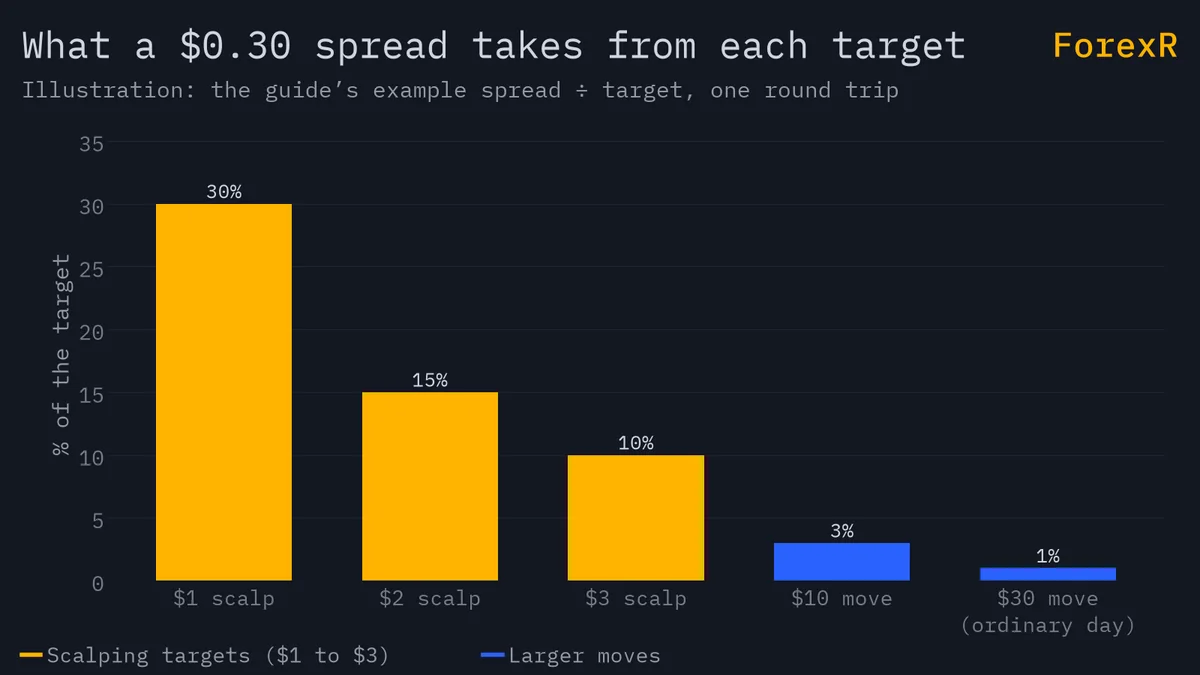
- Example spread: $0.30, which is $30 per standard lot per round trip, $3 per 0.10 lot and $0.30 per 0.01 lot.
- Example target: $2. At 0.10 lot that is $20 gross, so the spread takes 15% of every winner before the trade begins.
- Example day: 10 scalps at 0.10 lot cost $30 in spread. Over 20 trading days that is $600, on a strategy whose winners are worth $20 each.
- Add commission: a raw-spread account with a per-lot fee is often cheaper overall; only the total per round trip matters.
Scalping gold is buying rice one cup at a time from the corner shop. Each cup carries the shop's markup, and after fifty cups the markup, not the rice, is your biggest bill. Work out your own toll with the spread cost calculator; the guide to gold spreads and swap fees covers the spread's habits at the daily break and around news.
Which Account and Execution Make Gold Scalping Possible?
A scalper needs three things from a broker, and none of them is high leverage.
- A tight, stable gold spread: quoted in cents and compared per lot during the busiest hours, not the headline "from" figure.
- Market execution without requotes: a requote is the broker asking you to accept a new price, and on a $2 target one requote is the whole trade. Slippage, the gap between the price you clicked and the price you got, must be small in both directions.
- No minimum stop distance that swallows the setup: some brokers refuse a stop within a set number of cents of the market; check the contract specification.
The types of brokers guide explains why dealing-desk and raw-spread models differ at speed. Compare gold spreads, commissions and stop levels on the broker comparison before opening anything. Leverage matters less than people think: it changes the margin locked, not the dollar size of a $2 stop.
The 1-Minute and 5-Minute ATR as Your Unit
ATR (average true range) measures how far a candle usually travels. Read it on the timeframe you trade and set the stop and target as multiples of it.
- Suppose the 1-minute ATR(14) reads $0.60 and the 5-minute ATR reads $1.80 during the London-New York overlap. Both are examples.
- 5-minute stop: 1 × ATR = $1.80, rounded to $2.
- 5-minute target: 1.5 × ATR ≈ $2.70, rounded to $3.
- Sanity check: the $0.30 spread is 15% of the stop. If the spread is more than a quarter of the ATR, the timeframe is too small; move up one, or stop.
In quiet hours the 5-minute ATR can shrink to $0.60, the same $0.30 spread becomes half the stop, and no setup survives that. The ATR guide covers the settings; on gold the ATR is the only honest measure of whether a scalp is affordable in that hour.
Best Hours to Scalp Gold (And Hours to Avoid)
On ForexR's three-month sample of 1-hour candles, gold's average hourly range was largest from 8 to 11 a.m. New York time, most Asian hours were quieter, and nothing traded in the 5 p.m. New York hour. For a scalper that becomes a simple clock.
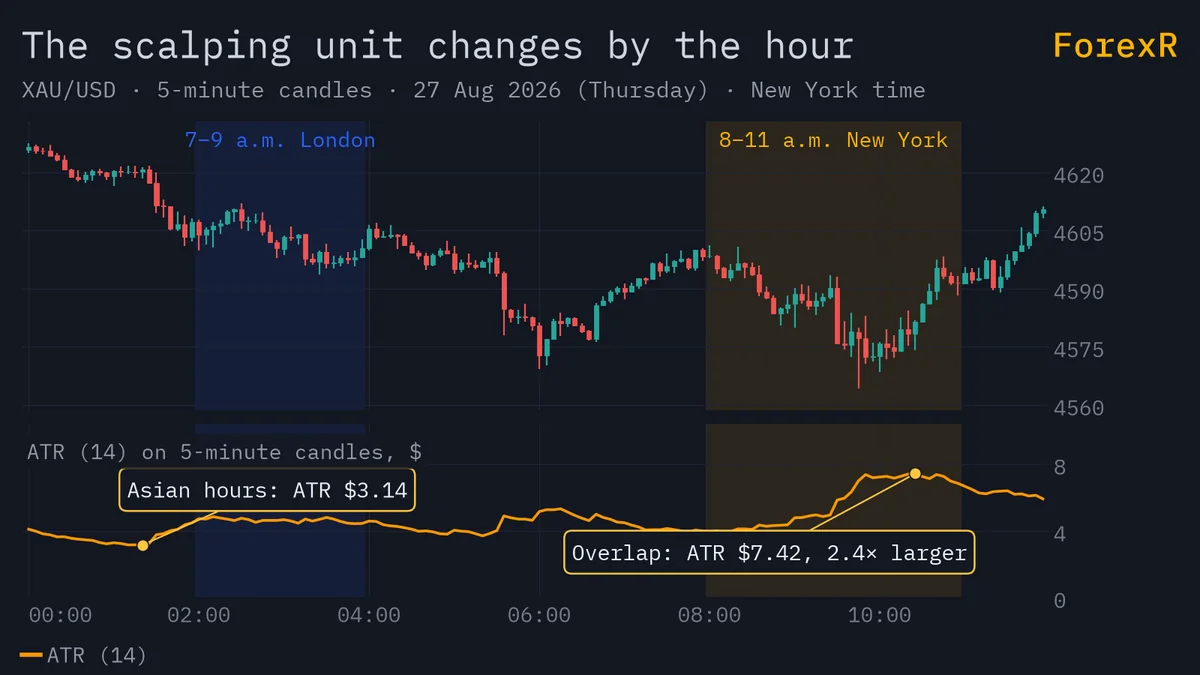
- Trade: the London open and the 8 to 11 a.m. New York overlap, which is 8 to 11 p.m. in Kuala Lumpur, Singapore and Manila in US summer time, 7 to 10 p.m. in Jakarta, Bangkok and Hanoi, and 5:30 to 8:30 p.m. in Mumbai.
- Avoid: the hour either side of the 5 p.m. New York break (5 to 6 a.m. in Kuala Lumpur in US summer), when the spread is widest and the range is dead.
- Avoid: the 15 minutes either side of NFP, CPI and the FOMC decision. Spreads jump, fills slip and a $2 stop is fiction. The gold during news guide explains the spike-and-retrace pattern.
Local session times are in the best time to trade gold guide.
A Simple 5-Minute Gold Scalping Setup to Test
A university student in Bandung scalps the London open from a laptop between lectures: 5-minute chart, one hour a day. She takes the first pullback after the open breaks the Asian high, stop one ATR, target one and a half. After two weeks she prints her statement, finds the spread column bigger than expected, and cuts her trades from eight a day to three.
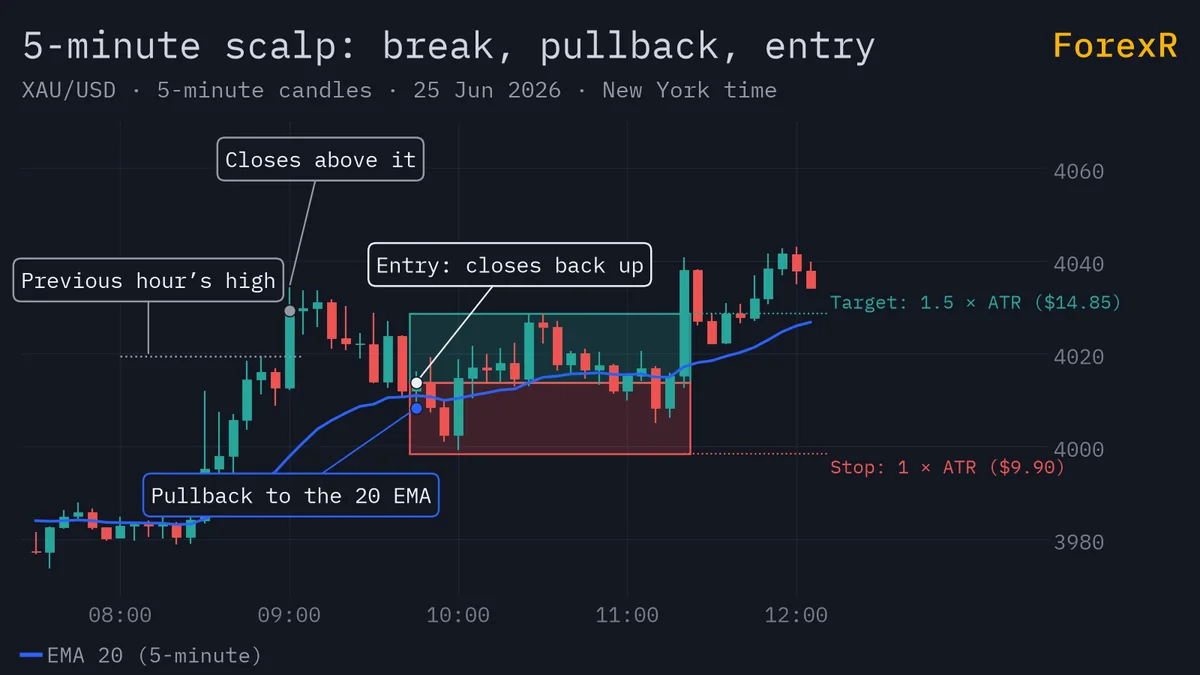
Her rules:
- Window: 7 to 9 a.m. London time, or 8 to 11 a.m. New York.
- Trigger: price breaks the previous hour's high, pulls back to the 20 EMA on the 5-minute chart and prints a candle that closes back up.
- Entry: the close of that candle. Stop: 1 × the 5-minute ATR below its low. Target: 1.5 × ATR.
- Filter: no trade if the spread is wider than a quarter of the ATR, or within 15 minutes of a red-flag release.
- Limit: three trades a day, then close the platform.
Try this in five minutes: open a demo, add ATR(14) to the 1-minute and 5-minute charts, and watch both across the 5 p.m. New York break and again at the London open. Write down the ATR and the spread at each; the numbers make the clock above obvious.
Gold Scalping Risk Rules
- Risk per trade: 0.5% or less. Twenty trades at 1% each is a 20% bad day.
- Daily stop: three losses or 2% down, whichever comes first.
- Size from the stop: lots = (account × risk) ÷ (stop in dollars × 100). A $5,000 account, 0.5% ($25) and a $2 stop gives $25 ÷ $200 = 0.125, so 0.12 lots. A $1,000 account gives $5 ÷ $200 = 0.025, so 0.02 lots.
- Hard stops always: a mental stop on gold is a $30 stop waiting to happen.
- Never hold a scalp: a scalp that becomes "a swing" carries swap, the daily break and headline risk it was never sized for.
Check the live ATR and day range on the XAU/USD rates page before a session; if the range is already unusually wide, recalculate the unit.
Why Gold Scalping EAs Fail
An EA (expert advisor) is a robot that trades MT4 or MT5 for you. Scalping EAs for gold look wonderful in backtests and then bleed live, for reasons outside the code.
- The backtest spread is fixed; the live spread widens exactly when the robot trades most, at opens and around data.
- Slippage is zero in the tester and real at 8:30 a.m. New York.
- Many are grids in disguise: a high "win rate" comes from never closing losers until the account can no longer hold them.
- Latency: a robot on home Wi-Fi is racing servers that sit next to the broker's.
The gold EA Library lists open-source gold robots from GitHub, untested and unrecommended, so read the code before you run the Strategy Tester.
Scalping gold with leverage carries a high risk of loss: a $2 stop can slip to $6 at news, the spread eats small winners, and ESMA-era disclosures show 74-89% of retail CFD accounts lose money. Gold can fall hard and fast inside a single candle. Risk only money you can afford to lose.
FAQ
How much money do I need to scalp gold?
Enough that a $2 stop at 0.01 lot ($2 of risk) is 0.5% or less of the account, which points to a few hundred dollars at the very least, and more if you want any flexibility in size. Under that, the spread and the minimum lot decide your risk for you, which is the wrong way round.
Is gold scalping profitable?
For some traders in some conditions, and for most it is not: ESMA-era disclosures show 74-89% of retail CFD accounts lose money, and scalping pays the spread more often than any other style. Whether it can work for you depends on your total cost per round trip, your execution and your discipline, not on the idea itself.
What lot size should I use to scalp gold?
Work backwards from the stop. Divide your risk per trade in dollars by the stop in dollars times 100. A $2,000 account risking 0.5% ($10) with a $2 stop gives 0.05 lots. Bigger lots feel efficient on a $2 target, but they turn a routine $5 slip at news into a serious loss.
Which timeframe is best for scalping gold?
The 5-minute chart is the practical floor for most retail accounts, because on the 1-minute chart the spread is often a large share of the ATR and the stop has no room. Use the 1-minute chart to time an entry the 5-minute chart has already set up, and never as the whole plan.