Gold as a Safe Haven: When It Works and When It Fails

What Does It Mean to Call Gold a Safe Haven?
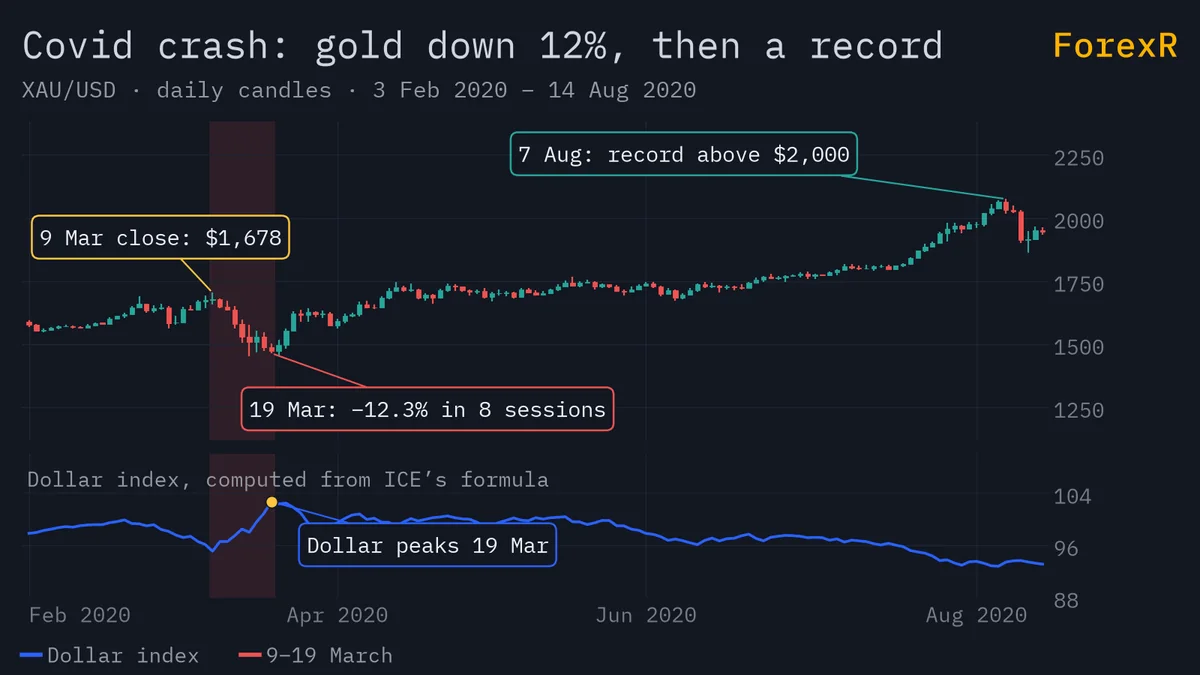
A safe haven is an asset people buy when they are afraid. Gold earns the label in slow-burning fear: wars, sanctions, currency crises. It loses it in sudden crashes, when funds sell whatever they can to raise cash. In March 2020 gold fell about 12% in about eight trading days before it rallied to a record. Both halves matter.
The label is not wrong, only incomplete, and the missing half has emptied plenty of small accounts. This guide looks at the two crashes every gold trader should know, then at when the haven holds, when it does not, and what to do when a headline hits.
What Gold Did in 2008: Down 30% Before the Rally
Gold touched about $1,000 in March 2008, its first visit to four figures. By October and November of that year it was about $700, about 30% lower, in the middle of the global financial crisis. Read that again: the safe haven fell 30% during the crisis it was supposed to protect against. Shares fell, of course, but so did the thing everyone had bought as insurance.
Then, once central banks flooded the system with liquidity, gold recovered before most other assets and went on to new records in 2009, 2010 and 2011, reaching about $1,920 in September 2011. Same crisis, two opposite chapters. The haven story is only true if you tell the second chapter as well as the first.
What Gold Did in March 2020: Down 12% in Eight Days
Twelve years later the pattern repeated, faster. Between 9 and 19 March 2020, as the Covid crash hit every market at once, gold fell about 12% in about eight trading days. Traders who had bought gold as protection watched it fall alongside shares, oil and most currencies except the dollar. Then it turned. By 7 August 2020 gold had rallied to a record above $2,000, about $2,070. If you slept through the spring, gold looked like the perfect haven. If you were leveraged in March, it looked like a trap.
Why Gold Falls First: Margin Calls and the Dash for Dollars
What people get wrong is the belief that when markets crash, gold goes up. Stated fairly, it rests on real history: gold does tend to rise while fear builds. The crash itself is different. A margin call is a broker's demand for more money when a leveraged position loses value. In a crash, funds get margin calls on everything at once and must raise cash today. They sell what they can sell, and gold is the most liquid thing they own that still has a buyer.
Think of a family that owns a car outright and suddenly faces a hospital bill. They sell the car fast, not because it lost its worth, but because it is the thing they can sell this week. Add the dash for dollars, since so much of the world's borrowing is in dollars, and you get both 2008 and March 2020: dollar up, gold down, then gold recovering first once central banks add liquidity and the margin calls stop. Gold and the US dollar explains why the two usually move apart and why they did not in those weeks.
When Gold Works as a Haven
The haven holds when the fear is slow and the plumbing of the financial system still works. Four settings stand out.
The official-sector side of that story is in central bank gold buying.
- Slow-burning geopolitics: wars and standoffs that last months lift gold steadily, because nobody is forced to sell it in a hurry.
- Sanctions: after the freezing of Russia's foreign reserves in 2022, central banks named that risk as a motive for buying gold, and they bought about 1,080 tonnes that year, the most on record. Gold held at home cannot be frozen by another government.
- Currency debasement: when your own currency weakens, gold in ringgit, rupiah or rupees rises even if the dollar price is flat, which is why savers in weak-currency countries trust it.
- Falling real yields: fear that pushes bond yields down while inflation expectations stay up is the best backdrop of all. Gold and interest rates explains why.
When Gold Fails as a Haven
Gold stops being a haven when the fear is fast, or when it is the wrong kind of fear.
- Liquidity crunches: 2008 and March 2020, as above. Everything is sold, gold included, until central banks step in.
- Rising real yields: in April 2013, with no crash anywhere, gold fell about 13% in two trading days, the largest two-day drop in about 30 years, and ended the year down about 28%. Nobody panicked; yields simply turned up.
- Inflation the Fed is fighting: if the scary thing is inflation and the central bank answers with fast hikes, real yields climb and gold can fall while prices rise.
- Priced-in fear: a crisis everyone expects is already in the price. When it arrives, the spike is often sold.
Gold vs CHF, JPY and the US Dollar
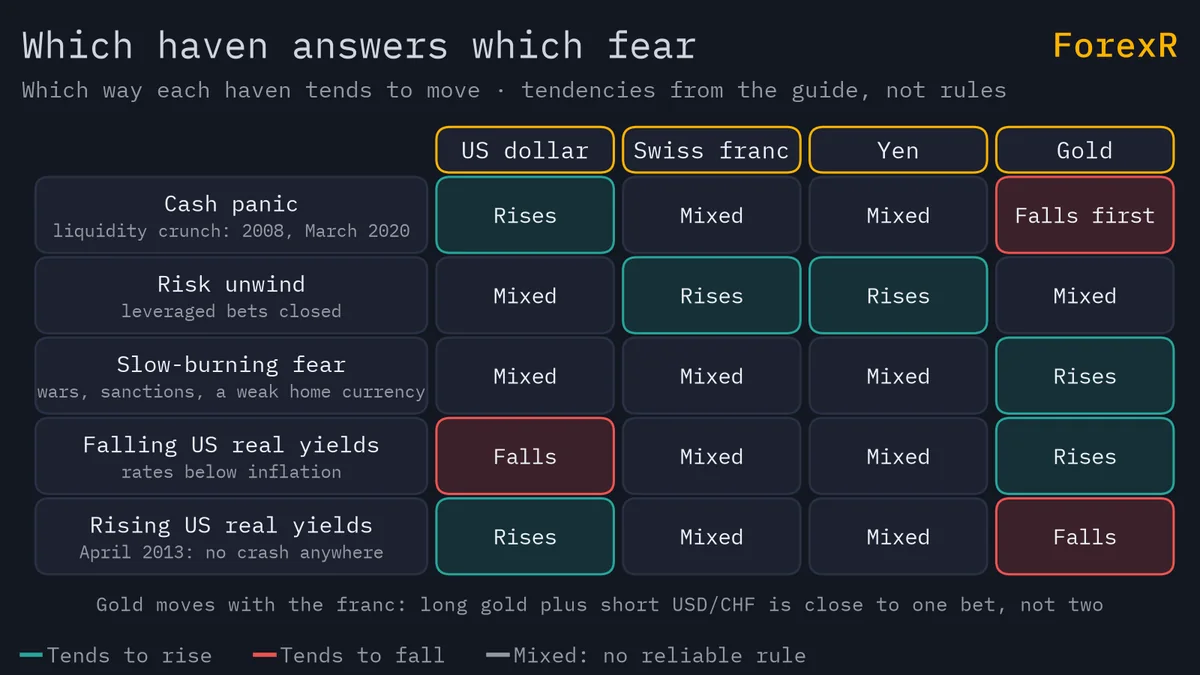
Nor is gold the only haven; it is rarely the first one bought. The US dollar wins in a cash panic because the debts are owed in dollars. The Swiss franc and the yen tend to rise when investors unwind risky positions funded in those currencies. Gold tends to move with the franc, so USD/CHF and gold usually move opposite, and it has a mixed record against the yen. Each haven answers a different fear: the dollar for a liquidity crunch, the franc and yen for a risk unwind, gold for sanctions, debasement and falling real yields. Safe-haven currencies covers the three currencies in detail. One warning: long gold plus short USD/CHF is close to one bet, not two, so count it as one position.
How to Treat a Headline Shock in Gold
A delivery rider in Bangkok saw a war headline on a Sunday afternoon and bought gold the moment the market opened at 5 a.m. his time (6 p.m. New York, during US summer time). The spread was several times its weekday width, the price gapped up, and by the London open the whole move had been given back. He was right about the news and still lost.
Put a crash in numbers. At the example price of $3,000 an ounce (an example, not a forecast), a March 2020-sized fall of 12% is $360 an ounce. On a 0.02 lot, a size many beginners call small, that is $720: about 14% of a $5,000 account and most of a $1,000 one. And it would have taken about eight trading days, with a weekend in the middle where a stop could have filled far below its level.
- Do not chase the first spike. The first fifteen minutes after a headline are wide spreads, slippage (a fill worse than the price you clicked) and reversal.
- Size for a gap, not a normal day. Gold opens with a gap on Sunday evening New York time after weekend news, and stops fill at the first available price. Gold spread and swap fees covers weekend gaps and the position size calculator turns a stop in dollars into a lot size.
- Keep the stop outside the daily ATR. The ATR (average true range, a measure of a normal day's movement) is shown on the live gold page; a stop inside it is noise, not protection.
- Know your stop-out. Margin call and stop-out explains what happens if a gap eats your margin, and negative balance protection is one of the features to look for when you compare regulated brokers.
Try This: Write Your Shock Plan
Write a three-line shock plan on a card and keep it by your screen. Line one: what I do in the first fifteen minutes after a shock headline (the honest answer is nothing). Line two: my maximum size for any position held over a weekend, in lots. Line three: my stop distance as a multiple of the daily ATR from the live gold page, never less than one. Then check the card against the next Sunday open.
Leveraged gold CFDs carry a high risk of loss; ESMA-era disclosures show 74-89% of retail CFD accounts lose money. Gold can fall hard and fast, and it has done so in the very crises it is bought to survive. Only risk money you can afford to lose.
FAQ
Is gold safer than cash during a recession?
Not in the short run. In 2008 and again in March 2020 gold fell sharply in the first weeks of the crisis while cash, especially US dollars, was what everyone wanted. Gold then recovered and set records once central banks added liquidity. Cash keeps its face value; gold can lose a tenth or more within days. Safer depends on your time frame.
Does gold go up during war?
Often at first, and not always for long. A war headline tends to lift gold within minutes, especially at the Sunday open, and slow-burning conflict with sanctions has supported it for months. But the first spike is frequently sold back, and if the conflict pushes interest-rate expectations higher, rising real yields can pull gold down. Headlines move gold; the rate response decides what lasts.
Why do central banks buy gold if it falls in crashes?
They hold it for decades, not days, so a bad month does not matter to them. Gold is nobody's liability, cannot be frozen by another government if it is held at home, and diversifies reserves away from the dollar. Central banks have been net buyers every year since 2010 and bought about 1,080 tonnes in 2022, the most on record.
Should I hold gold over the weekend when there is bad news?
Only with a size you can afford to see gapped against you. Gold reacts to weekend geopolitics and opens with a gap on Sunday evening New York time, Monday morning in Asia. A stop-loss is filled at the first available price, so a gap can cost more than the planned risk. Halve your size or close before Friday if a known event is due.