AI Market Analysis: How Machines Read the Forex Market

What Is AI Market Analysis?
AI market analysis is written market commentary produced by software instead of a person. The program reads price data, computes levels such as support and resistance, and turns those numbers into short written scenarios. It is fast, consistent and free of mood, but it has no foresight: it describes the market, it does not predict it.
How a Machine Turns Price Data Into Written Analysis
Most analysis engines follow the same four-step pipeline. First, the software pulls price history for a market: the highs, lows, opens and closes over recent days and weeks. Second, it computes numbers from that history. Typical outputs are a daily pivot (a reference level built from the previous day's prices), a ladder of support and resistance levels, and the ATR (average true range, a measure of how far price normally moves in a day). If you want to do the arithmetic by hand, our guides to pivot points and the ATR indicator show the formulas.
Third, a writing step turns the numbers into sentences. A careful engine does not predict one outcome. It describes scenarios: if price breaks above one level, the next target is another; if it drops below a third, the bullish idea is invalid. Fourth, a checking step compares the finished text with the source numbers, so the article cannot claim a level the data does not support. That last step matters most. Fluent text is now cheap to produce; text that matches its own numbers is the hard part, and it is where weak products fail.
A Worked Example: A Daily Forecast on ForexR
You can see this pipeline working in public on ForexR's analysis page, which publishes short structured articles through the trading week: daily forecasts for each market covered, session briefs for Asia, London and New York, previews and reactions around calendar events, and news pieces when a story moves prices.
A daily forecast has a fixed anatomy. It opens with a live price snapshot: the price, the day's change, the day's range and the ATR. Then comes a key levels table holding the daily pivot, three resistance levels, three support levels, the previous day's high and low, and the 20-day high and low. An annotated chart shows the same picture, and two written scenarios follow, one bullish and one bearish, each naming a trigger, a target and an invalidation level. Every article states the exact UTC time its data was taken. The articles run under named ForexR analyst bylines, but the levels are computed in code from live market data, the text is written from that data alone, and each draft is checked against the same numbers before it is published.
Why Machines Are Good at This Job
Turning price history into levels and scenarios is exactly the kind of work software does better than people, for four reasons.
- Speed. An engine can compute fresh levels for dozens of markets before a session opens, every trading day, without cutting corners on the dull ones.
- Consistency. The same method is applied the same way every time, so you can learn what its numbers mean and compare today with last month.
- No mood. Software does not fall in love with a position, chase a loss, or turn bullish because it is tired of being bearish.
- Traceability. Every claim in a well-built report can be traced back to a number in the data, which means you can check it yourself.
What AI Market Analysis Cannot Do
The same design brings hard limits, and an honest provider will state them plainly.
- No foresight. The engine describes where price has been and where levels sit now. It cannot know that a central bank will surprise the market an hour after publication.
- Only as good as its inputs. A delayed or faulty price feed produces confident nonsense in perfect grammar. Wrong numbers look exactly as tidy as right ones.
- It goes stale. Levels are indicative, and prices move after publication. A forecast written before London opens can be old news by lunchtime, which is why the data timestamp matters so much.
- No judgement. A human can pause and say a number looks odd. An engine will publish whatever passes its checks, including a well-formatted description of a feed error.
How to Check Any AI Analysis Before You Trust It
The habit that protects you is demanding method transparency from every provider, including this site. Five questions do the job.
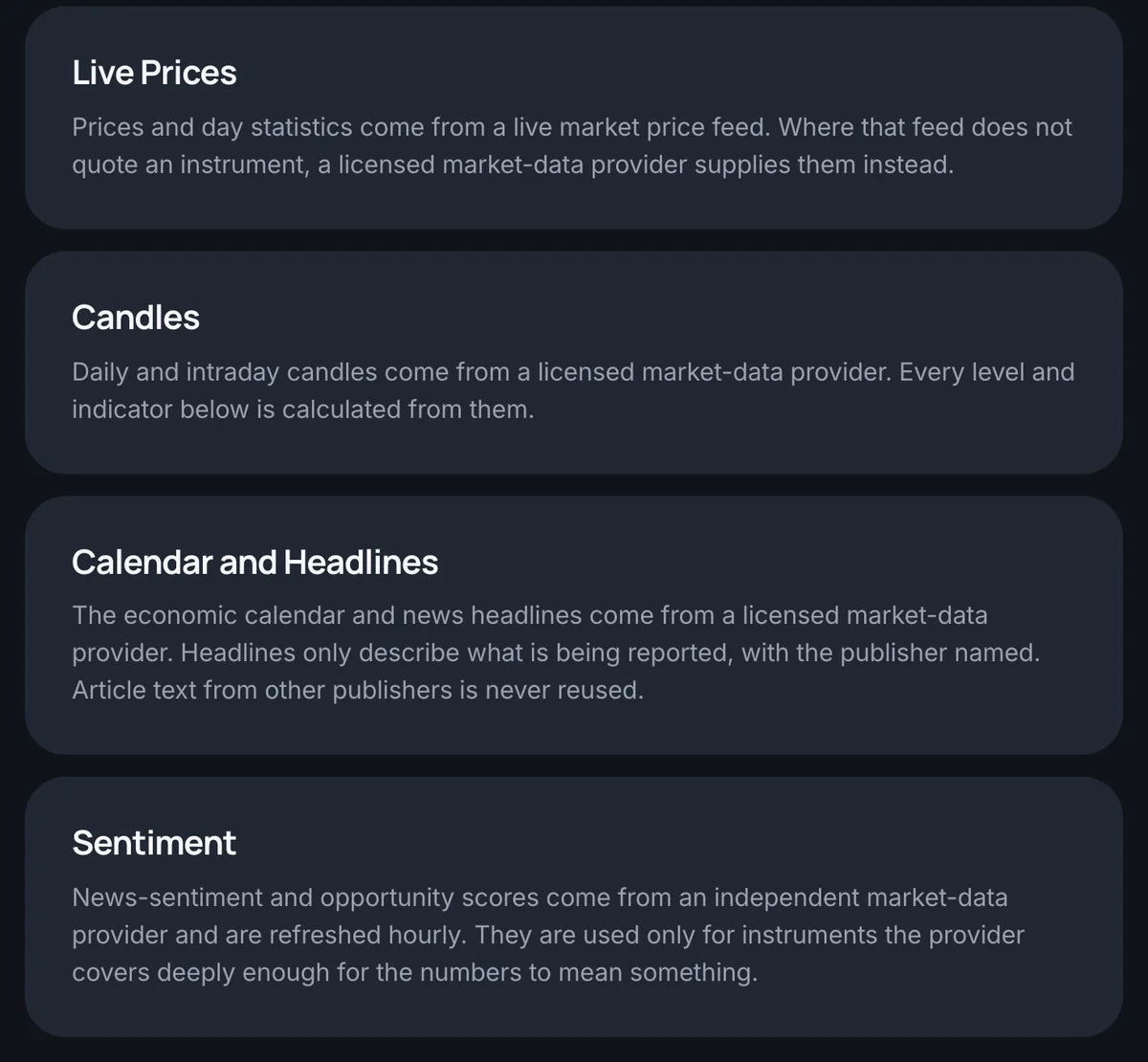
- Is the method public? ForexR documents its process on the analysis methodology page. Any serious provider should publish an equivalent. A “proprietary AI” with no detail is a marketing phrase, not a method.
- Is it timestamped? Analysis without a stated data time cannot be judged for staleness, so it cannot be judged at all.
- Is every claim a number? Levels, ranges and changes can be checked against a chart. Vague phrases about momentum building cannot.
- Does it show both sides? A bullish and a bearish scenario, each with an invalidation level, is honest about uncertainty. A single confident prediction is a red flag.
- Does it call itself advice? Honest analysis is labelled informational, not investment advice. The moment a service tells you what to trade, it has become a signal, which is a different product with different problems, covered in our guide to AI trading signals.
AI Analysis vs Human Analysis
Machines win on breadth, discipline and arithmetic. Humans win on context: a person can weigh a political story, a strange data print or a rumour that has no clean number attached to it. Human writing also carries human faults, including bias, fatigue and the urge to sound certain. The practical answer is not either-or. Use machine output for the measurable part, the levels and ranges, and use human judgement for meaning. Machines can also read the news itself at industrial scale, scoring thousands of headlines for tone; that separate craft has its own guide on AI sentiment analysis.
How to Use AI Analysis in Your Own Trading
Treat machine-written analysis as preparation, not instruction. Read it before your session, note the levels closest to the current price, and check them on your own chart. Then build your own plan: your entry, your stop, your position size. Our guide on how to use market analysis and news walks through that routine, and for the bigger question of whether an AI can simply trade for you, our AI forex trading guide gives the honest answer. Two supporting habits help. Check the economic calendar first, so a scheduled release does not blindside a level-based plan. And remember that costs decide whether a plan is worth taking: the same setup can make sense on a tight spread and fail on a wide one, so compare regulated brokers on trading costs before you commit real money.
The Risks of Relying on AI Market Analysis
AI market analysis is a description of the recent past written in the language of the future: it can compute where the levels are, but it cannot foresee news, guarantee a reaction at any level, or manage your risk for you. Leveraged forex and CFD trading carries a high risk of loss, and ESMA-era disclosures show 74-89% of retail CFD accounts lose money. Treat every forecast, human or machine, as one input to your own plan, and only ever risk money you can afford to lose.
FAQ
Is AI market analysis accurate?
Accuracy has two parts. The numbers, such as pivots and ranges, are usually exact because they are computed directly from price data. The scenarios built on them are conditional descriptions, not predictions, so they cannot be accurate or inaccurate in advance. Judge a provider on whether its numbers check out against a chart and whether its method is public.
Can I trade directly from AI market analysis?
You can, but you should not treat it as a ready-made trade. Published levels are indicative and prices move after publication, so verify each level on your own chart, decide your own entry, stop-loss and position size, and check the calendar for scheduled news first. Analysis tells you where a market might react, not what you should buy or sell.
What data does an AI analysis engine use?
Mostly price history: highs, lows, opens, closes and derived measures such as ranges and averages. Some engines add scheduled calendar events or news headlines. The output can only be as good as that feed, which is why a stated data timestamp matters. If a provider will not say what data it uses or when it was taken, treat the analysis as decoration.
Why does AI analysis give both a bullish and a bearish scenario?
Because the engine does not know which way price will go, and pretending otherwise would be dishonest. Markets can move either way from any level, so a scenario pair with triggers, targets and invalidation points prepares you for both outcomes. It turns the analysis into a decision map: if this level breaks, that plan applies. One-sided certainty is marketing, not analysis.