How to Choose a Forex Rebate Provider: 9 Checks to Make First

What Should You Check in a Forex Rebate Provider?
Nine things, in this order: the broker’s regulation, the provider’s status as a registered IB, whether the rebate account carries a wider spread, whether you can attach an existing account, how and when it pays, the minimum payout, the terms that cancel a rebate, the signs of a fake site, and the net cost on paper. The broker comes first every time.
A rebate provider is an introducing broker that returns part of its commission to you. Forex rebates and cashback explained covers how that works; this guide assumes you know and want one, and shows how to pick one without paying for it twice.
Check 1: The Broker Comes First, Not the Rebate
Start from the broker list, not the rebate list. Choose a regulated broker on execution, costs, platform and client-money rules, then ask whether any provider offers a rebate on that account. Rebate sites tend to feature the brokers that pay them the most, which are often the offshore entities with the widest markups. If your shortlist is built from a rebate table, the rebate chose the broker for you. How to choose a forex broker is the list to work from, and the ForexR broker comparison puts regulated brokers side by side.
Check the entity, not just the brand. A rebate on a well-known name is usually a rebate at that name’s offshore company, because EU, UK and Australian rules bar inducements to retail clients. You may be moving from a strict regulator to a lenient one to get $3 a lot.
Check 2: Is the Provider a Registered IB of That Broker?
Legitimate rebates flow through the broker’s own partner programme, so the broker can confirm the link. Ask the broker’s support, in writing, whether the provider is its registered introducing broker and whether your account is tagged to it. A provider that cannot be confirmed may be a sub-IB several layers down, which means more parties sharing your commission and a longer chain to chase when payments stop.
A real provider never needs your platform login. It sees your lots through the broker’s partner reports. Any site that asks for your trading password, or wants you to deposit with it rather than with the broker, is not a rebate provider; it is the first step of a forex scam.
Check 3: The Markup Trap: Same Broker, Wider Spread
This is the check that catches most people. Some partner programmes let the IB add its own markup to the spread of the accounts it refers. The rebate is then paid out of a cost that was raised to fund it. On paper you earn a rebate; in practice you pay more than a client who signed up direct.
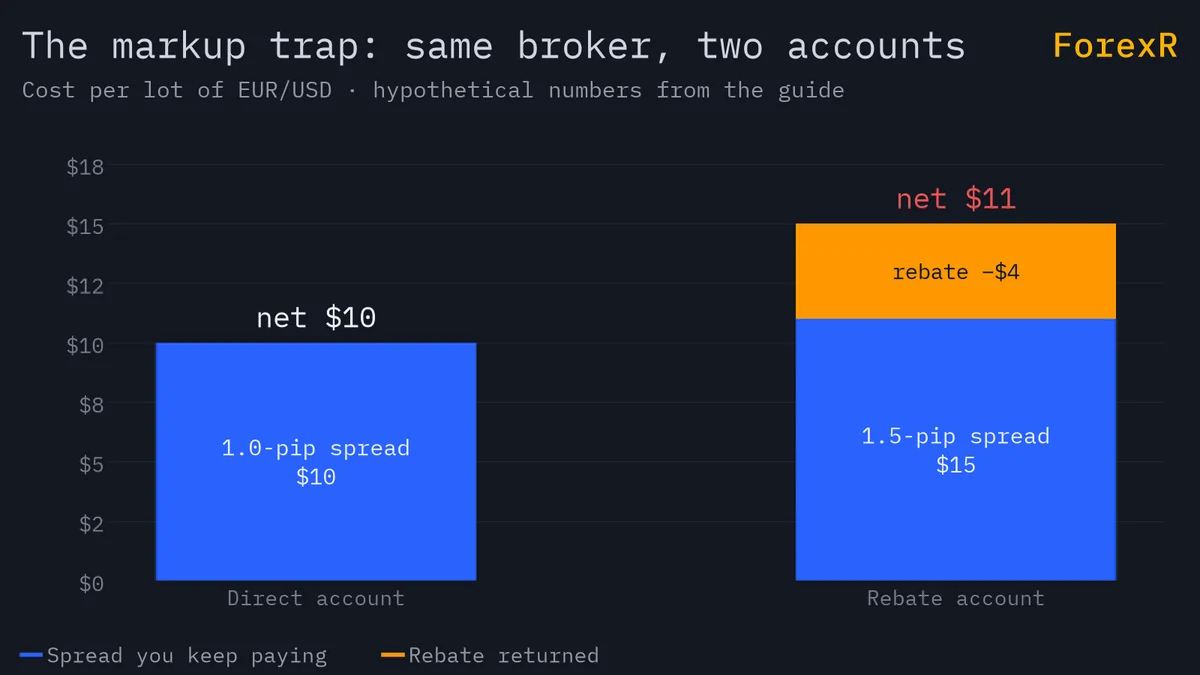
Worked example with example numbers. Direct account: 1.0-pip EUR/USD spread, no rebate, $10 per lot. Rebate account at the same broker: 1.5-pip spread with a 0.4-pip rebate. Cost $15 per lot, rebate $4, net $11 per lot. The “rebate” account costs $1 more per lot than walking in the front door. The test is simple: open a demo both ways and compare the spread on the same pair at the same minute; spreads and pips explains how to read it. If the rebate account’s spread is wider, the rebate must be larger than the difference, or it is a loss.
Check 4: Can You Attach an Existing Account?
Most brokers only tag an account to an IB at the moment it is opened. If you already have an account, the provider will usually ask you to open a second one under its link, or to email the broker asking to transfer your account to the IB. Some brokers allow the transfer, some refuse, and some require that the account has been inactive for a period first. Ask before you sign up, and get the answer in writing. Opening a new account also resets your trading history, which matters if you rely on your statement for a trading journal or a prop-firm application.
Checks 5 and 6: Payment Schedule, Minimums and Currency
- Frequency: daily, weekly or monthly. Daily is best for checking that lots are being counted; monthly hides errors for longer.
- Destination: paid into the trading account, an e-wallet or by bank transfer. Each has a fee and a delay; a bank transfer of a $20 rebate can lose a third of it to charges.
- Minimum payout: a $50 threshold on a $3-per-lot rebate needs about 17 standard lots, or 1,700 micro-lot trades. Many small accounts never reach it.
- Currency: rebates quoted in dollars but paid in your local currency pass through the provider’s exchange rate. Compare it with the mid-market rate on the currency converter.
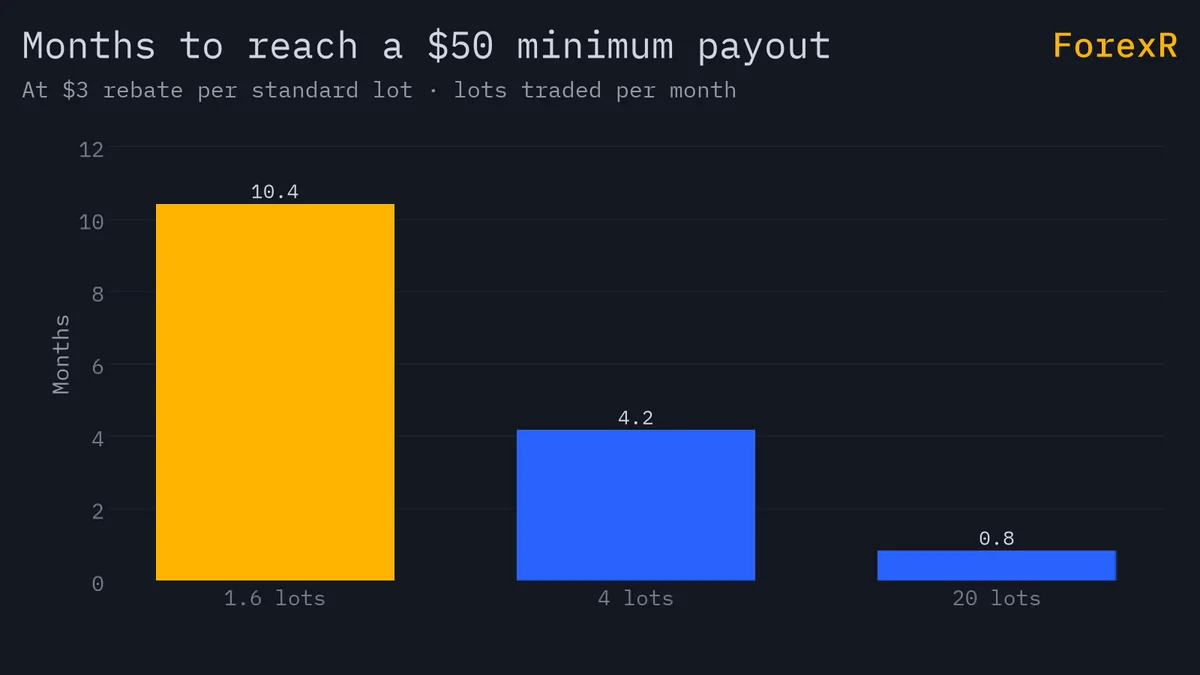
A swing trader in Jakarta who places eight trades a month at 0.20 lots generates 1.6 lots, about $5 of rebate at $3 a lot. A $50 minimum means the first payout arrives after ten months, if the account is still open. For a trader like that the rebate is nearly irrelevant, and the broker’s swap rates matter far more.
Checks 7 and 8: Terms That Can Cancel Your Rebate
Read the provider’s terms and the broker’s partner terms, because either can cancel a payment:
- Minimum trade duration: trades closed inside two or three minutes may earn nothing, which removes most of the rebate for a scalper.
- Bonus exclusivity: taking a deposit bonus from the broker often voids the IB commission, and so the rebate.
- Swap-free accounts: some programmes pay a reduced rate or nothing on swap-free accounts, because the broker’s income is lower.
- Abuse clauses: hedging the same pair across two rebate accounts, or arbitraging bonuses, is grounds for withholding every rebate and closing the account.
- Changes without notice: rates fall when the broker cuts its partner commission. A rate is a current offer, not a contract for life.
What people get wrong here is to treat the rebate as earned income. It is a discretionary payment from a third party, governed by terms the broker can change. Build your trading plan as if it did not exist, so that losing it changes nothing.
Check 9: Red Flags of a Fake Rebate Site
- Rebates larger than the spread: nobody can return more than the broker pays out. An offer bigger than the broker’s markup is being funded from your deposit or from the next client’s.
- Profit promises bundled in: “guaranteed” results, signals or a managed account offered with the rebate. A discount with a profit promise is a sales funnel, and forex signals explains why bundled signals rarely favour you.
- Payment only in a token or a closed wallet that cannot be withdrawn to a bank.
- Pressure to deposit more to reach a higher tier. Your rebate should depend on lots, never on your balance.
- No company name, address or registration, and no way to confirm the IB status with the broker.
How to Compare Two Offers on Paper
Put the two accounts into one sum: net cost per lot = spread in dollars + commission − rebate, using the spread you measured at your trading hour, not the advertised minimum. Then multiply by your real monthly lots. If you trade 4 lots a month, a $1 difference per lot is $48 a year; set that against the regulation, execution and swap of each account before you move. The spread cost calculator does the first term for you. Sizing stays separate: the position size scripts for TradingView, the browser-based charting platform, size a trade from the stop, which is the one input a rebate should never touch.
Try This: A Five-Minute Verification
Before you sign up anywhere: look up the broker entity named in the rebate terms on its regulator’s register; email the broker to ask whether the provider is a registered IB and whether rebate accounts carry a different spread; open a demo under the rebate link and compare the EUR/USD spread with a direct demo at the same minute; read the terms for minimum duration and bonus clauses; and note the minimum payout against your monthly lots. If any step fails, the rebate is not worth the move.
Leveraged forex and CFD trading carries a high risk of losing money quickly, and a rebate changes none of that risk. It can make a good account slightly cheaper and a bad one no safer, so choose the broker as if no rebate existed and only risk money you can afford to lose.
FAQ
Which forex rebate provider pays the most?
The headline rate is the wrong question. The highest rebates are usually attached to the widest-spread accounts at the most lightly regulated entities, so the biggest number can be the worst deal. Compare net cost per lot, spread plus commission minus rebate, measured at the hour you trade, and only between accounts at brokers you would be happy to use with no rebate at all.
Can a rebate provider see or control my trading account?
A legitimate provider sees only the partner report the broker gives it: your account number, lots traded and the commission earned. It cannot place trades, withdraw money or see your password. If a site asks for your platform login, investor password or a deposit made to the site rather than to the broker, stop; that is not how rebates work.
Why did my forex rebate stop being paid?
Common causes are a broker bonus that voided the partner commission, trades closed inside the minimum duration, a switch to a swap-free account with a reduced rate, the broker cutting its partner commission, or the account losing its IB tag after a transfer. Ask the provider for the broker’s partner report for the month and compare it with your own statement.
Is it worth switching brokers for a rebate?
Only if the new broker would be your choice without the rebate. Work out your real monthly lots and multiply by the rebate per lot; for many part-time traders the answer is a few dollars a month, which does not justify weaker regulation, worse execution or a higher swap. If the two brokers are equal on everything else, the rebate is a fair tiebreaker.