Gold and Interest Rates: Why Real Yields Drive the Price

Why Do Interest Rates Move the Gold Price?
Gold pays no interest. A government bond does. So every ounce you hold is a choice to give up the bond's income. When the return on safe bonds rises after inflation, that sacrifice grows and gold tends to fall; when it shrinks, gold tends to rise. That after-inflation return, the real yield, is the number to watch.
Each part of that answer hides a trap: which rate, which bond, and why the market so often moves before the Fed does. Take them one at a time.
Nominal vs Real Yields: The Difference That Matters
A nominal yield is the interest a bond pays on paper, say 4% a year. A real yield is that number minus expected inflation. If prices are expected to rise 3%, the real yield is about 1%: what the bond earns in buying power. Gold cares about the real number, because gold's own return in buying power is zero plus or minus its price change.
Two countries can have the same 4% bond yield and opposite gold outlooks: one with 1% inflation (real yield 3%, a heavy weight on gold) and one with 6% inflation (real yield −2%, a tailwind). The reference most traders use is the yield on the US 10-year inflation-protected Treasury, which is quoted as a real number directly. Is gold an inflation hedge? explains why the inflation half of that subtraction matters as much as the rate half.
Opportunity Cost: A $3,000 Ounce vs a Bond for a Year
Think of a rental deposit sitting in a landlord's drawer. While savings accounts pay almost nothing, you barely notice. When they pay 5%, that idle deposit costs you real money every month. Gold is the deposit; the bond is the savings account. The higher the real yield, the more it costs to hold gold. Economists call that the opportunity cost, and it is the same logic that powers the carry trade, run in reverse.
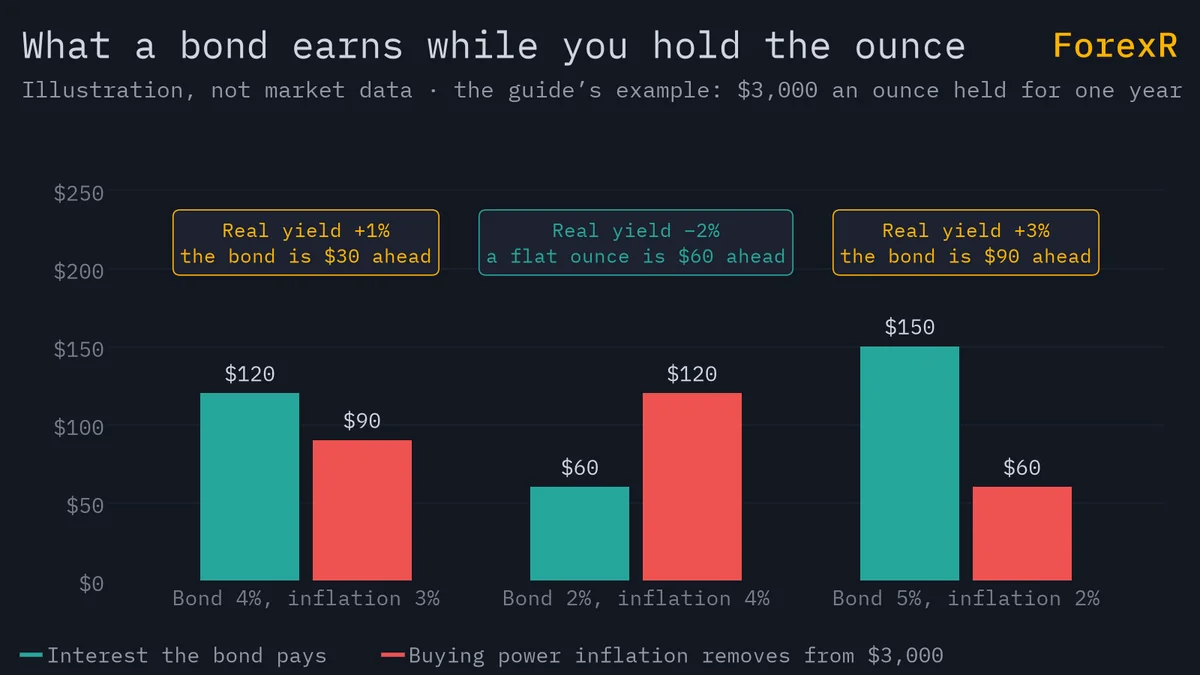
Put numbers on it, using the example price of $3,000 an ounce (an example, not a forecast). Suppose a one-year government bond pays 4% and inflation is expected at 3%. The bond turns $3,000 into $120 of interest; the real yield is 1%. Gold must gain 4%, or $120, just to draw level, and 3%, or $90, just to keep its buying power. Now flip the numbers: the bond pays 2% and inflation runs at 4%, a real yield of −2%. The bond earns $60 but loses $120 of buying power, so gold only has to stand still to win. Same ounce, same $3,000; the whole difference is the real yield. Redo it with your own country's rates.
Why Gold Tracks 10-Year Real Yields
Since the mid-2000s the link between gold and the US 10-year real yield has been gold's most reliable relationship, and it is strongly negative: real yields up, gold down, and the reverse. Why the 10-year rather than the Fed's overnight rate? Because the Fed funds rate is set for tonight, while gold competes with money parked for years. Long real yields blend where the market thinks rates and inflation are heading over a decade, which is the horizon of the central banks and long-term investors who hold most of it.
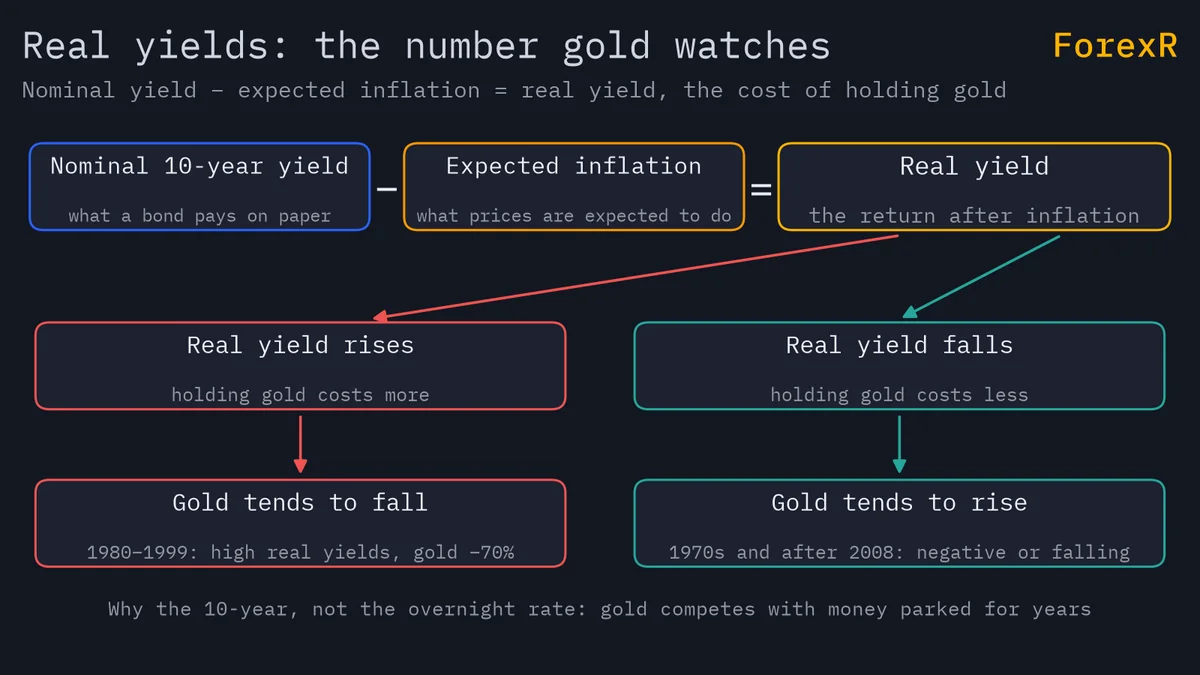
The 1980s and 1990s show the relationship at its cruellest. After the January 1980 peak of about $850, gold fell for about 20 years and bottomed at about $250-255 in 1999, an era of high US real yields. The 1980 peak took until 2008 to beat in nominal terms: 28 years. Gold and the US dollar shows how the same yield move pushes the dollar the other way.
Why Gold Can Rise While the Fed Hikes
What people get wrong: the Fed raised rates, so gold must fall. It sounds airtight, and it fails in two ways. First, markets price expectations in advance. If traders expected a hike and got one, nothing new has happened; gold may even rise if the statement hints the hiking is nearly over. Second, hikes only hurt gold if they lift real yields. In the 1970s the Fed raised rates repeatedly, yet inflation ran faster still, real yields stayed negative, and gold rose more than 20-fold from $35 to about $850 by 1980.
Rates rising is not the question. Rates rising faster than inflation, and faster than the market expected, is.
Rate Cuts and Gold: Not Always Good News
Cuts usually help gold, for the mirror-image reason: lower rates mean lower real yields, so the cost of holding gold drops. The same two traps apply. A cut the market fully expected is old news, and a cut smaller or less dovish (less inclined to keep easing) than hoped can send gold down on the day. Cuts made in a crisis carry a third problem: the liquidity crunch that forced them. In late 2008 and in March 2020 gold fell alongside shares as funds sold whatever they could to raise cash, then recovered first once central banks added liquidity. The cut is bullish; the week of the cut may not be. Gold as a safe haven covers those weeks.
How to Read a Fed Meeting for Gold
An accountant in Kuala Lumpur sets an alarm for 2 a.m. on Fed nights (3 a.m. in US winter). She reads the decision, the first paragraph of the statement and the first ten minutes of the press conference, watching the 10-year yield and the dollar rather than gold itself. If gold has already moved more than its daily ATR (average true range, a measure of a normal day's movement) before she has finished reading, she closes the laptop and goes back to bed.
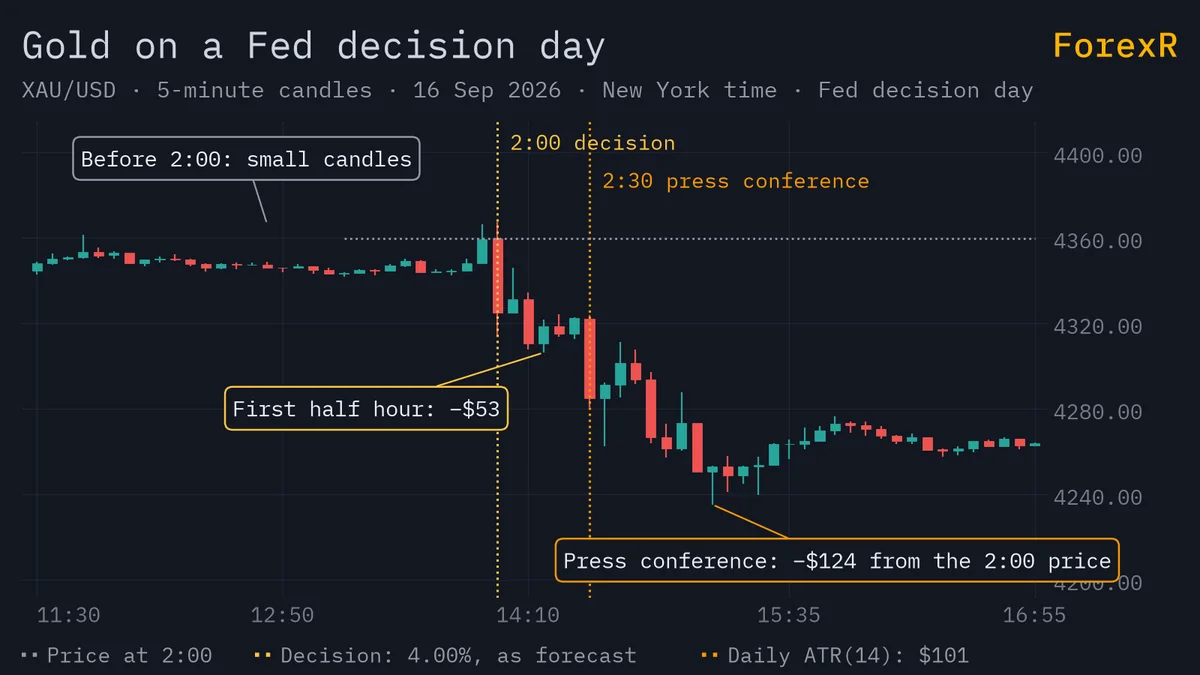
- Decision vs expectation: what matters is the gap between what the Fed did and what the market had priced, not the number itself.
- Statement wording: a changed sentence about inflation or the path of rates often moves gold more than the decision.
- Press conference: 30 minutes after the decision; the second move often reverses the first.
- Yields first: if the 10-year yield falls after the decision, gold usually finds support; if it rises, the opposite.
Our FOMC guide explains the meeting itself, the economic calendar guide shows how to find the date and the market's expectation beforehand, and the gold analysis hub publishes event pieces around each decision.
Swap: The Interest You Pay to Hold Gold Overnight
Interest rates reach a gold CFD (a contract for difference: you gain or lose the price change without owning metal) through swap, the overnight financing charge. Long gold usually pays, because holding gold costs roughly the US dollar interest rate minus a small gold lease rate (what a lender of gold earns); the short side may receive a little or also pay. Swap is charged at 5 p.m. New York, with one triple-swap night a week to cover the weekend. As an example, a swap of −$40 per lot per night on a one-lot long held ten nights, including one triple night, costs about $480.
So higher rates hit a leveraged gold long twice: they push the price down and they raise the nightly bill. Gold spread and swap fees has the full cost picture, and swap long is one of the first columns to check when you compare regulated brokers.
Try This: Build Your Own Yield Table
On paper, draw a table with three rows. In each, write a bond yield, an expected inflation rate, the real yield (the first minus the second) and what gold at $3,000 must do over a year to match the bond in dollars. Use 5% and 2%, 3% and 3%, 1% and 4%. Then open the live gold page and compare the daily ATR with the $120 and $90 figures from the worked example. A year of bond interest is often less than gold moves in a few ordinary days. That is the scale of risk you take on to avoid a small, certain cost.
Leveraged gold CFDs carry a high risk of loss; ESMA-era disclosures show 74-89% of retail CFD accounts lose money. A single Fed night can move gold further than a year of swap, in either direction, and gold can fall hard and fast when real yields jump. Only risk money you can afford to lose.
FAQ
What is the real interest rate and where can I find it?
The real rate is a bond yield minus expected inflation. The most watched version for gold is the yield on the US 10-year inflation-protected Treasury, which most free financial data sites list under TIPS or real yields. A falling real yield has usually been a tailwind for gold and a rising one a headwind, though the link is a tendency, not a law.
Does gold do well when interest rates are high?
Not usually, if high means high after inflation. Rates of 5% with inflation at 8% are a negative real yield and have historically favoured gold; rates of 5% with inflation at 2% are a strongly positive real yield and have usually hurt it. The 1980s and 1990s, an era of high real yields, were gold's long bear market.
Which interest rate matters most for gold: the Fed funds rate or bond yields?
Bond yields, and the 10-year real yield above all. The Fed funds rate is an overnight rate the Fed sets directly, and it matters because it steers expectations. But gold competes with money held for years, so the long real yield is the closer comparison, and since the mid-2000s it has been gold's most reliable relationship.
Do I pay interest to hold a gold CFD?
Yes, through the overnight swap. Long gold usually pays a nightly charge roughly equal to the US dollar interest rate minus a small gold lease rate, taken at 5 p.m. New York, with one triple-swap night each week to cover the weekend. Swap-free accounts remove the interest but may add an administration fee. Check your broker's contract specification.