How to Choose a Broker for Gold Trading: 9 Things to Check

What Should You Check in a Broker for Gold Trading?
A $0.30 spread on gold costs $30 per standard lot per round trip, and a −$40 nightly swap costs $480 over a 10-night hold. Those two numbers matter more than any indicator. Check nine things: regulation, spread, commission, swap, metals leverage and negative balance protection, minimum lot and stop level, execution at news, trading hours and account currency.
Choosing a gold broker is like choosing a phone contract: the advertised monthly price is the spread, but the real cost includes the connection fee (commission), the out-of-bundle charges (swap) and the exit penalty (slippage). The general broker guide covers the whole contract; this guide reads gold’s small print.
Check 1: Regulation Comes First
A broker with a licence from a serious regulator must keep client money segregated and answer to someone. Never open a gold account with an unregulated broker: ESMA-era disclosures show 74-89% of retail CFD accounts lose money even at regulated brokers, and an unregulated one adds the risk of never seeing what is left. The types of brokers guide explains market makers versus ECN-style brokers.
Checks 2 and 3: Spread in Cents and Commission
Gold is quoted to two decimals, so the spread (the gap between buy and sell) is in cents. Multiply by 100 for dollars per lot: a $0.30 spread is $30 per standard lot per round trip and $3 per 0.10 lot. Brokers advertise their lowest spread, usually from the London-New York overlap; ask what the average is in Asian hours and in the minute after US data.
Commission is the second line. A raw-spread account quotes a thin spread plus a commission per lot; a standard account folds it into a wider spread. Add the two before comparing. The spread cost calculator turns any spread into dollars for your lot size, and the gold spread and swap guide explains why gold spreads widen around the daily break.
Check 4: Swap Long, Swap Short and Triple-Swap Day
Swap is the overnight financing charge. On gold the long side usually pays; the short side may receive a little or may also pay. Read three lines in the contract specification:
- Swap long: the nightly cost of a buy position per lot; the number most gold traders forget.
- Swap short: often smaller, sometimes positive; your holding cost when you sell gold.
- Triple-swap day: one weekday carries three nights of swap to cover the weekend, Wednesday at many brokers for metals and Friday at some. Holding across it by accident is a common surprise.
Swap-free accounts drop the interest charge; check whether an administration fee replaces it after a set number of days.
Check 5: Metals Leverage and Negative Balance Protection
Leverage on gold is often lower than on forex: under ESMA-style rules retail accounts get 1:30 on major pairs but 1:20 on gold, while many offshore brokers offer 1:100 to 1:500. Higher leverage does not change what a trade can lose, only the margin, the deposit the broker locks up. At the example price of $3,000 an ounce, one lot needs $15,000 of margin at 1:20, $3,000 at 1:100 and $600 at 1:500, while a $20 move costs $2,000 in every case (the formula is in the gold lot size and margin guide).
Negative balance protection is the other half of this check. Gold reacts to weekend news and gaps at the Sunday evening New York open, and stops fill at the first available price, so a gap can leave you owing the broker money unless the loss is capped at your balance. ESMA-style regulators require it; ask an offshore broker in writing.
Check 6: Minimum Lot and Stop Level
A 0.01 lot of gold is one troy ounce, so a $1 move is $1. A broker whose smallest gold lot is 0.10 forces a $1,000 account to risk $10 per dollar of movement, which makes sensible stops impossible. Confirm 0.01 applies to gold, not just forex.
Stop level is the minimum distance from the current price at which you may place a stop or pending order. On gold some brokers set it at several dollars, which rules out tight stops and blocks a move to break even in a fast market. Zero or near zero is what you want; find it in MT4 or MT5 under the symbol’s specification, because it is rarely advertised.
Check 7: Execution and Requotes at News
On 12 and 15 April 2013 gold fell about 13% in two trading days, the largest two-day drop in about 30 years. A stop is a request to close at the next available price, and in a fall like that the next available price was far below the ticket. Slippage is that gap between click and fill; a requote is the broker refusing your price and offering another. Execution quality is how small both stay when gold moves.
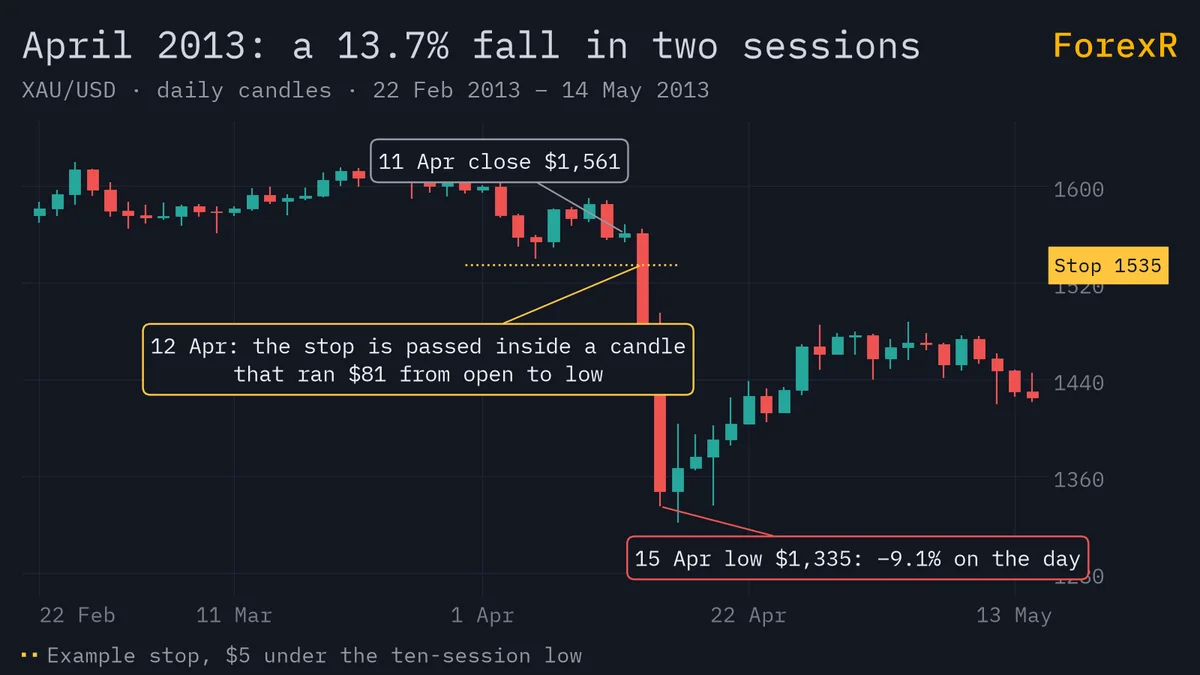
A part-time trader in Johor checks gold at 9 p.m. after work, half an hour after the 8:30 a.m. New York data release in US summer. For months he saw “requote” and “off quotes” at exactly that time while the price ran without him: not bad luck, an account type that could not fill at news. Before funding, place small demo trades in the seconds after a release and read the slippage in the trade history; the trading gold during news guide shows what is normal.
Checks 8 and 9: Trading Hours and Account Currency
Spot gold CFDs follow the futures clock: Sunday 6 p.m. to Friday 5 p.m. New York time, with a daily break from 5 to 6 p.m. New York (5-6 a.m. in Kuala Lumpur in US summer, an hour later in winter). Brokers differ at the edges of that clock, so read gold’s hours specifically; the best time to trade gold guide maps the day to local clocks.
Account currency is the last check. If your account is in ringgit, rupiah, baht or rupees, every gold profit or loss is converted from dollars at the broker’s rate, and that rate carries its own spread. A dollar account avoids the daily conversion but adds bank transfer costs. Check a $100 gold loss in your own money with the currency converter.
Worked Example: Total Cost of a 10-Night Swing Trade
Two regulated brokers, one long gold trade of 1 lot held 10 nights including one triple-swap night, at the example price of $3,000 an ounce (an example, not a forecast).
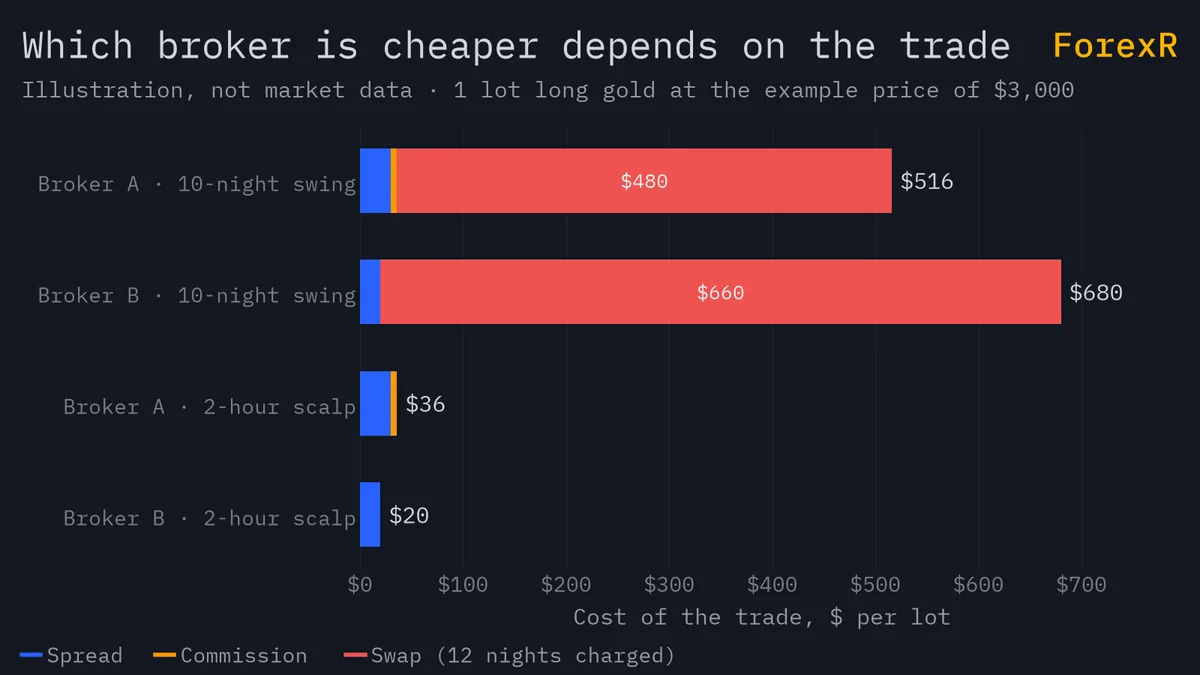
- Broker A: spread $0.30 ($30 per lot), commission $6 per lot round trip, swap long −$40 per night. Swap: 12 × $40 = $480. Total: $30 + $6 + $480 = $516.
- Broker B: spread $0.20 ($20 per lot), no commission, swap long −$55 per night. Swap: 12 × $55 = $660. Total: $20 + $660 = $680.
Broker B advertises the tighter spread and costs $164 more on this trade. Flip the trade to a two-hour scalp with no swap and Broker B is cheaper. There is no cheapest broker, only the cheapest for the way you trade.
What People Get Wrong: The Tightest Spread Is Cheapest
It sounds reasonable: the spread is paid on every trade, so the lowest spread must mean the lowest cost. On gold it fails three ways. Spreads are advertised at their best and charged at their worst, and gold’s worst is the daily break and US data seconds. Swap can outweigh the spread within a few nights. And a spread you cannot get filled at is not a spread; requotes at news turn a $0.20 headline into a $2 reality.
Try this in five minutes. On two demo accounts, open the gold contract specification and write down six numbers: spread now, commission, swap long, swap short, stop level and minimum lot. Then open the live gold page, note the daily ATR, its average daily range, and ask whether each broker’s stop level allows a stop at half of it. When you are ready for real accounts, the broker comparison puts two or three candidates side by side.
The risk note: a good broker lowers your costs, not gold’s risk. Leveraged gold CFDs carry a high risk of loss, gold can fall hard and fast, as April 2013 showed, and even the best execution fills a stop at the market price, not the price you hoped for. Only risk money you can afford to lose.
FAQ
What is a good spread for gold trading?
Judge it in dollars per lot against the move you are after, not in isolation. A $0.30 spread is $30 per standard lot per round trip: 10% of a $3 scalp but well under 1% of a $50 swing target. Compare the average spread during the hours you actually trade, and add any commission before ranking brokers.
Do I need a special account to trade gold?
Usually not. Most forex accounts include XAU/USD alongside currency pairs on MT4 or MT5. What differs is the small print: gold may have lower leverage, a different triple-swap day, a larger stop level and shorter hours than forex on the same account. Read the gold contract specification before funding, and ask whether a swap-free version is offered.
Why is leverage lower on gold than on forex?
Regulators treat gold as riskier than a major currency pair because it moves further: gold’s annualised volatility has typically been about 15%, roughly double EUR/USD. Under ESMA-style rules that means 1:20 on gold against 1:30 on major pairs, so more margin per lot. Offshore brokers may offer 1:100 to 1:500, which changes the margin, not the dollar risk.
Can I lose more than my deposit trading gold CFDs?
Without negative balance protection, yes. Gold can gap over a weekend or during a news release, and a stop is filled at the first available price, which can be far past your level. With negative balance protection the loss is capped at your account balance. Regulated brokers in ESMA-style regions must provide it; elsewhere, get the answer in writing.