AI Trading Signals: What They Are and When to Trust One

What Are AI Trading Signals?
AI trading signals are trade suggestions — a pair, a direction, an entry, a stop and a target — produced or packaged by software instead of a human analyst. The AI part may be real machine learning, a plain rule set relabelled, or a language model writing the explanation. The label alone tells you nothing about quality.
Signal anatomy, free-group economics and how to judge any provider are covered in the main forex signals guide. This guide covers only what the AI label adds and hides: how these signals are actually produced, how they fail differently from human ones, and how to test a service before it costs you real money.
How Services Generate AI Signals
Behind the label sit three recipes, in descending order of how common they are.
- Relabelled rules. A fixed indicator strategy — the same moving-average and momentum logic sold for decades — rebranded as AI. Nothing was learned by any machine; the distinction is unpacked in AI trading vs algorithmic trading.
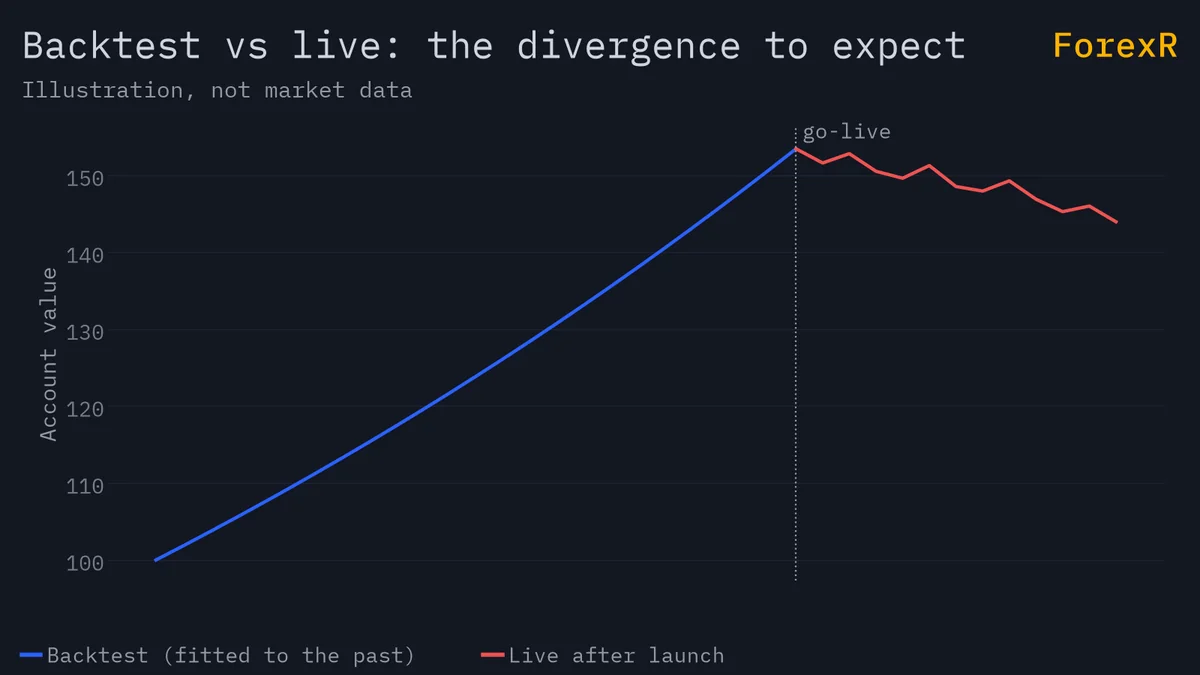
- Machine-learning scores. A model trained on past prices outputs a score or probability, and a signal fires when it crosses a threshold. This is genuine ML, with the known weaknesses of machine learning in forex — starting with overfitting, when a model memorises the past instead of learning a rule that survives the future.
- Language-model rationales. A language model writes a fluent paragraph of reasoning around a signal produced some other way. The prose is generated after the signal exists; polish is not evidence.
Ask which recipe a service uses. A seller who cannot or will not say has answered the question anyway — the AI is in the advertising, not the signals.
Why an AI Label Is Not an Edge
An edge is a repeatable reason your trades make more than they lose after costs. AI is a method, not an edge: the same models and data are available to millions of people, and a pattern everyone can see stops paying once everyone trades it. So ask the question the label distracts you from — why is this seller renting out profitable trades for a subscription fee instead of quietly taking them? Sometimes there is an honest answer; often the subscription is the business, and the extreme end of that logic is catalogued in AI trading scams.
The label carries a second cost: it invites you to stop thinking. A trader handed a human tip still asks why; the same trader shown a machine’s confident score often does not. Confidence displayed to two decimal places is still a guess about the future.
AI Signals vs Human Signals
The differences that matter are speed, volume and failure style.
- Speed and volume. Software reacts in seconds and never sleeps, so AI services can send far more signals than any analyst could. More signals is not more edge — it is more spread paid and more invitations to overtrade.
- Consistency. Software has no mood, no revenge trades and no collapse of discipline after a losing week. These are genuine advantages over a tired human.
- Failure style. An analyst fails one call at a time, visibly. A model fails silently and at scale: when market behaviour shifts, it keeps sending confident signals to every subscriber at once, and nobody inside the loop may notice for weeks.
- Saying nothing. A good human can say there is no trade today. A subscription under pressure to justify its fee rarely stays quiet.
Live Track Record vs Backtest
A backtest replays a strategy over past prices; a live track record logs real signals as they were sent. Backtests flatter — they can be tuned until history looks perfect, and they skip slippage, spread widening and missed fills. A live record with timestamps, every loss included, across months of varied conditions is the only evidence worth much; ask for read-only verification rather than screenshots. Watch for survivorship in the marketing, too: a company can run ten model variants privately and advertise only the one that did well. You see the winner; the nine quiet failures were the warning. Logging your own results is the countermeasure, and it is the habit at the centre of backtesting and keeping a trading journal.
Sample Size: The Coin-Flip Test
Small samples lie. Flip a fair coin 20 times and it lands 12 or more heads about one time in four — so a service showing 12 winners in its last 20 signals has shown you nothing a coin could not. This is not an accusation of fraud, just statistics: ten honest services with no edge will still produce one apparent star by chance, and the star is the one whose advert reaches you. Before trusting any record, insist on at least 100 signals spanning quiet and violent markets, and check the result was not built by one lucky month. The larger and duller the sample, the more it means.
Drawdown Honesty
Drawdown is the fall from an account’s peak to its next low, and it is the number sellers hide most. A record that shows returns without its worst losing run is incomplete by design: the drawdown tells you what following the service would have felt like, and whether your account and your nerves would have survived it. Ask directly for the deepest historical drawdown and the longest losing streak, and weigh them against the record’s length — a shallow drawdown over three months means far less than a moderate one survived over three years. If following the signals as instructed would break your own risk management rules, the service does not fit you, whatever its record says.
What an AI Signal Service Really Costs
Count all three costs. The subscription: $50 a month is 5% of a $1,000 account, because 50 ÷ 1,000 = 0.05 — a drag the signals must overcome every single month. The spread: every signal taken costs the spread, and high-volume AI services multiply it fast; execution and costs differ, so compare regulated brokers before comparing signal sellers. The slippage: by the time an instant signal reaches your phone and your thumb, price has moved, and the fastest signals age worst of all. There is an attention cost too: high-volume alerts train you to watch your phone all day, and tired traders make expensive mistakes no service refunds.
How to Test a Signal Service Safely
Treat any subscription as an experiment with a fixed budget, run like this.
- Demo first. Take every signal on a demo account for at least a month, with no exceptions for a hot streak.
- Log everything. Entry, exit, the delay between signal and fill, and the result. Your log, not their scoreboard, is the record you judge.
- Go live small. If demo results hold, trade minimum size, with stakes set by the position size calculator rather than the seller’s suggestion.
- Decide your exit in advance. Write down the drawdown or losing streak at which you stop following. Deciding mid-slump never goes well.
- Know what you are really doing. Following trades automatically is copy trading with extra steps, and it shares the same risks.
No signal, AI-generated or human, removes the risk of trading: a model cannot foresee news and can stop matching the market without warning. Leveraged forex and CFD trading carries a high risk of loss — ESMA-era disclosures show 74-89% of retail CFD accounts lose money — so follow signals, if at all, only with money you can afford to lose.
FAQ
Are AI trading signals accurate?
Accuracy varies by service and by market condition, and past accuracy does not persist reliably. Any service can look accurate over a short run by luck alone, which is why sample size matters more than a headline percentage. Judge accuracy only from a long, timestamped live record you have verified — ideally by logging the signals yourself on a demo account.
How much do AI trading signal services cost?
Anything from free to a substantial monthly subscription. Free services usually earn elsewhere — partnerships, upsells to a paid tier, or worse — while paid ones must beat their own fee before they help you at all. Measure the fee against your account size: a subscription that is trivial for a large account is a heavy monthly drag on a small one.
Can I automate trades from AI signals?
Technically yes: copier tools can turn incoming signals into orders on your account. Automation removes your last checkpoint, though — bad signals execute as faithfully as good ones, position sizes may not fit your account, and slippage grows with every delay. If you automate at all, cap the risk per trade, check it daily and keep the ability to stop it instantly.
What is a good win rate for a trading signal?
No single number, because win rate only means something next to reward-to-risk. A service winning 40% of trades whose winners are twice the size of its losers performs better than one winning 80% and giving everything back on rare huge losses. Ask for average win, average loss and maximum drawdown together; a win rate quoted alone is marketing.