AI Trading Tools Explained: What Helps and What Sells

What Are AI Trading Tools?
AI trading tools are programs that use machine learning or language models to do one job in your trading workflow: scan charts, rank markets, summarise news, score sentiment, trade rules automatically or write code. Each does a narrow task faster than you can. None of them predicts the future, and none replaces your own judgement.
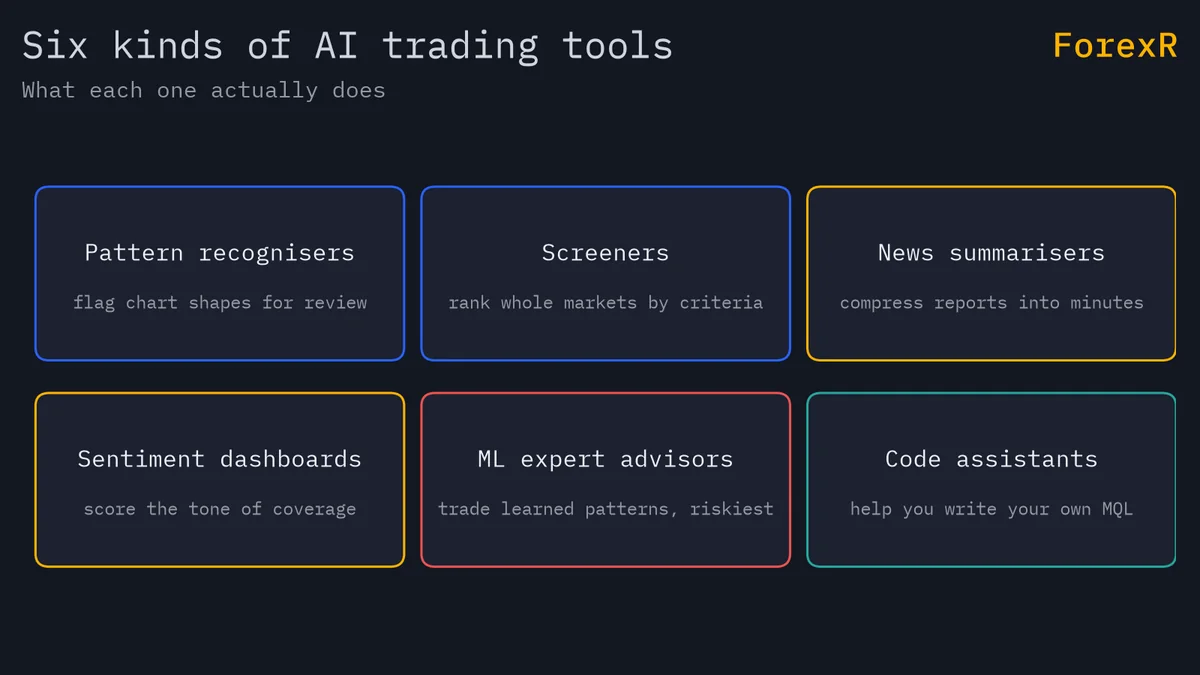
Almost every trading product carries an AI badge, which makes the word nearly useless for choosing between them. This guide sorts the market into six real categories, says what each genuinely does and where it fails, then finishes with a judging checklist and a cost calculation. For the definitions behind the badge, start with what AI trading actually means.
Chart-Pattern Recognisers
These scan price charts and flag formations — triangles, flags, head and shoulders — the moment they appear, across dozens of pairs and timeframes at once. What they genuinely do: apply one consistent definition of every pattern without getting tired, distracted or hopeful, which is more than most humans manage. If the formations themselves are new to you, our guide to chart patterns covers them.
Where they fail: a flagged pattern is a description of the past, not a forecast, and pattern definitions are loose enough that two tools can disagree about the same chart. Detection is the easy tenth of the job. The honest use is as a spotter: let the tool watch a hundred charts, then judge its finds with your own process — trend, levels and the news that no pattern scanner sees.
Screeners That Rank Whole Markets
A screener filters many markets down to a shortlist: strongest trends, unusual volatility, the biggest moves against their own average. Machine-learning versions go further and score or rank every market they watch. What they genuinely do: compress hours of chart-flipping into minutes and surface pairs you would never have opened.
Where they fail: a ranked list feels like advice but is only sorting, and a rank built on a meaningless score is still meaningless. When thousands of traders receive the same shortlist, the obvious trade also gets crowded. Treat a screener’s output as a list of things to analyse, never a list of things to buy.
News Summarisers
Large language models condense central-bank statements, economic reports and a full day of headlines into a few readable lines. What they genuinely do: reading breadth and speed no human matches. Where they fail: hallucination — when a model states something false with complete confidence — stale knowledge presented as current, and hedged official language flattened into false certainty, so that “the committee could consider” becomes “the bank will act”. A summary also cannot tell you what it left out, and the paragraph it dropped may be the one that mattered. Read the original before trading on any summary; our guide to using market analysis and news shows how.
Sentiment Dashboards
These turn thousands of headlines into numbers: the bullish and bearish share of coverage, a media mood score, news volume measured against its normal level. ForexR’s own pair pages carry a sentiment and opportunity block built this way — refreshed hourly, labelled informational only, with coverage varying by pair. What such dashboards genuinely measure is the tone and quantity of coverage, which is not the same thing as where price goes next; headlines usually follow price rather than lead it. The mechanics, uses and pitfalls have their own guide in this track: AI sentiment analysis in trading.
Machine-Learning Expert Advisors
An expert advisor (EA) is a program that trades your MT4 or MT5 account automatically. Most EAs follow fixed rules written in advance; a machine-learning EA instead leans on a model trained on past data to time entries or exits. What they genuinely do: execute without hesitation, fear or revenge trading, around the clock.
Where they fail: overfitting — when a model memorises the past instead of learning a rule that survives the future — and regime change, when market behaviour shifts and yesterday’s patterns quietly stop applying. A fixed-rule EA fails visibly; a model can fail silently while looking busy. Open-source candidates can at least be read and tested: the AI and machine-learning EAs in ForexR’s free library are listed automatically from GitHub, and the library never tests, verifies or recommends any of them. Before running one, work through how to choose a forex EA.
Code Assistants That Write MQL
AI chatbots can write working MQL4, MQL5 and Python, turning a strategy idea into testable code in an afternoon instead of a month. What they genuinely do: boilerplate, syntax, explaining error messages and translating your written rules into logic — a real barrier removed for non-programmers.
Where they fail: subtle logic bugs delivered in confident, clean-looking code, invented functions that do not exist, and no trading judgement at all — an assistant will happily code a terrible strategy. Compile in MetaEditor, run the Strategy Tester, then a demo account, before any real money goes near the result. The safe workflow, and the verification habits that go with it, are covered in how to use AI chatbots for trading.
Free Tools vs Paid Tools
Free tools are rarely free. Some are demonstrations for a paid tier, which is fair enough. Others earn by collecting your data, promoting a partner’s products or nudging you towards trading more often than you planned — the tool is the shop window, and you are the stock. Paid tools carry the opposite trap: once you have paid, you feel pressure to act on the output to justify the cost, which is how a harmless subscription quietly becomes overtrading. Either way the question is the same: does the output measurably improve one specific step of your process? If you cannot name the step, you do not need the tool.
A Checklist for Judging Any AI Tool
- Can you verify its claims? The method is explained, the record is checkable or the code is readable. “Proprietary AI” with no detail is a warning, not a feature.
- Does it show losing periods? Every honest tool has them. Marketing that shows only wins is hiding something.
- Can you test it before paying? A trial on a demo account, or a backtest you run yourself, outweighs any testimonial.
- What happens when it is wrong? A tool that alerts you costs a bad idea; a tool that trades for you costs real money.
- Who is behind it? A named, registered company can be held to account. Anonymity plus a subscription fee is the AI trading scam starter kit.
What a Tool Costs a Small Account
Run the numbers before any subscription. A tool at $40 a month against a $500 account must add $480 a year before it has helped at all: 40 × 12 = 480, and 480 ÷ 500 is 96% of the account. The same tool against a $50,000 account costs under 1% a year. Most AI tools are priced for accounts far larger than the ones beginners actually run.
Cheaper improvements usually come first. Your spread and commission are a cost on every single trade — measure them with the spread cost calculator and reduce them by choosing carefully among regulated brokers. It is an unglamorous saving, but it compounds with every order you ever place.
No AI tool sees the future. Each one automates a task, inherits the quality of its data and fails at the edges of what it was built on. Leveraged forex and CFD trading carries a high risk of loss whatever software sits on top of it, so only ever trade with money you can afford to lose.
FAQ
Do AI trading tools actually work?
They do narrow jobs well: scanning charts, filtering markets, summarising text and writing code faster than a human. None of them reliably predicts price, and every one fails somewhere — false patterns, invented facts, or models that quietly stop matching the market. Judge each tool on the one task it claims, tested by you on a demo account, not on its advertising.
What is the best AI tool for forex trading?
There is no single best tool, because they solve different problems. Pick by task: which step of your process is slow or inconsistent? A trader drowning in news needs a summariser; a coder needs an assistant; a chart-flipper needs a screener. Whatever you choose, prefer tools you can test free on a demo account and drop without penalty.
Are free AI trading tools safe to use?
Free usually means the tool is the marketing. Many free tools exist to collect your email, sell a paid tier or funnel you towards a partner. That does not make them useless, but read what data they collect, ignore any built-in trade recommendations, and never connect a live trading account to a free tool you have not researched.
Can AI create a profitable trading strategy?
AI can generate strategy ideas and code endlessly, but a real edge has to be found and proven, not typed out. Most generated strategies fail honest testing because they fit the past rather than the future. Treat AI as a fast way to build and test candidates, and expect to discard nearly all of them after testing.