Gold and the US Dollar: Why They Usually Move Apart

Why Do Gold and the US Dollar Usually Move Apart?
Gold is priced in US dollars, so every ounce carries a price tag written in one currency. When the dollar weakens, that tag rises even if gold has not moved in euros or yen. The same US interest-rate news also pushes gold and the dollar in opposite directions. Together, these two effects make the link usually negative, but never fixed.
Two effects sit behind that answer: the pricing effect, which is arithmetic, and the shared-driver effect, which is cause. Mix them up and you will pay for it on the days the link snaps. The seven gold drivers covers the full list; this guide zooms in on one.
The Pricing Effect: A Weaker Dollar Lifts the Dollar Price
Picture a kilo of rice in a Penang shop. It costs the same ringgit on Monday and Tuesday. If the ringgit weakens against the dollar overnight, that rice costs more in dollars, though the rice has not changed. Gold is that rice seen from the other side: quoted in dollars, so when the dollar loses value, the dollar price of an unchanged ounce rises.
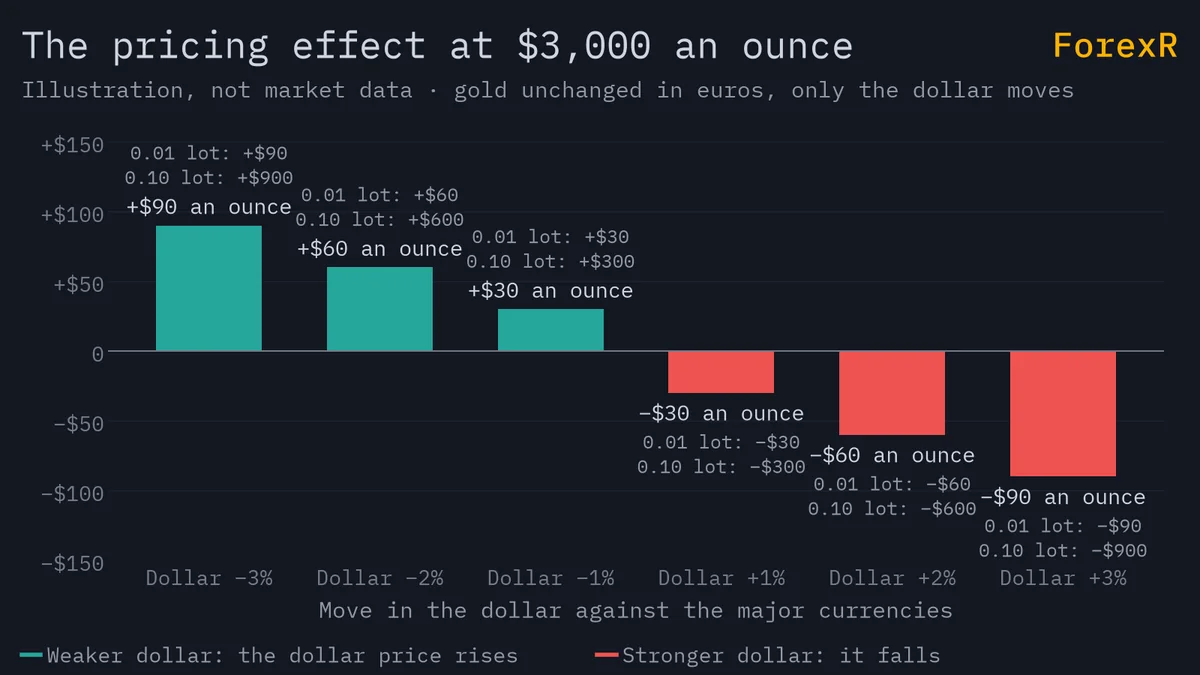
Here is the arithmetic, using the example price of $3,000 an ounce (an example, not a forecast). Suppose the dollar falls 2% against the major currencies and gold does nothing in euro terms. For the euro price to stay the same, the dollar price must rise about 2%: $60 an ounce, which is $60 on a 0.01 lot and $600 on a 0.10 lot. Run it backwards and gold falls $60. Redo it with 1% and 3%. Part of every XAU/USD move is just the ruler changing length.
The surprising part is how long the ruler was nailed down. From 1934 the United States fixed gold at $35 an ounce, and the 1944 Bretton Woods agreement tied the world's main currencies to that $35 dollar. On 15 August 1971 Richard Nixon ended the dollar's convertibility into gold. Freed from the peg, gold rose more than 20-fold to about $850 by January 1980. That was, above all, the dollar being re-measured.
The Shared-Driver Effect: US Real Yields Move Both
Now the second effect, which is about cause. A real yield is a bond's interest rate minus expected inflation. When US real yields rise, foreign money buys dollars to earn the higher return, so the dollar strengthens, and the cost of holding gold, which pays no interest, goes up, so gold weakens. One driver, two opposite results. When real yields fall, everything reverses.
Since the mid-2000s the link between gold and 10-year US real yields has been gold's most reliable relationship, and it is strongly negative. The dollar link is negative too, but only moderate, because the dollar has drivers of its own that gold does not share. Gold and interest rates goes deeper on the yield side.
Gold vs the Dollar Index: How Strong Is the Link?
The dollar index (DXY) measures the dollar against a basket of major currencies and is the usual yardstick for the dollar in gold commentary. Over long samples its correlation with gold is negative and moderate: more a tendency than a rule. Three consequences follow.
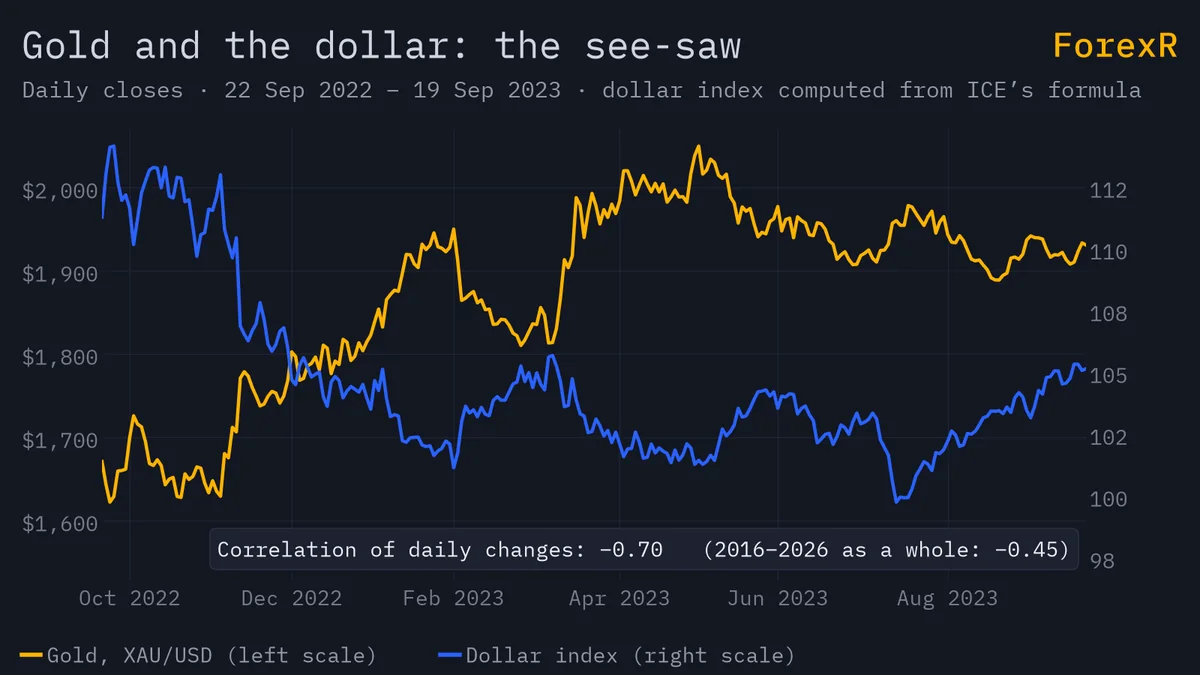
- Direction, not size. A 1% fall in the DXY does not mean a 1% rise in gold. Gold often moves several times as much, because yields and fear move it too.
- Weeks beat minutes. On a weekly chart the see-saw is easy to see; on a 5-minute chart it is buried under news spikes.
- The basket matters. The DXY tracks a handful of major currencies, not the ringgit, rupee or rupiah. Our DXY guide explains what is in it.
What people get wrong is turning the tendency into a law: gold and the dollar always move opposite, so a rising dollar index is a sell signal for gold. Most of the time it holds, but any rule built on the see-saw has to survive the years it failed.
When the Correlation Breaks: 2005 and 2010
Gold and the dollar rose together for long stretches in 2005 and again in 2010, and the same has happened in later years. The reason is fear. Worried investors buy the dollar because it is the deepest, most liquid currency, and they buy gold because it is nobody's debt. Both are havens, so both go up, and the pricing effect is swamped by demand for each.
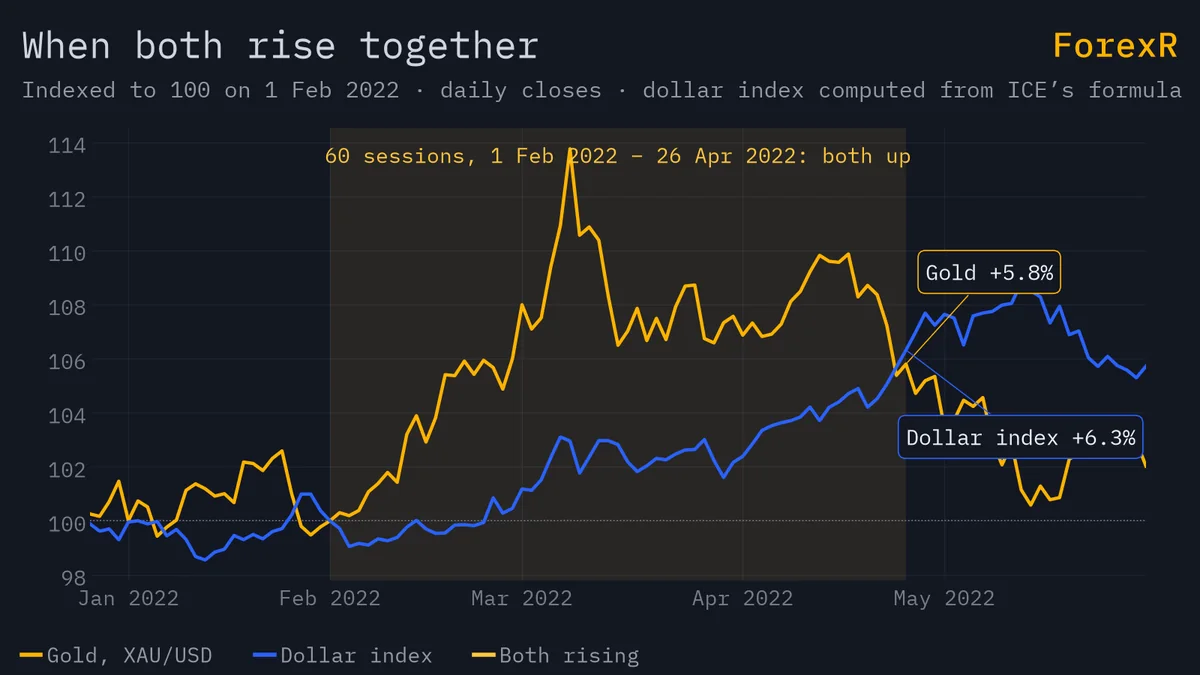
For a buyer outside the United States that matters. If the dollar rises 3% and XAU/USD also rises 3%, gold in euros or yen is up about 6%: a genuine rally in every currency. Liquidity crunches such as late 2008 and March 2020 broke the link the other way: the dollar shot up and gold fell with everything else.
Gold in Ringgit, Rupee or Rupiah Terms
Most readers of this site do not live in dollars. The gold price that matters in Kuala Lumpur, Chennai or Surabaya is the dollar price multiplied by the exchange rate, so a local buyer carries two exposures: gold, and their own currency. If the ringgit weakens 5% while XAU/USD is flat, gold in ringgit is up about 5%.
The same double exposure hides inside an account held in local currency: profit on a gold CFD (a contract for difference: you gain or lose the price change without owning metal) is worked out in dollars, then converted into ringgit, rupees or rupiah when the trade closes. The currency converter shows that conversion, and account currency is worth checking when you compare regulated brokers: some offer local-currency accounts and some do not.
How to Use the Dollar as a Filter for Gold Trades
A night-shift nurse in Manila checks two charts before her shift: daily XAU/USD and the daily dollar index. She wants to know whether the dollar is trending, ranging or about to face US data. If the dollar has fallen for two weeks while gold has risen, she treats a gold long as riding a tailwind and a gold short as fighting one. That is what a filter does: it says which side deserves the benefit of the doubt.
- Agreement: your gold setup points the way the dollar trend implies (dollar down, gold long). Take normal size.
- Disagreement: your setup fights the dollar trend. Halve the size or wait.
- Doubling up: long gold, long AUD/USD and short USD/CHF are close to one bet on a weaker dollar, not three trades. Gold correlations lists which pairs overlap with gold.
- Strength check: the currency strength meter shows whether the dollar is strong against everything or only against one currency.
The filter fails when both are bought as havens, as in 2005 and 2010, and when gold has news of its own. Treat it as one input, not a system.
What Happens to Gold on Hot US Data?
Hot data means a US number stronger than forecast: more jobs, higher inflation, faster growth. The market reads it as the Fed keeping rates higher for longer. Yields jump, the dollar jumps, and gold is hit by both effects at once, which is why it often drops sharply in the minute after a hot print.
The clock matters in Asia. Non-farm payrolls and CPI land at 8:30 a.m. New York: 8:30 p.m. in Kuala Lumpur, Singapore and Manila in US summer time, 9:30 p.m. in winter. Spreads widen at the release and the first move is often reversed within fifteen minutes. How to trade gold during news sets out three ways to handle those minutes; a stop inside the first-minute noise is a donation.
Try This: A Five-Minute Dollar Check
Open the daily charts of XAU/USD and EUR/USD side by side; EUR/USD moves close to the dollar index turned upside down. Mark the five biggest gold days of the last three months and note whether EUR/USD moved the same way on each. Most will. The days that did not are worth a second look: something else was in charge, usually yields or fear. The habit it builds is asking whether this is a gold move or a dollar move before you click.
A final word on risk. Leveraged gold CFDs carry a high risk of loss; ESMA-era disclosures show 74-89% of retail CFD accounts lose money. Gold can fall hard and fast, and a dollar link that held for months can reverse in a week. Only risk money you can afford to lose.
FAQ
Does gold always go up when the US dollar falls?
No. A weaker dollar lifts the dollar price of gold through the pricing effect, but yields, fear and positioning can push the other way on the same day. Over weeks the tendency is clear; over minutes it is often invisible. There have also been whole years, such as 2005 and 2010, when gold and the dollar rose together.
Is EUR/USD a good stand-in for the dollar index when trading gold?
For a quick check, yes. EUR/USD tends to move opposite to the dollar index, so a rising EUR/USD usually means a weaker dollar and a tailwind for gold. It is not perfect: the index holds several currencies, and gold has drivers, such as real yields and fear, that the dollar does not share. Use it as a filter, not a signal.
Can I use gold to bet against the US dollar?
Partly. A long gold position gains from a weaker dollar through the pricing effect, but it also carries gold's own risks: falling when real yields rise, selling off in liquidity crunches and paying overnight swap. If your view is only about the dollar, a currency pair expresses it more cleanly. If your view is about gold in every currency, gold is the right tool.
Does a strong dollar make gold cheaper to buy in Malaysia or India?
Usually the opposite. The local price is the dollar price multiplied by the exchange rate, so when the ringgit or rupee weakens against the dollar, gold in local currency rises even if XAU/USD is flat. A strong dollar can make gold cheaper in dollars and dearer in ringgit at the same time. Local buyers carry both exposures at once.