LBMA Gold Price and the London Fix: How Gold's Benchmark Is Set

What Is the LBMA Gold Price and the London Fix?
Twice each London trading day, at 10:30 a.m. and 3 p.m., an auction finds the price at which gold buyers and sellers balance. That number is the LBMA Gold Price. It replaced the London Gold Fixing, a telephone call among a handful of banks that ran from 1919 to 2015, and it is the reference in the gold industry's contracts.
If you trade XAU/USD you never trade at the fix, but the fix shapes the market you trade in. It decides what a miner is paid, what an ETF is worth at the close, how a central bank values its vault and, several steps downstream, the gram price at your local jewellery shop. This guide explains how the number is made and how to use the two fix times on your chart.
Why Gold Needs a Benchmark
A benchmark is an agreed reference price that contracts can point to. Gold needs one because most gold trades over the counter: in London, banks and dealers deal by phone and screen, with no single exchange tape recording every trade. The futures, spot and CFD guide explains that market. Without a benchmark, a mine selling a year's output to a refiner would have to argue about which quote, from which dealer, at which second, counts.
Think of the rent index a landlord points to when a lease renews. Nobody pays the index itself, but every negotiation starts from it and the contract says "index plus or minus a margin"; gold contracts say "LBMA Gold Price p.m. plus or minus a premium" in the same way.
From 1919 to 2015: The Telephone Fix
The first London gold fixing was held on 12 September 1919. For the next 96 years the method barely changed: a handful of banks (none named here) proposed a price, declared how much they would buy or sell at it, and adjusted until the two sides matched, in later decades by telephone. That is the surprising fact: until 2015 the reference price for the world's oldest monetary metal was set on a conference call among a few people in one city.
On 20 March 2015 the electronic LBMA Gold Price replaced the telephone fix. An independent benchmark administrator runs it, more firms take part, every round leaves an audit trail, and the two times of day were kept.
How an Auction Round Works
Each auction runs in short rounds:
- A price is proposed for the first round, close to where spot is trading at that moment.
- Participants enter volumes: how many ounces they want to buy and how many they want to sell at that price, for themselves and for clients whose orders are benchmarked to the fix.
- The imbalance is measured. If buying and selling volumes differ by more than a small tolerance, the price moves for the next round: up if buyers outnumber sellers, down if sellers dominate.
- Rounds repeat until the two sides balance within the tolerance. That final price is published as the LBMA Gold Price a.m. or p.m.
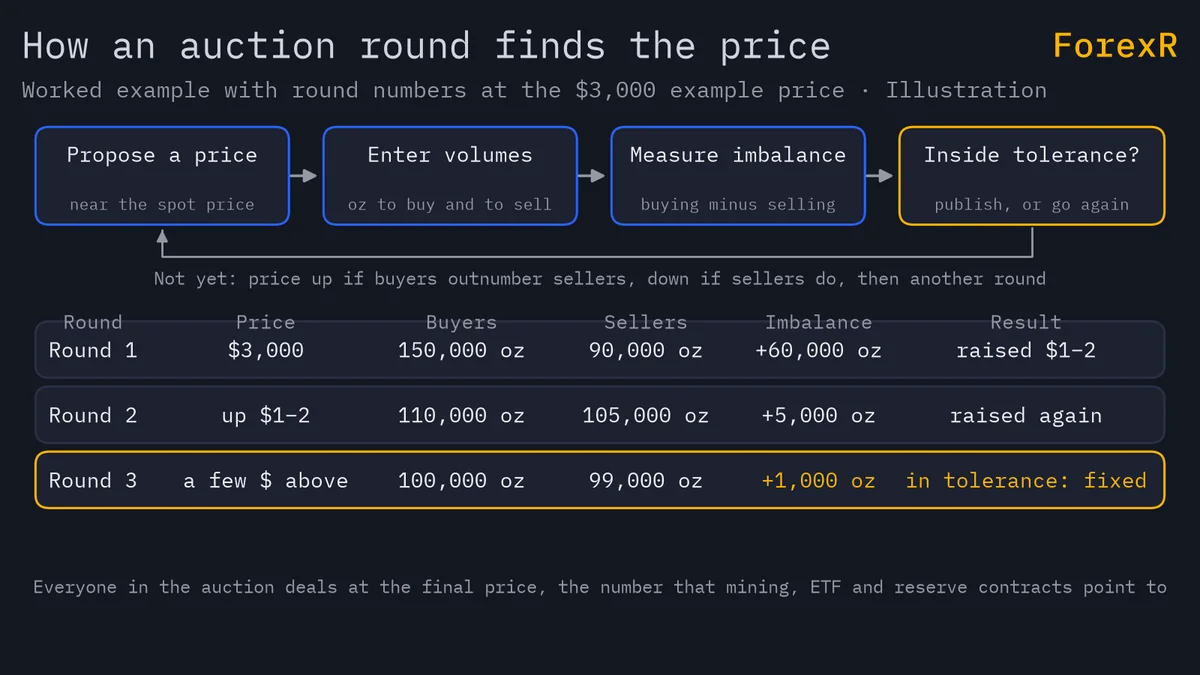
A worked example with round numbers, at the example price of $3,000 an ounce (an example, not a forecast). Round one opens at $3,000: buyers want 150,000 oz, sellers offer 90,000 oz, so the price is raised by a dollar or two. Round two at the higher price: buyers 110,000 oz, sellers 105,000 oz, still outside tolerance, so it ticks up again. Round three: 100,000 oz against 99,000 oz, inside tolerance, and the auction fixes there, a few dollars above where it began. Everyone in the auction deals at that single price, which is why a miner or an ETF can write it into a contract.
Who Uses the LBMA Gold Price
The benchmark sits inside contracts along the whole chain. Miners sell to refiners at the fix plus or minus a small margin. Large gold ETFs value their bars at the p.m. price to strike a daily net asset value. Central banks mark their reserves at it when they report. Refiners price kilobars off it. Jewellery wholesalers buy at a premium to it, and the shop at the end of the chain converts that into a local gram price.
Follow the arithmetic to the shop. At the example price of $3,000, one gram of pure gold is $96.45, and a gram of 916 jewellery holds about $88.35 of gold. Convert that at the day's exchange rate, add the wholesaler's premium and the shop's making charge, and you have the number on the board. The troy-ounce guide does the gram conversions, and the currency converter handles the ringgit, rupee or rupiah leg. When a shop in Kuala Lumpur or Chennai opens with a new price in the morning, it usually reflects the previous afternoon's London p.m. fix plus the overnight move in the currency.
How Your XAU/USD Quote Relates to the Fix
What people get wrong is the word "fix". Newcomers assume the price is fixed for the day, or that something is being rigged. Neither is true. Spot gold trades almost 23 hours a day; the fix is a snapshot of that continuous market at two moments, agreed by auction so that contracts have a number to point to. Your broker's XAU/USD quote comes from spot and futures feeds and never pauses for the auction. The a.m. and p.m. prices usually land within a few cents of where your chart was at that minute, and if they did not, dealers would trade the difference away.
Why 10:30 and 15:00 London Can See Extra Volume
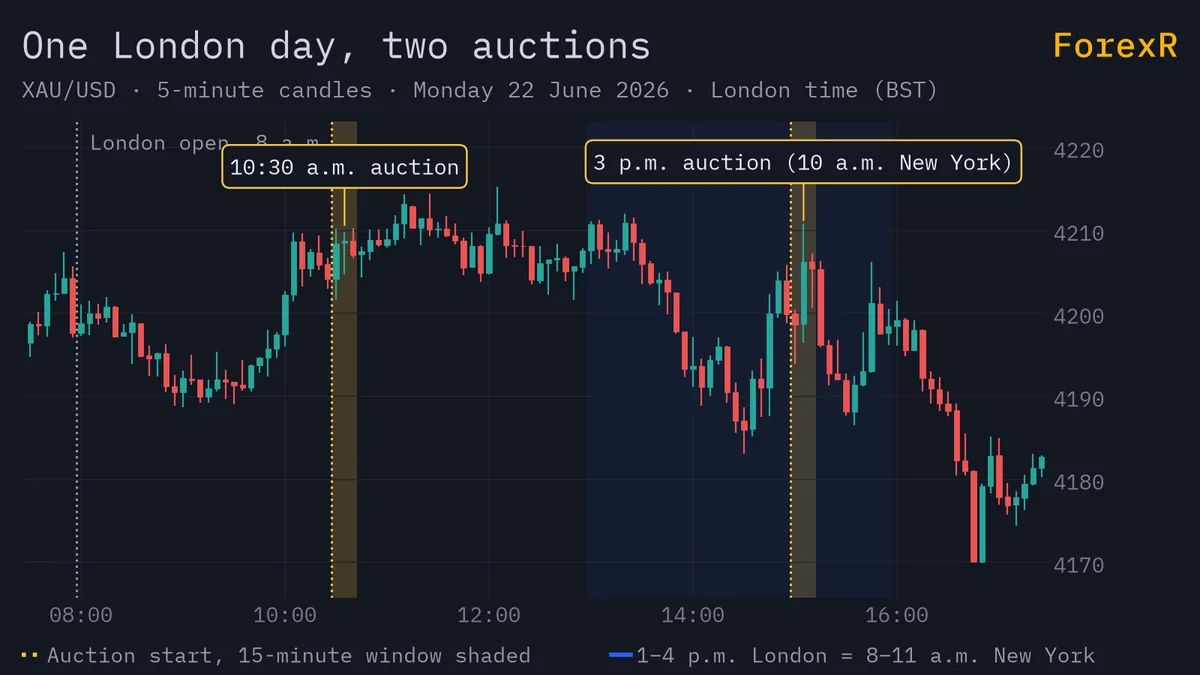
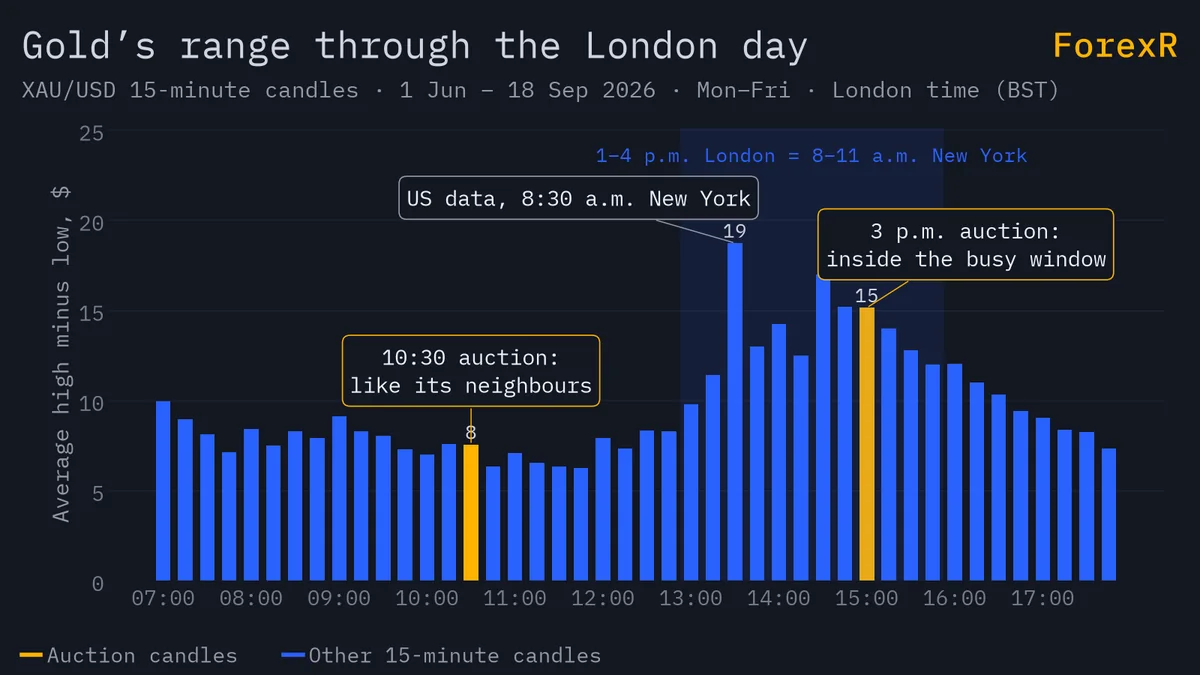
Three things meet at the p.m. fix. It is 3 p.m. in London and usually 10 a.m. in New York, so it lands inside the 8 to 11 a.m. New York window where gold's hourly range is largest. Benchmark orders are being worked, and the US morning's data is out. The 10:30 fix lands in the quieter London morning, but it is the first benchmark of the day for Asian and European physical buyers. In Kuala Lumpur, Singapore and Manila the p.m. fix falls at 10 p.m. in the British summer and 11 p.m. in winter; in Jakarta, Bangkok and Hanoi it is an hour earlier.
An evening trader in Ho Chi Minh City noticed that gold's 5-minute candles often lengthened around 9 p.m. his time through the northern summer, and wondered whether a US release he had missed was landing then. Nothing was scheduled. He was watching the London p.m. auction from thousands of kilometres away.
Try this for a week. On the live gold page, note the high-to-low range of the 15-minute candle that contains 10:30 London and the one that contains 15:00 London, and the ranges of the candles either side. After five days, compare. If the fix candles are wider on most days, treat them like a small scheduled event: widen a stop that sits a dollar or two away, or wait for the candle to close before entering. If not, you have learnt that too.
The Shanghai Benchmark and Good Delivery Bars
Since 2016 the Shanghai Gold Exchange has run a yuan-denominated benchmark with fixes at 10:15 a.m. and 2:15 p.m. Beijing time. It gives the world's largest physical market a reference in its own currency during the Asian session. The two benchmarks usually sit close once the exchange rate is applied; a persistent gap is read as local supply or demand pressure, not a broken price.
The bar behind all of this is the LBMA Good Delivery bar: 350 to 430 troy oz, nominally 400 oz or about 12.4 kg, at least 995 fine, cast by a refiner on the Good Delivery List so that a London vault accepts it without re-testing. Central banks, ETFs and London's clearing banks hold this bar. The kilobar sold in Asia, at 999.9 fine, is its retail cousin; the guide to owning gold covers what a retail buyer actually gets. A CFD, whichever broker you pick on the broker comparison page, gives exposure to this price without any bars.
A benchmark does not make gold safe. Leveraged gold CFDs carry a high risk of loss, gold can fall hard and fast between one fix and the next, and you should only risk money you can afford to lose.
FAQ
Is the LBMA Gold Price the same as the spot gold price?
Not quite. Spot gold is the continuous price in the London market and on your chart; the LBMA Gold Price is a snapshot of it, found by auction at 10:30 a.m. and 3 p.m. London time. The two usually match to within a few cents at that minute. Contracts use the benchmark because it is a single published number rather than a moving quote.
What time is the London gold fix in Malaysia and India?
The 10:30 a.m. London auction is 5:30 p.m. in Kuala Lumpur and 3 p.m. in Mumbai during British summer time, and an hour later in winter. The 3 p.m. London auction is 10 p.m. in Kuala Lumpur and 7:30 p.m. in Mumbai in summer, again an hour later in winter. Jakarta, Bangkok and Hanoi are one hour behind Kuala Lumpur.
Who runs the LBMA Gold Price auction?
Since 20 March 2015 an independent benchmark administrator has run the electronic auction on behalf of the London Bullion Market Association. The participants are accredited banks and dealers who enter buy and sell volumes each round. Before 2015 a handful of banks ran the fixing themselves by telephone, which is one reason the process was moved to a regulated, auditable platform.
Can I trade gold at the fix price with a CFD broker?
No. Orders executed at the LBMA Gold Price are placed with participating banks by institutions such as ETFs, refiners and miners. A CFD broker fills you at its own live quote, which at that minute is usually within a few cents of the auction result. If you want a fix-like fill, place your order at the time of the auction and accept the small difference.