Gold Futures vs Spot vs CFDs: Contango, Roll and Which to Trade

Gold Futures vs Spot vs CFDs: What Is the Difference?
The same ounce carries three prices. London spot is the price for metal settled now. A COMEX future is a promise to deliver 100 ounces in a set month, so it trades a little above spot. A retail CFD is a broker's quote built from the other two, with swap in place of a roll. They track each other, imperfectly.
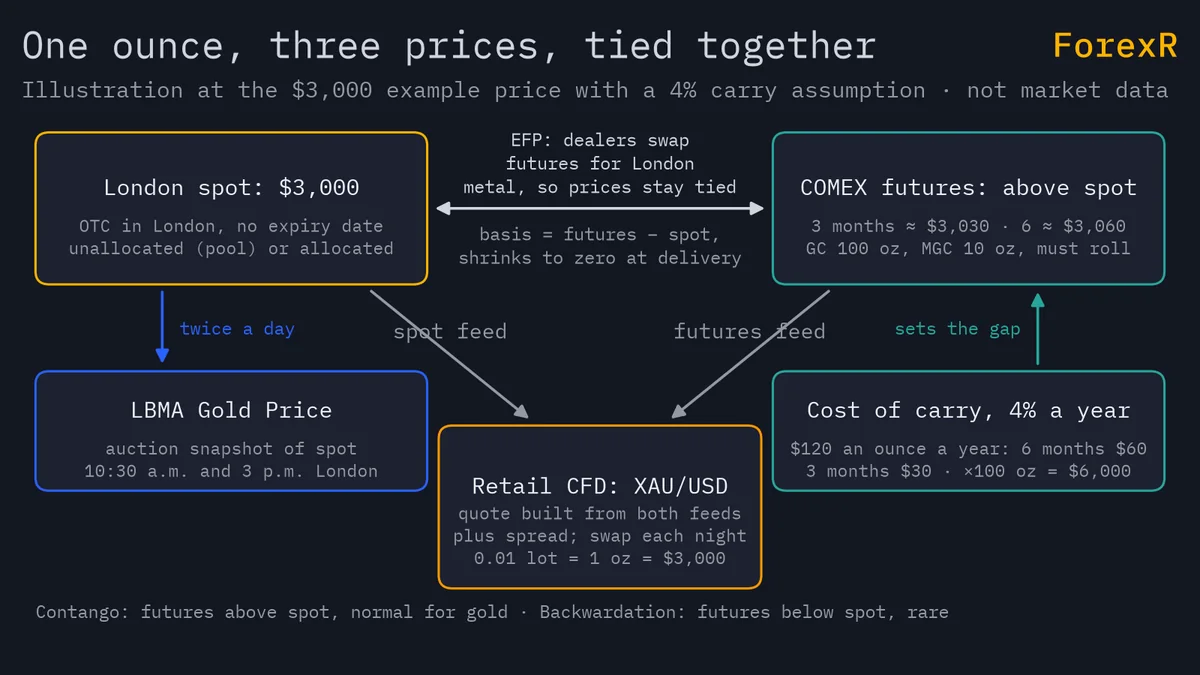
A one-paragraph pointer on spot versus futures sits in the XAU/USD specification guide. This guide owns the mechanics: how the three prices tie together, what carry and roll cost, and which route fits your size and holding period.
London Spot: Loco London, Allocated and Unallocated
Spot gold trades over the counter in London between banks, refiners and dealers as "loco London" metal, meaning the bars sit in London vaults. Most of it changes hands as unallocated gold: a claim on a bank's pool, with no specific bars set aside. Allocated gold is the opposite: numbered bars held in your name. It is the difference between money in a current account and notes in a safe-deposit box: the account moves in a second; the box is yours even if the bank fails.
London clears gold worth tens of billions of dollars every day, yet almost none of it moves. The bars stay where they are and only the ledger changes. The 400 oz bars behind it come from refiners on the LBMA Good Delivery List, and its reference price is set by auction twice a day; the LBMA Gold Price guide covers that benchmark.
COMEX Futures: Contract Sizes, Delivery Months and First Notice Day
COMEX, part of CME Group, lists the gold futures the world watches. The standard contract (GC) is 100 troy oz and the micro (MGC) is 10 troy oz. Contracts trade almost 23 hours a day, five days a week, with the same 5 p.m. New York break as your CFD. Each contract has a delivery month; the most active are February, April, June, August and December.
A future is a promise that comes due. Before first notice day, the day from which a long can be assigned delivery, a trader must close or roll into a later month, or the contract goes to physical delivery through exchange-approved warehouse receipts. The exchange sets margin per contract and raises it when volatility jumps, so the cash you need can change overnight; it is a performance bond, not a loan.
Contango, Backwardation and the Cost of Carry
Futures usually trade above spot, a state called contango, and the gap is roughly what it costs to carry gold until expiry: the US interest you give up (minus a small gold lease rate) plus storage and insurance. Backwardation, futures below spot, is rare in gold and signals physical tightness. The futures-minus-spot gap is called the basis.
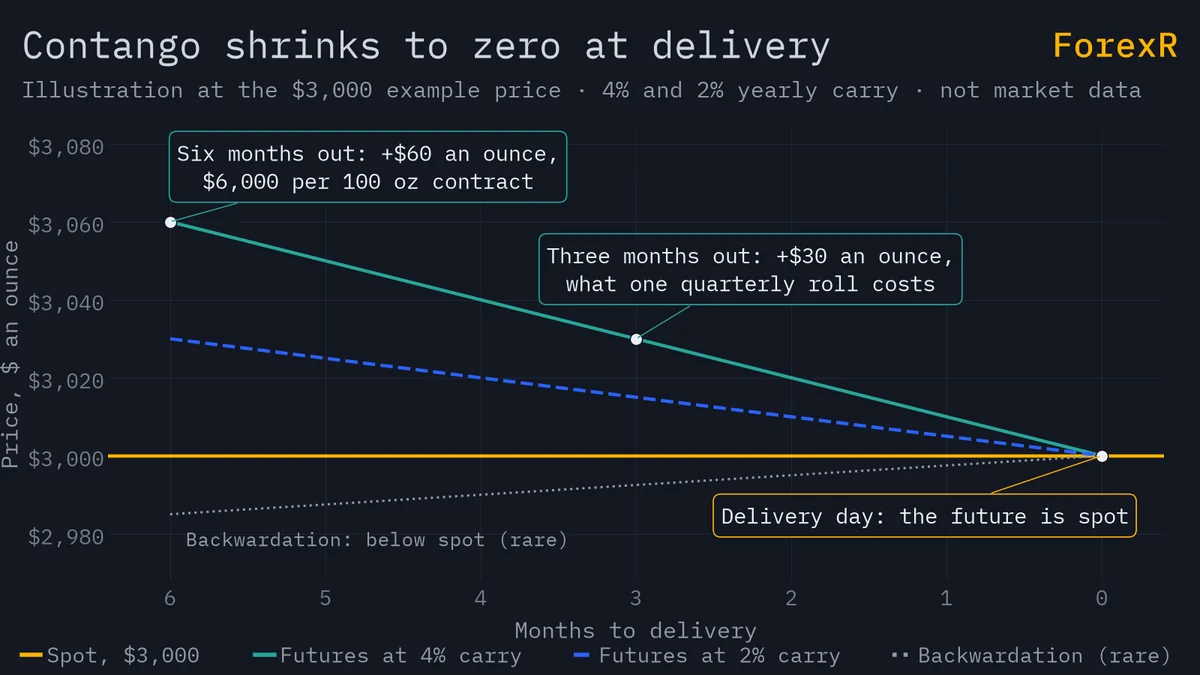
Work it through at the example price of $3,000 an ounce (an example, not a forecast) and suppose carrying gold costs 4% a year all in, an assumption for the sum, not a market reading. A year of carry is $120 an ounce, so a contract six months from delivery should sit about $60 above spot and one three months out about $30 above. Multiply by 100 oz and the six-month basis is $6,000 per contract. Change the assumption to 2% and every number halves. As expiry approaches the remaining carry shrinks, and the basis reaches zero on delivery day, when a future simply is spot gold.
What people get wrong is reading contango as a forecast. A future $60 above spot does not mean the market expects gold to rise $60. It means holding gold for six months costs about $60. If the market expected a rise, spot would already have risen. Contango is interest-rate arithmetic, the same arithmetic that makes long gold usually pay swap on a CFD.
Basis, EFP and Why Futures and Spot Converge
The two markets stay tied through the exchange for physical (EFP). An EFP lets a dealer swap a futures position for loco London metal at an agreed basis. If COMEX drifts too far above London, dealers sell futures, buy London gold and EFP the two together to pocket the excess, pulling the prices back into line. Convergence at expiry is the anchor; the EFP is the rope.
What Rolling a Futures Position Costs
Roll means closing the expiring month and opening the next one. In contango a long roller sells the cheaper near month and buys the dearer far month, so each roll locks in the carry as a cost. Using the sum above, a long rolled every three months pays about $30 an ounce per roll, or about $120 an ounce a year, which is $12,000 per 100 oz contract, plus spreads and slippage each time. A short roller collects that carry instead, which is why hedgers on the short side, such as miners or a jeweller hedging stock with a short, do not mind contango.
A CFD has no expiry, so there is no roll. Instead the broker charges swap every night at 5 p.m. New York, with one triple-swap night to cover the weekend. Swap is the roll paid in daily instalments. With an illustrative swap of −$40 per lot per night, ten nights including one triple night cost about $480 on a 1-lot long, and the swap guide shows how the nightly figure is built.
Retail CFDs: A Price Built From the Other Two
Your CFD is a contract with your broker to exchange the difference between the opening and closing price. No metal, no delivery month, no warehouse receipt. The broker builds its XAU/USD quote from spot and futures feeds, adds a spread, and finances the position through swap. Leverage is set by the broker and its regulator (1:20 under ESMA-style rules, often 1:100 to 1:500 offshore); futures margin is set by the exchange.
The cost is counterparty risk. Your profit is a claim on the broker, not on a clearing house, and your fill at news depends on the broker's liquidity, not an exchange order book. The lot-size guide covers the arithmetic of 1 lot = 100 oz, and comparing swap, spread and stop-out rules on the broker comparison page matters more on gold than on any major pair.
Which Route Suits You: Size, Holding Period, Hours and Account
- Size: one standard futures contract is 100 oz, $300,000 of gold at the example price; the micro is 10 oz, $30,000. A CFD goes down to 0.01 lot, one ounce, $3,000. Below one micro contract, a CFD is the only leveraged route.
- Holding period: for days or a few weeks, CFD swap is a nuisance. For months, futures roll and CFD swap add up to the same carry, but futures carry no broker mark-up on it.
- Hours: both trade 23 hours a day with the same break; London spot is a bank market, not a retail one.
- Account: futures need a futures broker, exchange margin and a buffer for margin increases; CFDs need an MT4/MT5 account with a regulated broker. AAOIFI Standard 57 does not permit conventional gold futures; the halal guide lays out the questions without ruling.
- Ownership: if you want metal, none of the three is the answer; the ways-to-own-gold guide covers bars, accounts and ETFs.
A full-time trader in Bangkok who holds gold for a month at a time compares the two each quarter: a year of her broker's swap against the futures roll implied by the gap between delivery months. She keeps whichever is cheaper for her size; some quarters the answer changes.
Try this in five minutes. Open your broker's contract specification and copy the long swap per lot per night. Multiply it by 365 plus about 104 for the extra triple nights, divide by 100 to get dollars per ounce, then divide by $3,000 and multiply by 100. That percentage is your CFD's cost of carry. Compare it with the 4% assumption above and with a single day's range on the live gold page.
Leveraged gold CFDs and gold futures both carry a high risk of loss, and futures add the risk of delivery and sudden margin increases. Gold can fall hard and fast in all three markets at once. Only risk money you can afford to lose, and know your carry cost before you hold through a weekend.
FAQ
Is spot gold the same as XAU/USD?
XAU is the ISO code for one troy ounce of gold, so XAU/USD names gold priced in US dollars. On a retail platform that symbol is a CFD built from spot and futures feeds, not the London bank market itself. It follows spot closely, but the price, spread, hours and swap are your broker's, and you never own or receive any metal.
Can a retail trader take delivery of gold from COMEX futures?
In principle yes: a long held past first notice day is assigned delivery through an exchange-approved warehouse receipt for 100 troy oz. In practice most retail futures brokers close or force out positions before that date, delivery involves fees and paperwork, and the bar stays in the warehouse until you pay to move it. A CFD never delivers at all.
Why is gold almost always in contango?
Because carrying gold costs money. The holder gives up US interest, pays storage and insurance, and earns back only a small gold lease rate. As long as interest exceeds the lease rate, a future must trade above spot by roughly that cost or dealers would buy spot and sell futures for a risk-free gain. Backwardation appears only when physical gold is scarce enough to push the lease rate up.
Does a gold CFD track the futures price or the spot price?
It tracks the broker's own feed, which is usually built from the spot market with futures as a cross-check. Most of the time the difference is a few cents, because EFP arbitrage keeps the two tied. Around the daily break, the Sunday open and news, a CFD quote can drift from both as the broker widens its spread and manages its own risk.