Hedging Physical Gold With XAU/USD: A Guide for Jewellers

What Does Hedging Physical Gold With XAU/USD Mean?
It means selling short, through a CFD, the same weight of gold you hold as metal, so a fall in the price loses on the shelf and gains in the account. A jeweller with 5 kg of 916 chains holds about 4.58 kg of fine gold; a short of about 1.47 lots of XAU/USD covers it. Insurance, not a strategy.
A hedge is a second position taken to cancel the risk of a first one. Your first position is the metal: every gram in the safe, the display case or the family cupboard is a long bet on the gold price, whether you think of it that way or not. The general hedging guide covers the idea for currency pairs; this one is for people whose exposure weighs something.
Who Should Even Think About This
- A jeweller carrying stock: the counter holds months of gold bought at yesterday’s prices and sold at tomorrow’s; the profit is meant to come from the making charge, not from guessing the metal.
- A dealer between buying and selling: scrap bought on Monday and refined and sold on Friday is exposed for a week.
- A family holding bars: kilobars or coins meant for a wedding or a house deposit in a year or two, where a fall before the date would hurt.
- Not a trader: if you hold no metal, a short XAU/USD is a speculation and belongs in a trading plan, not here.
Why Insurance, Not a Strategy
People often see hedging as the risky move and holding unhedged metal as the safe one. It is the other way round. The unhedged stock is the open position, and it has an unlimited holding period and no stop-loss. From the January 1980 peak of about $850 to the 1999 low, gold lost about 70% in dollar terms while US consumer prices roughly doubled; a jeweller who stocked up in 1980 and never hedged watched the inventory’s metal value fall for twenty years. From 2011 to 2015 the fall was about 45%. The gold price history guide lists every such stretch.
Think of a wedding-hall deposit. Paying it fixes the price of the hall: if the hall gets more expensive you are protected, and if it gets cheaper you do not benefit. Nobody calls the deposit a strategy for profiting from hall prices. A hedge fixes the price of your gold the same way, in both directions.
Converting Weight to Lots: Fine Gold First
One lot of XAU/USD is 100 troy ounces of 31.1035 g each, so one lot is 3,110.35 g of pure gold. The conversion is two steps.
- Fine gold content first: multiply the gross weight by the fineness. 916 jewellery is 91.6% gold, so 1,000 g of 916 holds 916 g of fine gold; a 999 kilobar holds 999 g. The units and purity guide has the full karat table.
- Grams to lots: divide fine grams by 3,110.35. So 5 kg of fine gold is 160.75 oz and 1.61 lots; 5 kg of 916 is 4,580 g fine, 147.25 oz and 1.47 lots.
Round to your broker’s lot step, usually 0.01; the unhedged remainder is a first taste of why this is never exact.
A Worked Example: 5 Kg of 916 Jewellery
Take a shop carrying 5 kg of 916 chains and bangles at the example price of $3,000 an ounce, an example, not a forecast. Fine gold: 5,000 × 0.916 = 4,580 g. Ounces: 4,580 ÷ 31.1035 = 147.25. Lots: 147.25 ÷ 100 = 1.47. The metal in the shop is worth 147.25 × $3,000, about $441,750 at spot before any making charge, and the short covers 147 of those ounces.
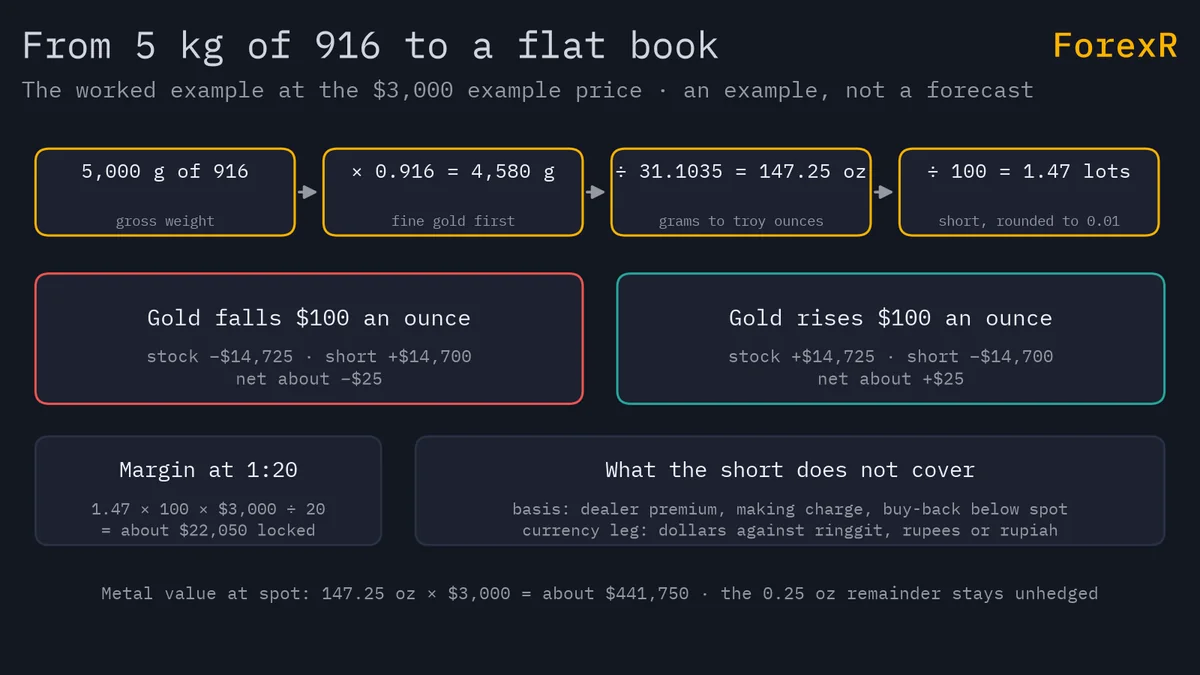
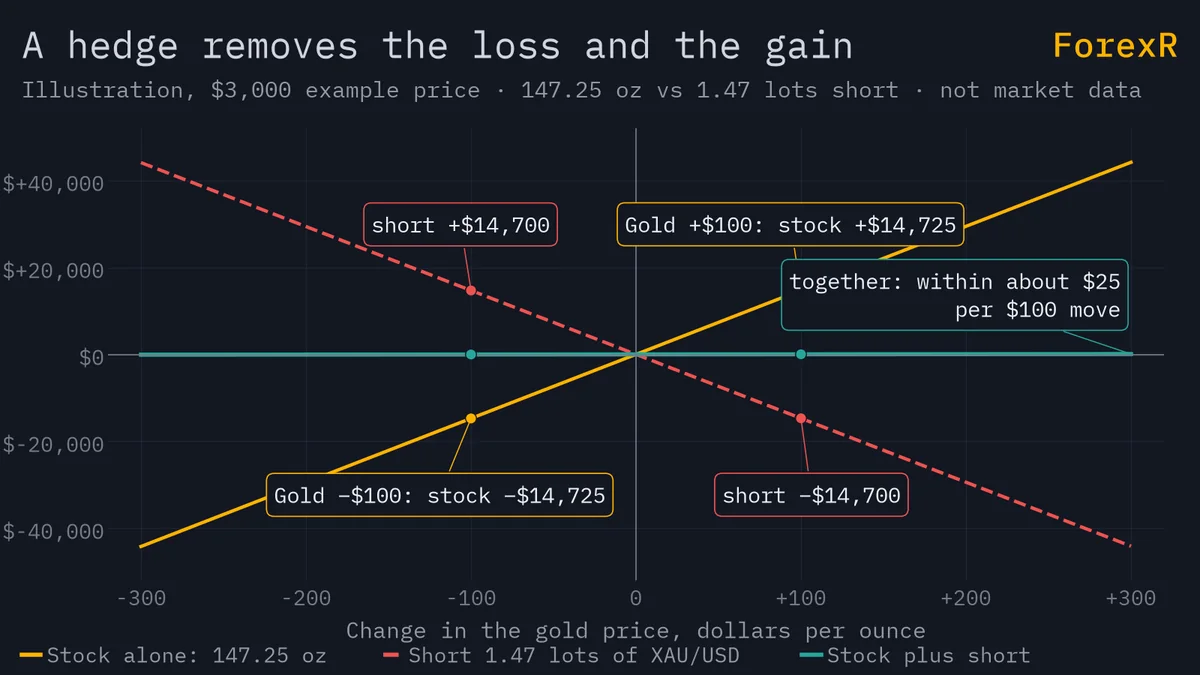
Now move the price. Gold falls $100 an ounce: the stock’s metal value falls by 147.25 × $100, about $14,725, and the 1.47-lot short gains 1.47 × 100 × $100 = $14,700. Gold rises $100: the stock gains about $14,725 and the short loses $14,700. Either way the shop’s gold is worth roughly what it was when the hedge went on, and the business earns what it should: the making charge and the retail premium. Margin at 1:20 leverage is 1.47 × 100 × $3,000 ÷ 20, about $22,050, which the margin calculator will confirm for your broker’s leverage.
What the Hedge Costs and Earns
- Spread: paid once on entry and once on exit. A $0.30 example spread on 1.47 lots is about $44 per round trip.
- Swap: on gold the long side usually pays, and the short side pays little or earns a little, because holding gold costs roughly the US interest rate minus a small lease rate. Check the contract specification for the short-side figure and the triple-swap day; the gold spread and swap guide explains the number.
- Margin locked: the $22,050 above sits idle in the account and must grow if the price rises, because the short loses as the stock gains.
- Time: someone has to watch it; a hedge nobody checks gets stopped out in a gap.
Why the Hedge Is Imperfect
Three gaps sit between a shop’s gold and a CFD quote.
- Basis: you buy and sell at local dealer prices that include premiums, making charges and buy-back discounts, not at spot. Those margins move on their own; the hedge covers only the spot leg, which the LBMA benchmark guide traces from London to the shop’s gram price.
- The currency leg: XAU/USD is priced in dollars, but you sell in ringgit, rupees or rupiah. If gold is flat in dollars and your currency weakens, your local gold price rises and the hedge does nothing. A dollar position against your currency, or an account in your local currency, can offset this.
- Gaps and margin calls: gold gaps on weekend news, and a short is on the wrong side of a fear rally. If the account cannot meet margin, the broker closes the hedge at the worst moment and leaves you unhedged in a rising market; the margin call guide explains the mechanics. Keep spare margin well above the minimum.
Futures as the Professional Alternative
Refiners and large dealers hedge on COMEX rather than with CFDs, using the 100 oz standard contract or the 10 oz micro, with exchange-set margin, expiry months and a roll before first notice day. Futures are cleared on an exchange rather than against a broker, but they need a futures account, more capital and attention to the roll. The futures vs spot vs CFD guide compares the three; for a shop hedging a few kilos, a CFD at a regulated broker from the broker comparison is the practical route, and the live XAU/USD page gives the spot reference to size against.
When to Put the Hedge on and Take It Off
A second-generation jeweller in Kuala Lumpur puts on the short the day a large purchase of 916 arrives from the wholesaler, and lifts a slice of it each week in step with what the counter sells. He does not wait for a good level: the hedge goes on when the exposure appears and comes off when it leaves. His one exception is the seconds around US data, which he lets pass before clicking.
Remember the accounting. A hedge removes the gain as well as the loss, so in a rising market the account shows a red number that matches a green number in the stockroom, and the two must be read together. If you find yourself lifting the hedge because gold “looks like it will rise”, you have stopped insuring and started trading. Whether a short CFD on gold is acceptable in Islamic finance is a separate question this guide does not rule on; the halal gold trading guide lays out the positions.
Try this on paper before any live order. List every item of stock with its gross weight and fineness, work out the fine grams, divide by 3,110.35 and round to 0.01 lot. Then place that short on a demo account and follow it against your stock valuation for a month.
The risks remain real: a leveraged short on gold can be closed out by a margin call in a gap, the basis between shop prices and spot can move against you, and physical gold carries its own buy-back spreads and storage risk. Hedge only with money set aside for margin, never with the working capital of the business.
FAQ
Can I hedge gold jewellery using a swap-free account?
Mechanically, yes: the short is placed the same way and the nightly swap is removed, though some brokers add an administration fee after a set number of days, so check the contract specification. A swap-free label does not settle the religious question of whether a short CFD is acceptable, because the CFD still involves no possession of gold. That is a matter for a qualified scholar.
How much margin do I need to hedge 1 kg of gold?
One kilogram of fine gold is 32.15 troy ounces, or 0.32 lots after rounding to your broker’s step. Notional value is lots × 100 × price, and margin is notional divided by leverage, so at the example price of $3,000 and 1:20 leverage the margin is a little under $5,000; at 1:100 it is about a fifth of that. Keep extra cash on top for a rising market.
Should I hedge all of my stock or only part of it?
Many businesses hedge the part of the stock they expect to hold for weeks and leave the fast-moving part alone, because a piece sold within days carries little price risk and the spread on the hedge would eat what it saves. A partial hedge means smaller margin. Decide the share in advance and stick to it; changing it because of a view on the price turns insurance into trading.
Is shorting gold to hedge the same as selling my gold?
No. You still own the metal, still pay for storage and insurance, and it still counts as your gold for accounting and any religious obligation such as zakat. The short only fixes its price for as long as the position is open. If you would rather not carry margin and watch a position, selling part of the stock outright is the simpler way to cut exposure.