How to Build an AI Trading Bot: An Honest Walkthrough

Can You Really Build an AI Trading Bot?
Yes, and the code is the easy part. A weekend is enough to write a bot; the real work is finding a testable edge, cleaning your data and proving the idea survives on data it has never seen. This guide walks that honest route in six steps, with the Python and MQL5 paths compared.
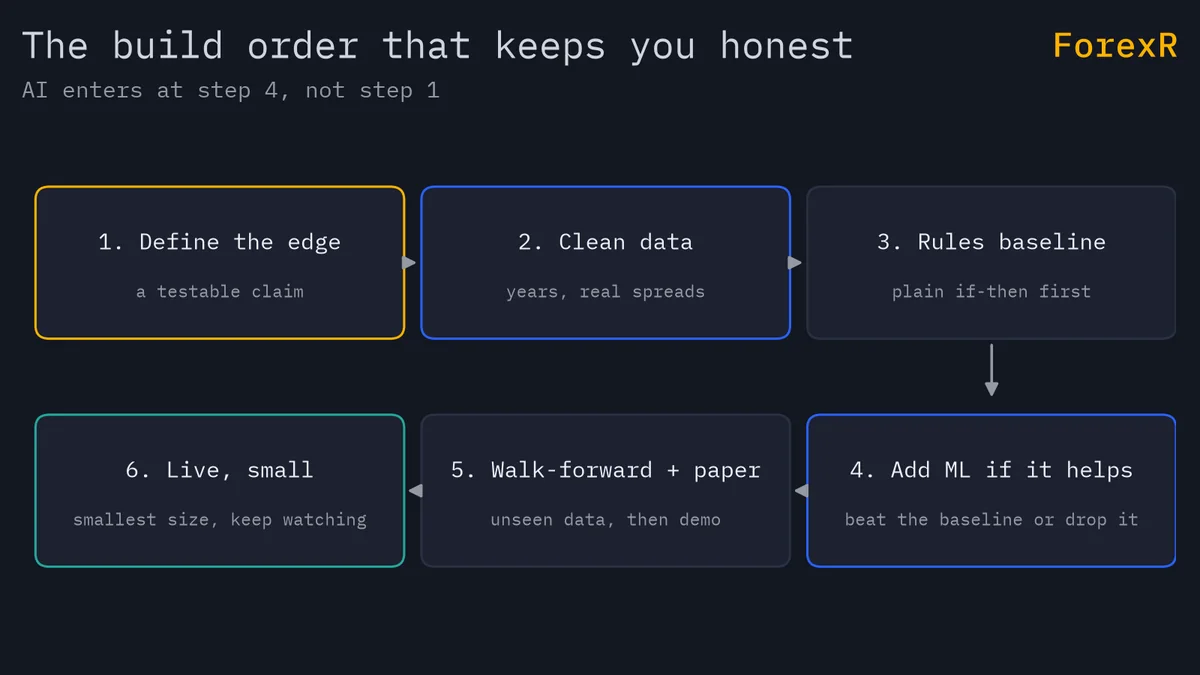
Set expectations first. Most retail bot projects fail, not because the builder lacked skill, but because there was no edge where they looked. Our overview of AI in forex explains what machine intelligence can and cannot do in this market; this guide assumes you want to build anyway, with your eyes open.
Step 1: Define a Testable Edge Before You Touch AI
An edge is a repeatable reason your wins should outweigh your losses. It must be written down as a rule precise enough to test. “The London session often breaks the Asian range within its first hour” is testable. “The AI will find patterns” is not a strategy, it is a hope, and a model trained on noise will happily hand you back noise dressed up as a pattern.
Write down the market, the timeframe, the entry, the exit and the filter before you write any code. If you cannot state your edge in two plain sentences, you are not ready for step two yet.
Step 2: Get Clean Data You Can Trust
Your bot will learn from history, so bad history teaches bad lessons. You need several years of price data for your chosen market, ideally covering calm stretches, strong trends and nasty shocks. Watch for gaps, bad ticks and weekend bars. Broker price feeds also differ slightly from each other, so test on data close to the feed you will actually trade on; if you have not chosen a firm yet, compare regulated brokers before you commit.
Collect the boring numbers too: typical spread, swap fees, and realistic slippage, the difference between the price you asked for and the price you actually got. Costs decide more bot projects than entries do.
Step 3: Build a Plain-Rules Baseline First
Before any machine learning, code your edge as fixed rules and test that version. This baseline tells you whether the idea has any life in it at all, and it gives every later AI version a number to beat. Skipping the baseline is the most common structural mistake in bot building.
Work the arithmetic on paper as well. Say the baseline takes 100 trades: it wins 50 at an average of $30 and loses 50 at an average of $20. Expectancy is 0.5 × $30 − 0.5 × $20 = $5 per trade before costs. Now charge $6 per trade for spread and slippage, and the same system loses $1 per trade. A strategy must clear its costs before anything else matters, and no amount of AI can repeal that rule.
Step 4: Add Machine Learning Only Where It Helps
Machine learning earns its keep as a helper, rarely as the whole strategy. Realistic upgrades to a working baseline include:
- Trade filters: a model scores every signal and skips the weakest ones, for example taking 60 of 100 signals while keeping most of the profit.
- Regime detection: a model flags ranging or trending conditions, so the bot only runs where its edge actually lives.
- Volatility sizing: a model forecasts how rough the next stretch may be, so position size shrinks when markets turn wild.
Our machine learning in forex guide explains features, labels and training in plain words. The danger to respect is overfitting, when a model memorises the past instead of learning a rule that survives the future. More parameters and more attempts make it worse, which is exactly why the next step exists.
Step 5: Walk-Forward Test, Then Paper Trade
Test the bot the way time actually flows: train on one stretch of history, trade the next untouched stretch, then roll the window forward and repeat. This walk-forward method, plus a final held-out test set used exactly once, is your best defence against fooling yourself. The full trap list, from look-ahead bias to data leakage, is covered in our AI backtesting guide.
If walk-forward results still look sane, run the bot on a demo account in real time. Give it enough trades to mean something, several months and dozens of trades at least, and compare live behaviour with the backtest. Differences are information: usually costs, data quirks or plain bugs.
Step 6: Go Live Small and Keep Watching
When demo results hold up, start with the smallest size your account allows, worked out with a position size calculator so one bad week cannot do serious damage. Decide your kill-switch before launch, for example: stop the bot if drawdown passes 10%, or if it trades twice as often as the backtest predicted. Sound risk management matters more for a bot than for a human, because a bot repeats its mistake perfectly, every time.
A live bot also has to stay switched on. A home computer that sleeps mid-trade is a genuine risk, and our guide to running an EA 24/7 walks through the options and their costs.
Python vs MQL5: Which Path Should You Choose?
- MQL5 (or MQL4): the built-in language of MT5 and MT4. Your bot becomes an expert advisor (EA) written in MetaEditor and tested in the platform's Strategy Tester; our EA backtesting guide walks through that workflow. Execution is handled for you, but machine-learning libraries are limited.
- Python: the standard language for data work and model training, with a huge ecosystem of free libraries. The catch is execution: Python needs a bridge to a platform or a broker API before it can place a trade.
- The common hybrid: research and train in Python, then ship the final, fixed rules as a plain MQL5 EA. You get Python's analysis power and the platform's reliable execution, without live model plumbing.
Reading working code beats reading about code. The ForexR EA Library's AI and machine-learning filter lists open-source MT4/MT5 EAs from GitHub, with stars, updates and licences synced automatically. The library never tests, verifies or recommends an EA, so treat every listing as study material rather than a shortcut.
Why Do Most AI Trading Bots Fail?
- No edge existed. The model searched noise and found noise. No amount of tuning fills an empty well.
- Overfitting. The bot memorised one version of the past, and the future declined to repeat it.
- Costs. Spread, swap and slippage quietly delete thin edges, exactly as the $5-per-trade example showed.
- Regime change. Markets shift character, and a model trained on one regime decays in the next.
- Operations. Crashes, disconnections and bad data feeds can turn a sound strategy into a losing account.
An AI bot automates your rules; it does not remove the risk inside them. It cannot foresee news, cannot promise profit, and cannot watch itself with human judgement. Leveraged forex and CFD trading carries a high risk of loss, and ESMA-era disclosures show 74-89% of retail CFD accounts lose money. Build carefully, start small, and only ever risk money you can afford to lose.
FAQ
How much money do I need to run an AI trading bot?
There is no fixed number, but count all the costs first: hosting so the bot runs around the clock, possibly paid data, and the trading capital itself. On a very small account, fixed costs and spreads can outweigh any realistic profit. Testing costs nothing, though: build and prove the bot on a demo account before a single real dollar is involved.
How long does it take to build an AI trading bot?
Writing the first version can take a weekend. Making it trustworthy takes months, because validation is the slow part: cleaning data, walk-forward testing, then several months of demo trading to gather enough live trades to judge. Be suspicious of anyone promising a working AI bot in days; that speed is only possible by skipping the steps that protect you.
Can I build a trading bot without knowing how to code?
Partly. AI code assistants and visual strategy builders can produce a working bot from a plain-English description. The danger is running code you cannot read: you cannot spot the bug that doubles your position size or ignores your stop. If you go this route, keep the logic simple, test on demo for longer, and learn enough code to audit what you run.
Should my trading bot trade every day?
No. Trade frequency should come from the edge, not from impatience. A sound rule might fire three times a week; forcing daily trades just adds spread and slippage costs, and gives an overfitted model more chances to be wrong. Judge the bot on expectancy per trade and drawdown over months, not on how busy it looks day to day.