Gold EAs and Trading Bots: Why XAU/USD Breaks Forex Robots

Why Do Forex EAs Fail on Gold?
An expert advisor (EA) is a program that trades your MT4 or MT5 account by fixed rules, and rules written for EUR/USD assume a market that moves in pips and never closes. Gold moves in dollars, costs more to hold, breaks for an hour every day and spikes on US data. Same code, different planet.
This guide assumes you know what an EA is and how to install one; the expert advisors guide covers that. Everything here is specific to XAU/USD: what to change, how to test it and what to check before a single live lot.
Six Ways Gold Differs From EUR/USD for a Robot
- Dollar ranges: a daily range of 1-2% is ordinary for gold. At the example price of $3,000 an ounce (an example, not a forecast) that is $30-60 a day, and one lot moves $100 per dollar.
- Spread: quoted in cents and wider than a major pair’s in cost per lot, so short-target logic that survives on EUR/USD bleeds on gold.
- Swap: the long side of gold usually pays every night, with one triple-swap weekday. An EA that holds longs for weeks pays a bill the EUR/USD backtest never showed; the gold spread and swap guide has the arithmetic.
- The daily break: gold stops trading from 5 p.m. to 6 p.m. New York every day, spreads are widest either side of it, and an EA that trades on a clock can open into the worst price of the day.
- News spikes: CPI, the Fed and payrolls hit gold hard, with slippage and long wicks in the first minutes.
- Gaps: gold opens on Sunday evening New York time with a gap whenever the weekend brought geopolitics, and a stop is filled at the first available price, not the price in the code.
What Each EA Family Does on Gold
- Grid and martingale EAs: add positions, or bigger ones, as price moves against them. On gold they produce their smoothest equity curves in ranges and their worst blow-ups in long trends and news spikes, because gold’s trends run far further in dollars per lot than a major pair’s. The martingale and grid guide explains the maths of the eventual loss.
- Trend-followers: moving-average or channel systems that buy strength; they catch gold’s clean trends and get whipsawed in its wide, noisy ranges, where a $30 swing looks like a breakout and is not.
- Breakout bots: built for the London open on the Asian range; on gold the break comes with a wider spread and more false starts than on a major pair.
- News bots: straddle a release with pending orders; on gold the spread widens and slippage arrives exactly as they trigger.
What People Get Wrong: The Smooth Gold Backtest
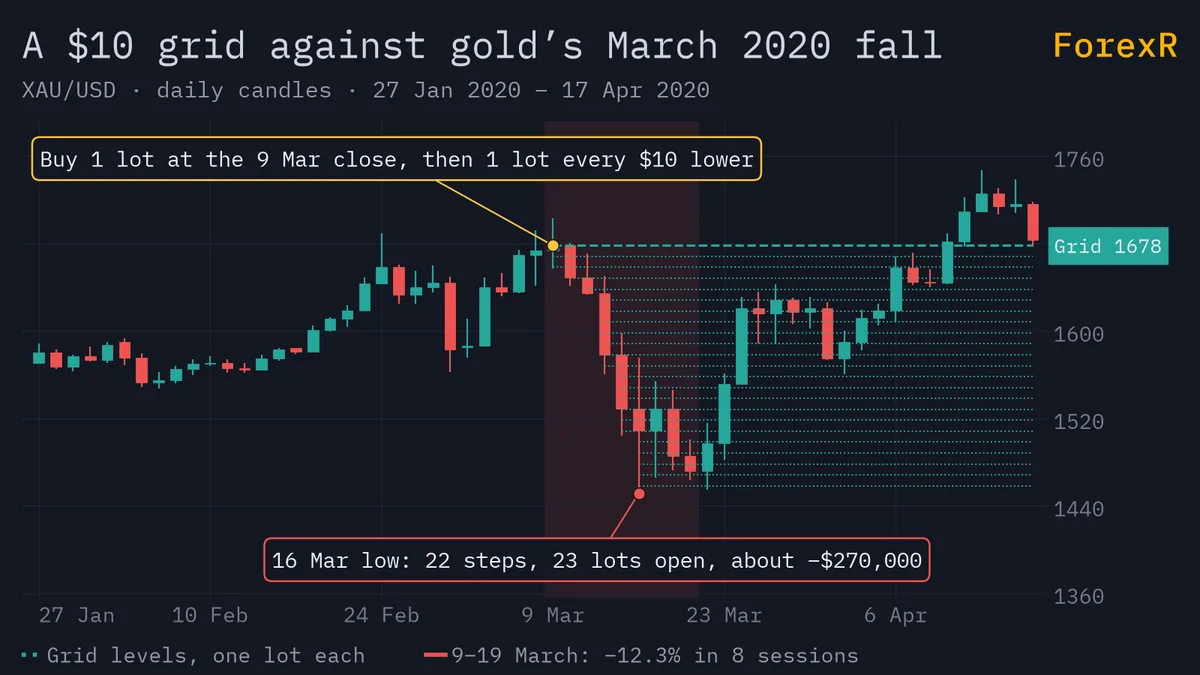
The belief: a five-year backtest on XAU/USD with a steady, rising equity line proves an EA is safe. On gold a steady line is more often a warning than a credential. Grids and martingales show exactly that shape while they work, because every losing position stays open and is never counted as a loss until the account cannot carry it. In the March 2020 crash gold fell about 12% in about eight trading days; at the example price of $3,000 that is a move of about $360, and a grid adding a lot every $10 against it would be carrying dozens of lots long before the bottom. The gold price history guide lists such moves, including a fall of about 45% from 2011 to 2015. Look for the maximum drawdown and the largest open loss, not the shape of the line.
The Settings That Must Change for XAU/USD
Think of an EA as a rice-cooker recipe: the steps are the same for every grain, but the water and the timing are not, and basmati settings ruin glutinous rice. Below are gold’s water and timing; the EA settings guide explains what each parameter does.
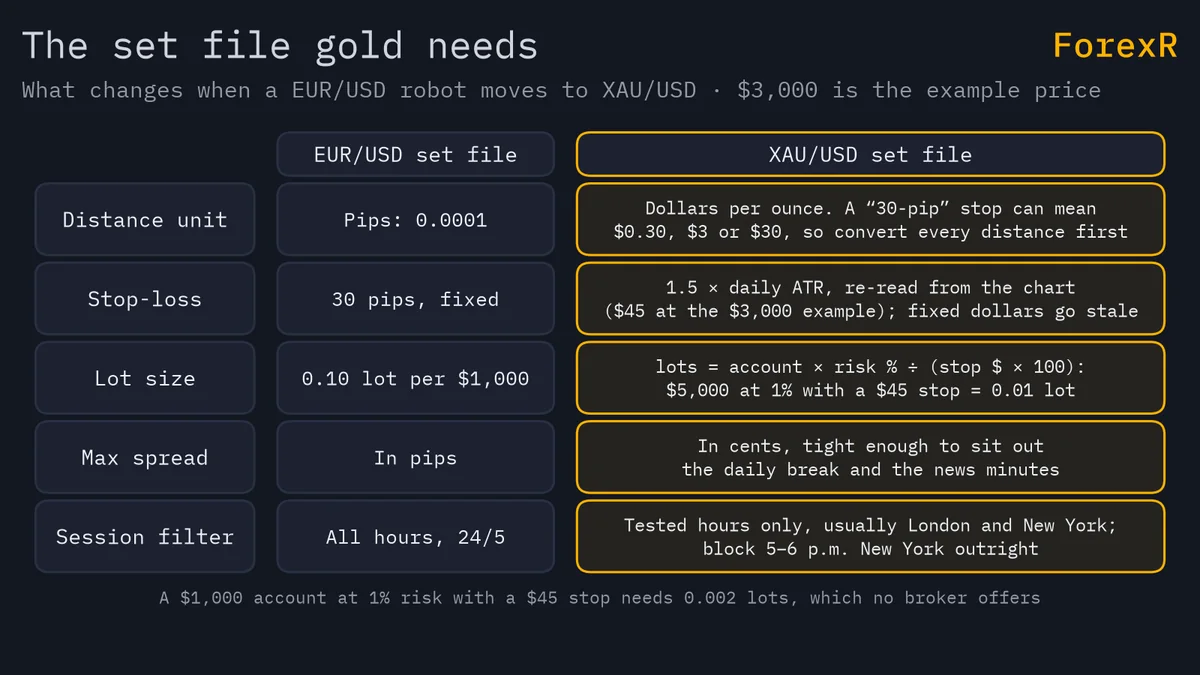
- Points vs pips: brokers quote gold to two decimals, and some call $0.01 a point and $0.10 a pip while others call $1 a pip. A “30-pip” stop can mean $0.30, $3 or $30. Convert every distance into dollars per ounce first.
- Stop distance in ATR: gold’s daily ATR can more than double within a few months, so a fixed-dollar stop goes stale. Set stops and targets as a multiple of the ATR the EA reads from the chart; the live XAU/USD page shows the current figure.
- Lot sizing from dollars: lots = (account × risk %) ÷ (stop in dollars × 100). Never accept a fixed lot per thousand of balance chosen for a forex pair.
- Max spread filter: in cents, not pips, and tight enough to keep the robot out of the break and the news minutes.
- Session filter: allow trading only in the hours you have tested, usually London and New York, and block 5 p.m. to 6 p.m. New York outright.
A Worked Example: Transplanting a EUR/USD Set File
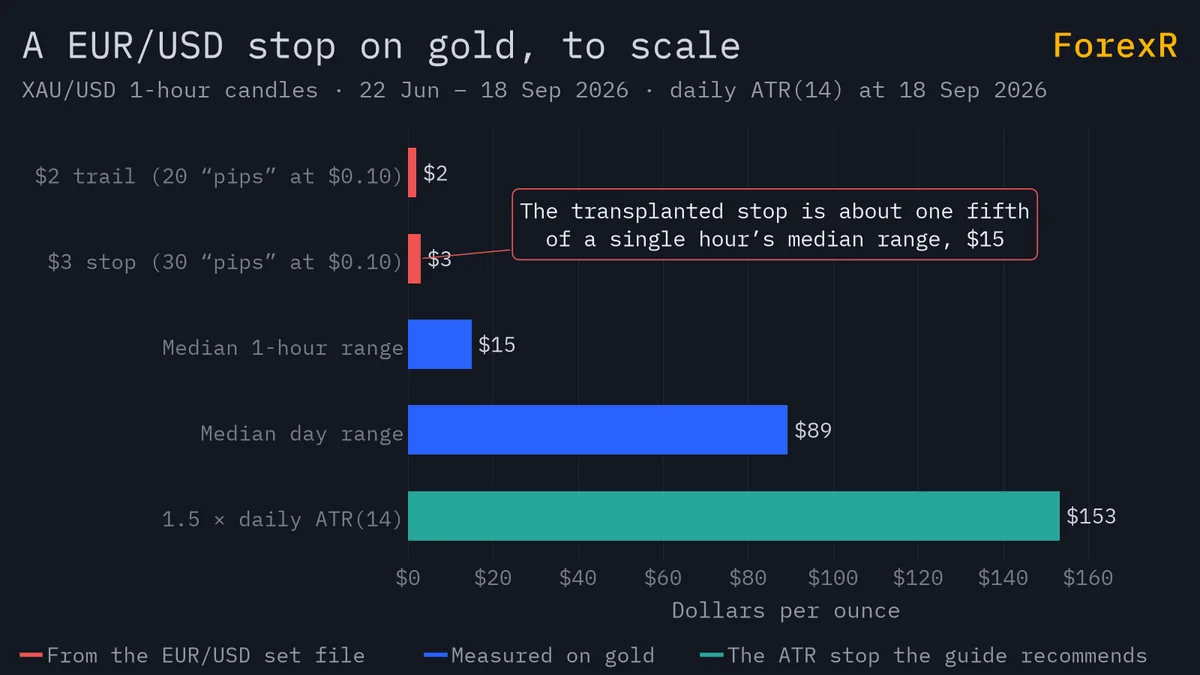
A trend EA runs on EUR/USD with a 30-pip stop, a 20-pip trailing step and 0.10 lot per $1,000 of balance. On gold at a broker that calls $0.10 a pip, the stop becomes $3 and the trail $2, both inside the noise of a single hour on an ordinary $30 day. Now the size: 0.10 lot on gold moves $10 per dollar, so a $30 day swings $300 against a $1,000 account, 30% of it, on an unremarkable day. Sized properly, with a 1.5 × ATR stop of $45 and 1% risk, the same account gets $10 ÷ ($45 × 100) = 0.002 lots, which no broker offers: a $1,000 account cannot run this EA on gold at 1% risk. A $5,000 account gets $50 ÷ ($45 × 100) = 0.011, rounded down to 0.01 lot.
How to Backtest a Gold EA Properly
The general method is in the EA backtesting guide; gold adds four rules. Use MT5’s “every tick based on real ticks” mode, because gold’s spikes live between one-minute bars and a modelled tick stream hides them. Use your broker’s real, variable spread, never a fixed figure, so the test pays the widened spread at the break and at news. Switch swap on and make sure the tester knows the triple-swap day. And check that the data include the 5 p.m. break, or the test is meaningless. Then forward-test on demo for weeks, comparing every fill with the backtest.
Browsing the EA Library’s Gold Filter
ForexR’s EA Library filtered to gold lists open-source MT4 and MT5 EAs from GitHub automatically, with a summary of each. The site does not test or recommend any of them; a listing is a starting point for reading the code, not an endorsement. The low-risk filter hides grid and martingale EAs, a sensible first cut for gold.
A Checklist Before Running Any Gold EA Live
A shift worker in Cebu runs a breakout EA on a rented server so it trades London while he sleeps. On demo it opened into the daily break twice and lost the spread each time, so he added a session filter and watched another month. He still checks the log every morning and switches it off before Fed days.
- Every distance converted to dollars per ounce and checked against the daily ATR.
- Lot sizing from dollars at risk, with the minimum 0.01 lot fitting your account.
- No averaging into losers unless you have read the code and accept the eventual loss.
- Spread and session filters that block the break, the Sunday open and release minutes.
- Backtest on real ticks with variable spread and swap, then a demo forward test in the hours you will trade, as the guide to running an EA 24/7 sets out.
- A broker whose metals spread, swap, stop level and execution at news suit an EA; compare them on the broker comparison.
Try this in five minutes: take the set file of any gold EA you are considering and write each pip or point parameter in dollars per ounce at the example price of $3,000. If the stop is under one daily ATR, stop there.
No EA removes risk. Leveraged gold CFDs carry a high risk of loss, gold can fall hard and fast, an EA can lose faster than a human because it never hesitates, and ESMA-era disclosures show 74-89% of retail CFD accounts lose money. Risk only money you can afford to lose.
FAQ
Do gold EAs work better on a swap-free account?
A swap-free account removes the nightly charge on long gold positions, which matters for an EA that holds trades for days, but it changes nothing else: the spread, the daily break, news slippage and Sunday gaps remain. Some brokers replace swap with an administration fee after a set number of days, so a long-holding EA may still pay. Backtest with the fee the account actually charges.
Which timeframe is best for a gold EA?
There is no universal answer. Shorter timeframes multiply the number of trades and therefore the spread paid, and gold’s spread is wide in dollar terms. Longer timeframes need ATR-based stops that can be $30 or more per ounce at the example price, which means more margin and smaller lots. Test the EA on the timeframe it was built for, with real ticks, before changing it.
Is a gold scalping EA a good idea?
It is the hardest gold robot to run, because a scalp targets a move of a dollar or three per ounce and the spread takes a large slice of that on every trade. Slippage in the news minutes thins the edge further. If you test one, use real ticks, a session filter and the widest spread your broker showed, and expect demo to be worse than the backtest.
Are the EAs in the ForexR EA Library safe to use?
They are open-source MT4 and MT5 programs collected from GitHub and listed automatically. ForexR does not test, verify or recommend any of them, and a listing says nothing about whether one is profitable or safe. Read the source code, check how it sizes lots and where it puts stops, backtest it on real ticks and run it on a demo account before it touches money.