Machine Learning in Forex: What Works and What Fails

What Is Machine Learning in Forex?
Machine learning in forex means training software on historical market data so it learns rules from examples instead of being given them. A model is shown inputs (features) and answers (labels) and finds patterns that map one to the other. It works well in some jobs, such as volatility forecasting, and badly in the famous one: predicting tomorrow's price.
Features, Labels and Training Data Explained
The common flavour in trading is supervised learning, which means learning from labelled examples. You give the model rows of history. Each row holds features, the inputs, such as yesterday's return or current volatility, and a label, the answer you want predicted, such as whether price closed higher the next day. The model searches for a mathematical rule that links features to labels. Crucially, the data is split. The model learns on a training set and is then judged on a test set it has never seen, because scoring a model on the data it learned from is like marking your own homework with the answer sheet open. This is also the real difference from a classic rule-based robot, where a human writes the rules in advance; that dividing line is the subject of AI trading vs algorithmic trading.
A Worked Example With Round Numbers
Take 1,000 days of EUR/USD daily data, about four years. The features for each day are simple: the past five days' return, the current ATR (average true range, a measure of normal daily movement), and the day of the week. The label is 1 if the next day closed higher, 0 if not. Train the model on the first 800 days and hold back the last 200 as the test set.
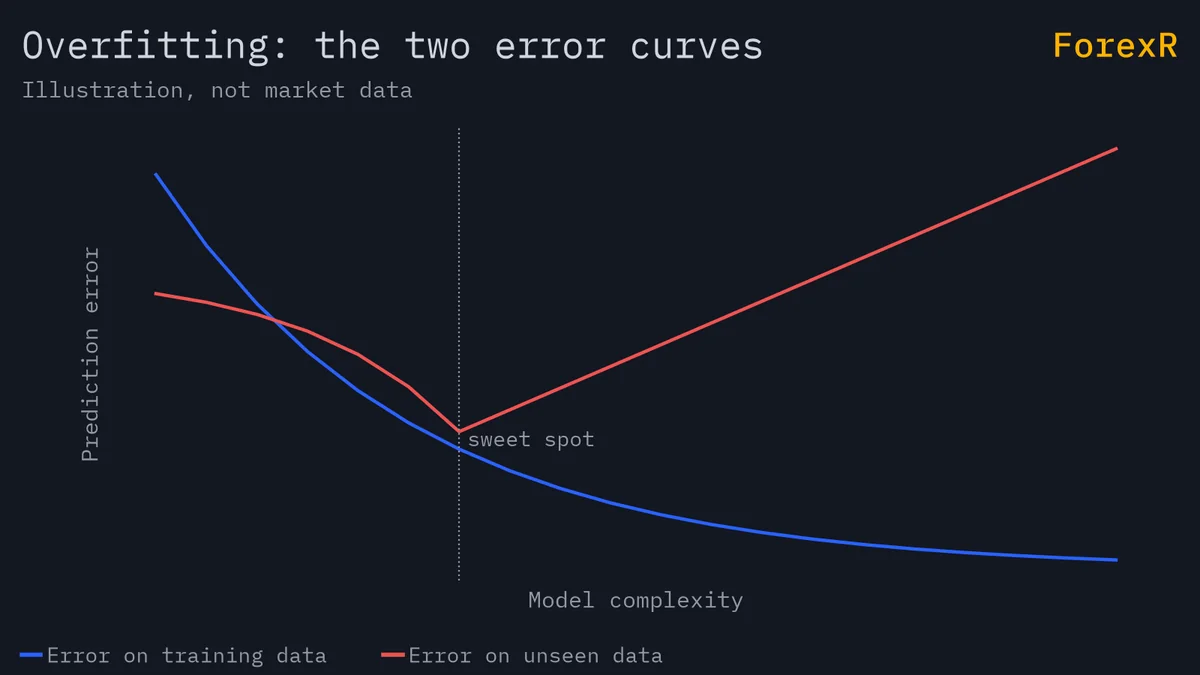
Say the model calls the training days correctly 58% of the time, but the unseen test days only 51% of the time. Now price that edge. Imagine 100 test trades risking 20 pips to make 20 pips: 51 winners earn 1,020 pips, 49 losers cost 980 pips, leaving 40 pips of gross edge. Then subtract costs at 1.5 pips per trade, which is 150 pips across 100 trades, and the account is down 110 pips. The model was better than a coin flip and still lost money. The gap between 58% and 51% is also your first warning of overfitting, when a model memorises the past instead of learning a rule that survives the future.
Why Forex Is Harder Than Image Recognition
Machine learning is genuinely brilliant at some jobs, such as recognising objects in photos, and the difference between those jobs and forex explains most failed projects.
- Low signal-to-noise. A cat photo is nearly all signal. A day of price data is mostly noise, random-looking movement, with only a sliver of repeatable pattern buried inside, so the model has very little true signal to learn from.
- Non-stationarity. This means the statistical rules of the data change over time. A cat photographed next year is still a cat. The euro next year is driven by different interest rates, different politics and different flows than the euro the model trained on.
- Markets adapt. Prices flip between regimes, distinct market conditions such as trending, ranging, calm and panicked, and profitable patterns attract traders whose own orders erode the pattern. The subject learns it is being photographed and changes its pose.
Where Machine Learning Earns Its Keep
Models earn a place where the target is more stable than tomorrow's direction.
- Volatility forecasting. Volatility clusters: wild days tend to follow wild days, and calm follows calm. Predicting how much price may move is far more tractable than predicting which way, and it directly improves stop placement and position sizing. It is also why the most volatile currency pairs keep their character for long stretches.
- Regime filters. A model that only has to answer “is this market trending or ranging?” faces an easier question than “up or down tomorrow?”, and its answer can switch an ordinary strategy on and off.
- Execution. Large institutions use models to time and slice big orders so they move the market less. The retail version of that lesson is smaller but real: costs are the one thing you can reliably improve.
Why Predicting Tomorrow's Direction Keeps Failing
Direction is the prize everyone wants and the target with the least signal in it. If a stable pattern reliably predicted tomorrow's close, traders exploiting it would move prices until the pattern faded, so whatever edge survives is small, unstable and easily eaten by costs, exactly as the worked example showed. Our AI forex trading guide covers the wider question of what AI can and cannot do in live trading; the short version is that a model that must beat spread, slippage and regime change every single day is fighting uphill, whatever its training accuracy says.
Overfitting: The Trap That Catches Almost Everyone
Overfitting deserves its own section because it catches beginners and professionals alike, and forex data practically invites it. With enough features and enough attempts, some model will always fit the old noise beautifully. Test a thousand random strategies on the same history and the best one will look brilliant by pure luck, while containing no edge at all. The defences are procedural rather than clever: keep a final test set untouched until the very end, use walk-forward testing (train on one period, test on the next, then slide forward and repeat), and count every experiment you run, because the more models you tried, the less your best result means. These traps, and the discipline that counters them, get a full guide of their own in how to backtest an AI strategy.
How to Try Machine Learning Without Fooling Yourself
Experimenting is a fine way to learn, provided you do it in an order that keeps you honest.
- Build a plain baseline first. Code a simple rule, such as a moving-average filter, and test it properly. If the model cannot beat the plain version out of sample, it has added complexity and nothing else.
- Get clean data. Gaps, wrong timestamps and duplicate candles poison labels silently, and no model recovers from poisoned labels.
- Split, then walk forward. Train on one period, test on the next, slide the window and repeat, and leave one final slice of history untouched until the very end.
- Test like an EA. Python is the usual research tool, but a strategy that will trade on MT4 or MT5 should also face the Strategy Tester with realistic spread settings, as our guide on how to backtest an EA explains.
- Paper trade and keep a journal. Live behaviour differs from any test, and backtesting and a trading journal shows how to record it honestly.
- Study working code. The free ForexR EA Library lists open-source AI and machine-learning EAs from GitHub, with stars, updates and licences synced automatically. It never tests, verifies or recommends an EA, so treat it as a reading list, not a menu.
Finally, remember that costs decide the outcome. The worked example lost because 1.5 pips per trade ate a 40-pip edge, so a small real edge survives only where costs are tight; compare brokers on spreads and execution before you test with money.
The Risks of Machine Learning in Forex
Machine learning cannot manufacture an edge that is not in the data: it finds patterns whether they are real or noise, it cannot foresee regime change, and a beautiful backtest is a claim about the past, not a promise about the future. Leveraged forex and CFD trading carries a high risk of loss, and ESMA-era disclosures show 74-89% of retail CFD accounts lose money, so test on paper first, treat every model as wrong until live out-of-sample results say otherwise, and only risk money you can afford to lose.
FAQ
Do banks and hedge funds use machine learning in forex?
Yes, heavily, but mostly not to guess tomorrow's direction. Large institutions use models for execution, meaning trading big orders cheaply, plus risk measurement, fraud detection and pricing. They also hold advantages retail traders cannot copy: private flow data, dedicated researchers and serious infrastructure. Their success in those jobs says nothing about whether a retail model trained on free price data can predict prices.
How much data do you need to train a forex model?
More than most beginners expect. A few hundred daily candles is far too little for reliable patterns; a thousand is a bare minimum, and daily data only produces about 260 candles a year. More history helps, but it brings a catch: older data comes from different market regimes, so the model may learn rules the current market no longer follows.
What is the best programming language for machine learning in forex?
Python is the practical default: free libraries cover data handling, model training and testing, and most tutorials assume it. MQL5 lets a model run inside MT5 and use the Strategy Tester directly. Many builders research in Python, then port the finished rules. The language matters far less than testing discipline; a leaky backtest fails the same way in every language.
Can machine learning work on small timeframes like one minute?
The obstacles get worse as timeframes shrink. Costs are the killer: spread and slippage stay roughly fixed per trade while the average move per trade shrinks, so a tiny edge is consumed faster. Noise also rises and data quality matters more. If a model cannot show an edge on hourly or daily data after costs, one-minute data will not save it.