How to Backtest an AI Trading Strategy the Right Way

How Do You Backtest an AI Trading Strategy?
Split your history into training, validation and test sets in time order, tune only on validation, and touch the test set once, at the end. Walk the model forward through time, charge realistic spread and slippage, and judge drawdown and trade count, not just win rate. AI strategies need this extra discipline because they are built to fit data.
A backtest, a replay of a strategy over past prices, is the cheapest way to kill a bad idea before it costs money. Our backtesting and trading journal guide covers the general craft; this guide covers the traps that are special to machine-learning strategies, because they fail in quieter and sneakier ways.
Why Do AI Backtests Lie More Often?
A fixed-rule strategy can only cheat in a few places. A machine-learning model is different: it is a machine for finding patterns, and it will find them whether or not they are real. Give it enough freedom and it will reconstruct the past perfectly while predicting the future not at all. Our machine learning in forex guide explains why price data makes this worse: weak signal, heavy noise, and rules that shift over time.
So treat an AI backtest as guilty until proven innocent, then work through the traps below in order. Each one has inflated thousands of published results, and each one has a practical counter.
What Is Look-Ahead Bias?
Look-ahead bias means the test quietly used information that did not exist at the moment of each trade. Classic versions include trading today's open using today's close, or computing an indicator across a full day and then acting inside that same day.
Machine learning adds sneakier versions. The most common is scaling: if you normalise features using the average and range of the whole dataset, every training row secretly knows something about the future. The rule is strict: compute every feature, every scaler and every label using only data available at that bar's timestamp. One careless line of code can add years of imaginary profit to a report.
Data Leakage and Survivorship Bias Explained
Data leakage means test data seeps into training, so the model is examined on questions it has already seen. The usual leaks:
- Shuffling time series: randomly mixing rows before splitting puts tomorrow's bars in the training set and yesterday's in the test set.
- Overlapping windows: features built from long lookback windows can straddle the split line, letting training rows contain test-period prices.
- Tuning on the test set: every time you peek at test results and adjust the model, the test set quietly turns into another training set.
Survivorship bias is choosing markets with hindsight, for example testing only pairs or strategies that are still popular today. Fix your market list in advance and keep it fixed.
Curve Fitting and the Hundred-Tries Trap
Curve fitting means shaping a strategy to match past accidents instead of a lasting rule. AI makes it industrial. Test one hundred model variants and a handful will look brilliant by pure luck, the same way someone in a large crowd of coin-flippers throws seven heads in a row. Publish the lucky one and it looks exactly like skill.
The counter is to count your tries. If you tested forty ideas, your best result must be judged against the luck of forty draws, not one. The baseline-first discipline in our bot-building guide exists partly to limit this: a few well-motivated attempts beat a thousand blind ones.
Train, Validation and Test Splits Explained
Split your data into three blocks, kept in time order, and give each block one job:
- Training set: the oldest block, say years one to six of a ten-year history. The model learns its patterns here.
- Validation set: the next block, say years seven and eight. You compare settings and models here as often as you like.
- Test set: the newest block, years nine and ten. Locked away until every decision is final, then used exactly once.
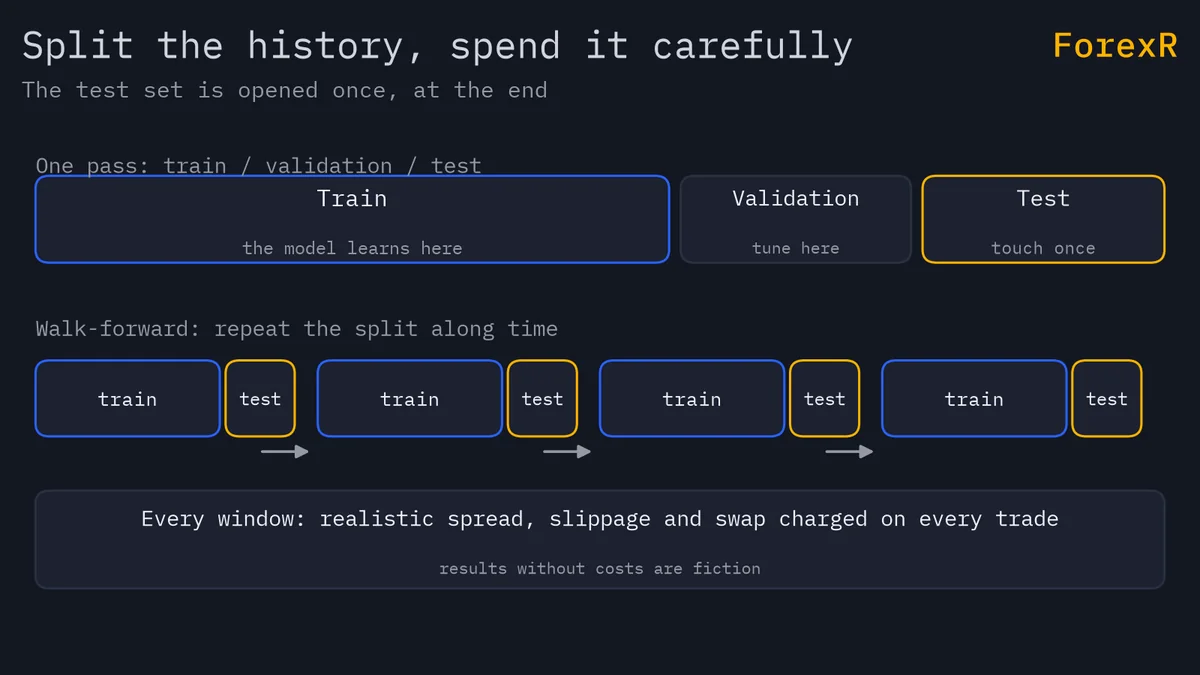
The single-use rule is the heart of the method. A test set you revisit is not a test set any more; it is just a slower way of memorising the answer key.
What Is Walk-Forward Testing?
Walk-forward testing repeats train-then-trade the way live trading actually happens. Train on years one to three, trade year four on those frozen settings; slide everything forward a year and repeat until the history runs out. Stitch the traded segments together and you get an equity curve built entirely from decisions the model made on data it had not seen.
It also measures stability. A real edge earns in most windows; a curve-fitted one earns in one lucky stretch and bleeds everywhere else. If your strategy runs as a standard EA, the Strategy Tester workflow in our EA backtesting guide covers the platform-level version of the same idea.
Charge Realistic Spread, Slippage and Swap
Backtests are frictionless by default; markets are not. Charge every simulated trade the spread (the gap between the buy and sell price), slippage (the difference between the price you asked for and the price you got) and swap, the overnight holding fee.
The arithmetic is sobering. Suppose your model averages 4 pips gross per trade on EUR/USD across 250 trades a year, 1,000 pips in total. Charge a realistic 1.5 pips per trade for spread and slippage, 375 pips, and only 625 remain: more than a third of the “edge” was never real. Costs differ by account type, so compare regulated brokers on trading costs and price your own setup with the spread cost calculator before trusting any backtest number.
How to Judge Results Beyond Win Rate
- Maximum drawdown: the deepest peak-to-trough fall in the equity curve. It tells you whether you could actually live with the strategy, and the drawdown calculator shows how hard deep losses are to recover.
- Trade count: 40 trades prove almost nothing; several hundred, spread across different market conditions, start to mean something.
- Expectancy: average profit per trade after costs. A 90% win rate with rare, huge losses can still carry negative expectancy.
- Stability: results should hold, at least roughly, across neighbouring pairs and across the years of the test. An edge that appears on one pair in one year is probably an accident.
From Backtest to Demo: The Final Checks
A passed test set is a permission slip, not a verdict. Run the strategy on a demo account in real time and compare its live behaviour with the backtest: trade frequency, average win and loss, and the shape of the drawdowns. Live results that fall far outside the tested range mean something in the test was wrong, and the market is now showing you what.
No backtest, however clean, can promise future profit; it can only fail to find the flaws you actually tested for. Markets change regime without notice, and patterns that held for years can dissolve in weeks. Leveraged forex and CFD trading carries a high risk of loss, with ESMA-era disclosures showing 74-89% of retail CFD accounts lose money, so trade any strategy, AI-built or not, only with money you can afford to lose.
FAQ
How much data do I need to backtest an AI strategy?
Think in trades, not years. A few hundred trades across different market conditions, calm, trending and volatile, is a reasonable floor, and complex models need more. Two thousand bars that produce thirty trades prove almost nothing. If your strategy trades rarely, extend the history or add comparable pairs so the sample grows honestly.
What is a good win rate for an AI trading strategy?
There is no magic number, because win rate means nothing without the size of wins and losses. A 40% win rate is profitable when wins are twice the losses; a 90% win rate can lose money when rare losses are huge. Judge expectancy after costs, drawdown and sample size together. Anyone leading with win rate alone is hiding the rest.
Why does my strategy win in backtests but lose live?
Usually one of four things: the backtest saw information the live bot cannot see, which is look-ahead bias; the model memorised the past, which is overfitting; real spread and slippage were undercharged; or the market changed regime after your data ended. Recheck in that order. If the test was honest and the market simply changed, no fix exists; retire the strategy.
Can I trust a backtest published by a bot seller?
Treat it as advertising until proven otherwise. Fabricated or cherry-picked backtests are common in bot marketing, and a screenshot proves nothing. Ask for the method, the out-of-sample results, the costs charged and the number of trades. A seller who will not share those has answered your question. Only your own test, on your own data, deserves real weight.